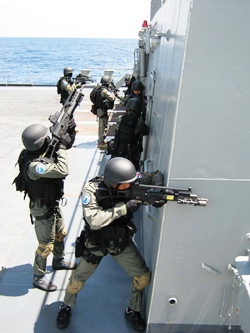
Thai special forces train to battle pirates
in the Gulf of Aden off the coast of Somalia.
Patcharapol Panrak
Royal Thai Navy ships will return to the Gulf of Aden
for their second mission against Somali pirates.
The HTMS Similan, which patrolled the waters off
Somalia last winter, will be joined by the HTMS Narathiwat for the
140-day mission. Capt. Paradon Puangkaew, director of the Royal Thai
Fleet, will be the mission commander while Capt. Tanin Likitwong, the
Royal Thai Fleet’s deputy director-general, will head the unit.
The task force of 368 men, which includes a navy SEAL
team and Bell helicopter group, will depart from Sattahip Naval Base
July 12 and is expected to return Nov. 28.
The HTMS Pattani and HTMS Similan made a much-touted
137-day mission to the Gulf of Aden from September until January, but
returned to a muted welcome due to the Thai task force’s mixed results
in combating piracy as part of an international task force.
During the nearly fourth months, the vessels helped
protect 1,703 cargo ships, participated in 12 convoys to guard 61 ships
- five of them Thai - provided escort to a Sudan-based armaments vessel
and provided emergency medical treatment to vessels in distress.
The high point of the mission was the dramatic rescue
of 23 crew members of a Thai fishing boat hijacked by Somali pirates off
the coast of Yemen Nov. 3. The Similan plucked seven Thais, 15
Cambodians and one Yemeni police officer out of the sea 15 miles off the
Yemen coast Nov. 7 and transported them to a hospital in Oman.
The early successes, however, were dampened by the
failure to free 27 Thai fishing boat crewmembers hijacked and held
hostage since Dec. 24. The Thai naval vessels could follow the hijacked
ship, but not get close. And it had to break off pursuit once the vessel
entered Somali waters. They remained hostages until mid-April, three
months after the Thai fleet returned home.
Likewise, 77 Thais and Burmese abducted in April also
remain hostages of Somali pirates after their three ships were hijacked.
Ironically, those fishing boats, Prantalay 11, 12 and 14, have become
“motherships” for the pirates, equipped with enough equipment to run
three piracy crews each, complete with lightweight skiffs and ladders to
scale the hulls of larger ships.
Forty-four of the hostages were released in March.
The rest remain in captivity.