Forming five-party coalition government
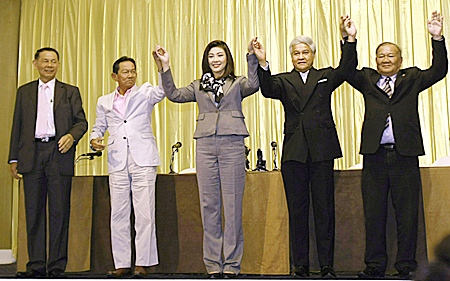
Yingluck Shinawatra, the leader of Pheu Thai
Party, center; Sanan Kachornprasart of Chat Thai Pattana party, second
left; Wannarat Charnnukul of Charty Pattana Pue Pandin party, left;
Yongyuth Wichaidith of Pheu Thai, second right; and Chao Maneewong of
Palung Chon party, right; raise their arms after a joint news conference
in Bangkok. Yingluck, sister of ousted Prime Minister Thaksin
Shinawatra, announced an agreement to form a five-party coalition
government after her party won a landslide victory in Thailand’s
parliamentary elections. (Full story page 2) (AP Photo/Apichart
Weerawong)
Grant Peck
Bangkok (AP) - Thailand’s election winner moved
quickly Monday to shore up her party’s already-resounding victory,
forming a ruling coalition with four smaller parties and vowing to
pursue national reconciliation after five years of instability and
political violence over the military coup that ousted her brother.
Yingluck Shinawatra, who will become Thailand’s first
female prime minister, said her priority would be “how to lead the
country to unity and reconciliation.”
The military eased concerns of renewed turmoil Monday
by declaring acceptance of the sweeping electoral win of Yingluck’s
pro-Thaksin Pheu Thai Party.
Defense Minister Gen. Prawit Wongsuwon said the army
would accept a government led by 44-year-old Yingluck, and vowed the
military would not stage a coup.
“I’ve said this several times,” Prawit was quoted as
saying by several Thai newspapers. “We are not going to intervene.”
The lower house of parliament has 30 days to convene,
and another 30 days from its first session to officially select a prime
minister, but Pheu Thai’s speedy agreement to form a five-party
coalition is a sign that a new government can be expected ahead of the
deadlines.
Pheu Thai won an outright majority of 265 seats in
the 500-seat lower house of parliament, according to preliminary results
from Sunday’s vote. Her five-party coalition will hold 299 seats in all,
a figure Yingluck described as “auspicious” - the number nine is
considered lucky in many Asian cultures - and enough to ensure
stability.
Although the coalition partners still must agree on
an allocation of Cabinet seats, their pact should strengthen Yingluck’s
government-to-be, especially if legal challenges under electoral law
force some of her party’s lawmakers from their positions.
The opposition’s strong mandate in parliament is
likely to boost stability in the short-term - a fact reflected in a
sharp rise in the Thai stock market Monday.
Thaksin’s supporters have often cast the
establishment’s rejection of him as a case of the privileged rich
fearful of letting the poor majority make their voices heard through
electoral democracy. Thaksin also won their allegiance by instituting
populist programs such as subsidized housing and health care.
“In many ways, for Pheu Thai voters, Thaksin is
symbolic of the lack of democracy and fairness,” commented Kevin
Hewison, professor of Asian studies at the University of North Carolina.
“More than that, the vote is about having a voice that is heard. If you
could yell into the ballot box, this is that yell. It is not a ‘rebel
yell,’ but a demand for elections and votes that count in Thailand.”
Prime Minister Abhisit Vejjajiva meanwhile resigned
Monday as leader of the Democrat Party, which has led a coalition
government since December 2008, after it won just 159 seats.
“I think that a good leader has to show
responsibility,” he said, explaining why he decided to step down.
Joining the Democrats in opposition will be the Rak
Thailand - Love Thailand - Party of former massage parlor tycoon Chuvit
Kamolvisit, whose tough-talking, anti-corruption campaign garnered four
seats.
Yingluck said her coalition would be joined by Chart
Thai Pattana, with 19 seats in preliminary results; Chart Pattana Puea
Pandin, with 7 seats; Palang Chon, 7; and Mahachon, 1.
In Dubai, Thaksin hailed the election result. “The
Thai people spoke,” he said. “They told the world, the whole country ...
(that) the last five years, the country has gone nowhere.
“It’s very clear,” he said of those who cast ballots,
“that they want to see reconciliation in the country, the end of the
conflict ... it will be a big challenge for Pheu Thai.”
Thaksin, who became a billionaire in
telecommunications before entering politics, was convicted of graft and
lives in exile to escape a two-year-prison sentence. Thaksin says the
charges are politically motivated.
Thaksin said he would stay in Dubai for the time
being “doing business,” and if his sister’s party needs advice, he will
give it. “If they don’t need, I don’t have to worry. The Thai people
will be in good hands.”
Asked about his return to politics, Thaksin said, “I
may be too old ... I really want to retire.”
Whatever his plans, Thaksin will continue to be at
the center of Thai politics for the foreseeable future.
“In all likelihood, the immediate aftermath of the
election is going to be more about Thaksin,” said scholar Hewison. “The
group who designate themselves ‘the people who hate Thaksin’ are going
to be hard at work. The Democrat Party has made it clear that opposing
Thaksin is their main task. They will be joined by those who have
opposed Thaksin since 2005.
“For Pheu Thai, much now depends on Thaksin being
less aggressive and headstrong than he has been in the past. Has he
learned to be more patient?”