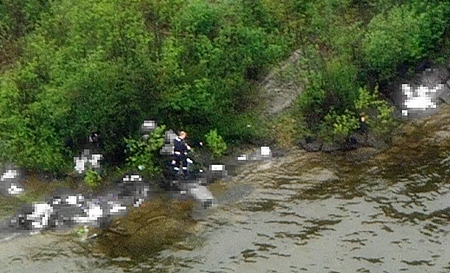
This photo, digitally altered to protect the
identities of the victims, was taken from a helicopter above Utoya
Island near Oslo, Norway. It shows what police believe is the alleged
gunman walking among victims after opening fire on a youth retreat,
killing at least 86, Friday, July 22, 2011. The mass shootings are among
the worst in history. With the blast outside the prime minister’s
office, they formed the deadliest day of terror in Western Europe since
the 2004 Madrid train bombings killed 191. Full story and a survivor’s
tale on page 7.
Oslo, Norway (AP) - A Norwegian who dressed as
a police officer to gun down summer campers killed at least 86 people at
an island retreat, horrified police said last weekend. It took
investigators several hours to begin to realize the full scope of
Friday’s massacre, which followed an explosion in nearby Oslo that
killed seven and that police say was set off by the same suspect.
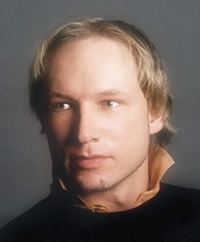
This is an undated image
obtained from the Twitter page of Anders Behring Breivik, 32, who was
arrested in connection to the twin attacks on a youth camp and a
government building in Oslo, Norway.
Anders Behring Breivik, 32, has confessed he was
behind the bombing in downtown Oslo and shooting massacre at a youth
camp outside the capital, but denies criminal responsibility.
The mass shootings are among the worst in history.
With the blast outside the prime minister’s office, they formed the
deadliest day of terror in Western Europe since the 2004 Madrid train
bombings killed 191.
Norwegian Prime Minister Jens Stoltenberg told
reporters Saturday that he had spent many summers on the island of
Utoya, which was hosting a youth retreat for his party.
Utoya is “my childhood paradise that yesterday was
transformed into Hell,” Stoltenberg said at a news conference in the
capital.
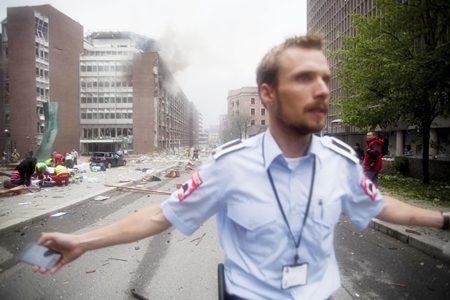
An official attempts to
clear away spectators from buildings in the center of Oslo following an
explosion that tore open several buildings including the prime
minister’s office, shattering windows and covering the street with
documents.
Police initially said about 10 were killed at the
forested camp on the island, but some survivors said they thought the
toll was much higher. Police director Oystein Maeland told reporters
early Saturday they had discovered many more victims.
“It’s taken time to search the area. What we know now
is that we can say that there are at least 86 killed at Utoya,” Maeland
said. “It goes without saying that this gives dimensions to this
incident that are exceptional.”
Maeland said the death toll could rise even more. He
said others were severely wounded, but police didn’t know how many were
hurt.
The island is about 500 meters from one shore of
Tyrifjorden Lake, an oddly shaped body of water that is 25 kilometers at
its longest and 12 kilometers at its widest.
The search for more victims continues and police have
not released the names of the dead. But Norway’s royal court said Monday
that those killed at the island retreat included Crown Princess
Mette-Marit’s stepbrother, an off-duty police officer, who was working
there as a security guard.
Court spokeswoman Marianne Hagen told The
Associated Press that his name was Trond Berntsen, the son of
Mette-Marit’s stepfather, who died in 2008.
Meanwhile, French police searched the suspect’s
father’s home Monday. About a dozen officers surrounded the house in
Couranel in southern France, entering and leaving at irregular
intervals. The house is cordoned off, and reporters do not have access.
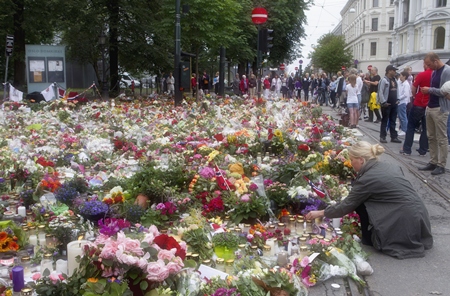
A woman places flowers
amongst candles and other floral tributes in memory of the victims of
Friday’s bomb blast and shooting massacre in Oslo, Norway.
The regional gendarme service confirmed the house was
that of Anders Behring Breivik’s father but would not comment on the
search operation. News reports have said Breivik’s father, Jens Breivik,
has not been in touch with his son in many years.
The attacks rattled Norway, a small and wealthy
country unused to political violence, and known internationally as a
peace mediator, prominent foreign aid donor and as home of the Nobel
Peace Prize. Survivors of the camp shooting on Utoya Island described
how a gunman dressed in a police uniform urged people to come closer and
then opened fire, sending panicked youth fleeing into the water.
Police say 86 people were killed. About 90 minutes
earlier, a car bomb exploded in the government district in central Oslo,
killing seven.
More than 90 people were wounded, and others remain
missing at both crime scenes.
Norwegian newspaper Aftenposten, without
citing sources, reported that Breivik told investigators that he had
hoped to reach the island while former Prime Minister Harlem Brundtland
was visiting the youth camp of Norway’s left-leaning Labor Party, but
got there after she had left. Oslo police spokesman Henning Holtaas
declined to comment on the report.
Breivik laid out his extreme nationalist philosophy
as well as his attack methods in a 1,500-page manifesto. It also
describes how he bought armor, guns, tons of fertilizer and other bomb
components, stashed caches of weapons and wiped his computer hard drive
- all while evading police suspicion and being nice to his neighbors.
Dr. Colin Poole, head of surgery at Ringriket
Hospital in Honefoss northwest of Oslo, told The Associated Press
that the gunman used special bullets designed to disintegrate inside the
body and cause maximum internal damage. Poole said surgeons treating 16
gunshot victims have recovered no full bullets.
“These bullets more or less exploded inside the
body,” Poole said. “It’s caused us all kinds of extra problems in
dealing with the wounds they cause, with very strange trajectories.”
Ballistics experts say “dum-dum”-style bullets also are lighter in
weight and can be fired with greater accuracy over varying distances.