Dr Iain Corness
The very active Automotive Focus Group (AFG) on the
Eastern Seaboard which is now over 100 members, held their monthly meeting
at the Shibuya Japanese restaurant on 2nd floor of the ESIE Plaza 1, with
the event sponsored by Hemaraj Land & Development PCL.
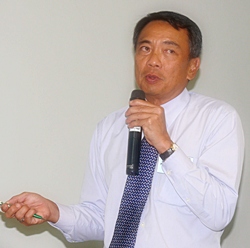
Preeprem Malasitt.
With the rapid growth of the automotive industry in
Thailand, and on the Eastern Seaboard in particular, the AFG has seen that
there will be a need for trained personnel. A shortage in the workforce,
especially the technically qualified, needs to be addressed and Hemaraj and
AMCHAM are trying hard to push many ideas towards government. One of the
concepts is a Technical College within the surrounding industrial estate,
with private sector participation.
The AFG group was addressed by Preeprem Malasitt, the
Special Project Director at Hemaraj involving labor relations, training and
development, with government and private bodies.
Preeprem began by outlining the root causes starting with
the mismanagement of the education system where sections in need are glossed
over in favor of bachelor degree graduates. However, industry only needs
46,000 of these, while the education system pumps out 130,000.
A lack of career guidance in school is another root
cause, and with 118,000 new employees needed in the Auto industry by 2015,
this is a severe shortfall.
Another factor is the fact that entry level wages do not
reflect training, so there is little incentive to join industry, rather than
working in the agriculture arena.
Preeprem did offer some short and medium term remedies
including, for large companies, using sub-contractors and agencies, but
small businesses could join a vocational program with a local technical
school. However, he did point out that only eight of the 100+ companies in
their industrial estate availed themselves of this opportunity.
He also suggested that to improve industrial relations,
employers should look to becoming involved with up-country communities to
create a feeling of ‘belonging’ between the workers and the company. This
was a successful ploy by Japanese companies, who now claimed zero turnover.
Other HR projects should include setting up cooperative
loans (like Credit Unions) and adjust entry level wages to reward technical
competence.
For the long term remedies, Preeprem suggested the
government Skill Development Centers could be better used to encompass
training in the technical skills, but this was hampered by a lack of skilled
teachers.
Finally, he outlined the proposal to build a Hemaraj
Eastern Seaboard Technical College, which would be funded jointly by large
corporations and Hemaraj itself. This would be a boarding college which
would implant discipline and teamwork in its graduates. They would expect
student numbers of 350 initially, enlarging to 1,050 by year 2015. Teaching
staff would begin at 15 and swell to 60 by 2015.
In the discussions afterwards, it was felt by many that
there were some very good points that had been raised, but could the costs
be justified. With no apprenticeship scheme in Thailand, would a privately
run technical college be a viable program. Everyone agreed with the concept
but the suggested 30 million baht for six to eight companies to get the
technical college scheme up and running was a very heavy investment.
There was also quite a groundswell of opinion that the
government should be more involved, but Preeprem countered that by
intimating that government involvement would end up as public service
government agency meddling! And could leave the project open to corrupt
practices. Preeprem finished his lecture with the quotation, “Helping the
diligent and committed poor and give them opportunities.”
Another very thought-provoking evening for the AFG members, which
continued on for some time over some tasty Japanese food from the Shibuya
Japanese restaurant and Belgian beer and South African wine. If you are
interested in joining the AFG, contact the secretariat at
[email protected]
Cross border trade at Chong Sa-ngam border crossing with
neighboring Cambodia in Si Sa Ket on Sunday has reportedly been revived as many
Cambodians queued up for the opening of the border crossing in the morning to
exchange products with Thai traders.
Cambodians crossed the border to buy and sell large amounts
of consumer products. Border trade activities were seen as active again amidst
security provided by police officers from Phu Sing Police Station and local army
rangers.
Apart from the trade, tourism along the Thai-Cambodian border
was also boosted as many tourists have been visiting the area, asking for
information about cross-border excursions to attractions such as Angkor Wat and
Angkor Thom in Siem Reap, according to Hattachai Pengchaem, head of the trade
and tourism operators association in Chong Sa-ngam.
Hattachai said that the return of the active trade and
tourism can be attributed to the International Court of Justice (ICJ) or World
Court July 18 rulings on the Thai-Cambodian border, adding that both Thai and
Cambodian traders have expressed their confidence in the border situation.
The rulings applied to both Thailand and Cambodia, requiring
that both countries withdraw troops from the disputed border area near Preah
Vihear Temple. (MCOT)
Myanmar’s Commerce Ministry annulled its import ban on 15
Thai items from Thailand, according to Thailand’s director-general of Trade
Negotiations Department.
Srirat Rastapana said the 15
types of merchandise were fresh fruits, monosodium glutamate (MSG), chewing
gum, sweet drinks and other beverages, crackers, wafers, cake, canned food,
instant noodles, liquor, beer, cigarettes, plastic products, and other
controlled goods.
The annulment was made last month after over ten years of
prohibition. However, licenses to import these goods are obligatory and to
be issued by the Commerce Ministry of Myanmar.
Representatives of Thailand’s Trade Negotiations
Department had travelled to Myanmar twice in October and December last year
in order to negotiate the issue, for Thailand saw that the 15 types of goods
were popular among Burmese consumers, particularly sweet drinks and other
beverages, canned food and MSG.
The import ban will directly benefit Thailand’s importers
as in 2010 Thailand had exported Bt7.7 billion worth of goods to Myanmar.
(MCOT)