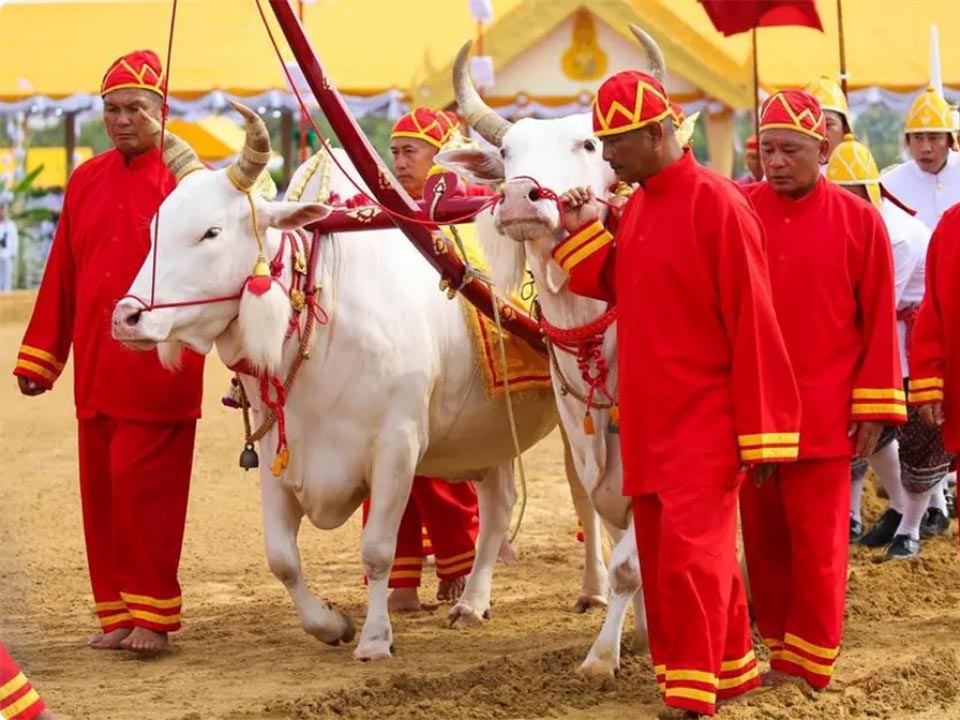
BANGKOK, Thailand – The Royal Ploughing Ceremony remains one of Thailand’s most enduring traditions, blending history, spirituality, and agriculture into a single event that continues to hold relevance in modern society. Held each year in May, the ceremony signals the start of the rice-growing season and celebrates the country’s long-standing connection to farming, a sector that continues to support livelihoods and the national economy.
What is commonly known as the Royal Ploughing Ceremony combines two distinct rites. The “Phuech Mongkol” ceremony is a Buddhist ritual held at the Temple of the Emerald Buddha, where prayers are offered for agricultural prosperity. The “Raek Na Khwan” ceremony, held at Sanam Luang, is a Brahmanical rite involving symbolic ploughing. The two events represent a blend of spiritual traditions that have influenced Thai cultural practices over time.
The ceremony dates back to the Sukhothai period and has evolved through successive eras. In early periods, the king presided over the ritual, while later practices introduced appointed representatives to carry out ceremonial duties. During the Rattanakosin era, the ceremony was revived and formalized, and in the reign of King Rama IV, Buddhist elements were incorporated, creating the combined form observed today.
The event carries practical and symbolic importance. It has long served to encourage farmers and renew confidence in agricultural cycles. Rice and other crops remain essential to Thailand’s food security, and seeds used in the ceremony, including those cultivated under royal projects, are later distributed to farmers nationwide as a symbol of good fortune for the planting season.
The ceremony is scheduled each year based on traditional astrological calculations rather than a fixed date, aligning it with an auspicious period for cultivation. Since 1966, the day has also been recognized as National Farmers’ Day, honoring farmers and highlighting the continued importance of agriculture. (NNT)