|
|
 |
|
Books Review: by
Lang Reid |
|
|
|
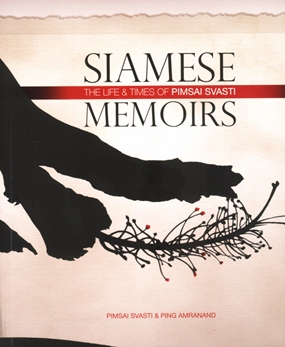
Siamese Memoirs - The Life and Times of Pimsai Svasti
 For
those who were not in Thailand in 1977, the name Pimsai Svasti may not ring
any bells, but for those who followed Thai history, she will be remembered
as the woman of noble birth who was murdered by her gardeners. For
those who were not in Thailand in 1977, the name Pimsai Svasti may not ring
any bells, but for those who followed Thai history, she will be remembered
as the woman of noble birth who was murdered by her gardeners.
Siamese Memoirs (ISBN 978-974-225-713-2, Amulet Production, 2011) is the
story of Pimsai Svasti as told by herself and her son Ping Amranand.
The book begins with the table of the Kings of the Chakri dynasty. This is
followed by a (partial) family tree of the descendants of King Mongkut (Rama
IV), showing that her grandfather Prince Svasti was one of the sons of King
Mongkut. Indeed inheriting ‘royal’ blood.
By page 16 I was being educated. The surname “Svasti” actually came from the
Sanskrit word “Svastika” and the family emblem is the swastika, but
inverted, compared to that taken by Adolf Hitler. The symbol actually dating
back thousands of years to the Indus Valley civilizations.
Pimsai was one of the foremost English language writers, having spent many
years in England as part of the retinue of King Prajadhipok, who ruled up
till in 1933 until his abdication and self-imposed exile in the UK.
She begins with “I was born in a haunted house” a classical ploy to attract
the attention of the reader. And she does.
There are some very sage concepts expressed in this book. King Prajadhipok
discussing the push for democracy, that ended with his abdication. “(It has
become) increasingly apparent that democracy is a two-edged sword. Unless
the majority of the populace are well informed, the democratic process
itself can be used as a tool by politicians with less than ideal morals to
manipulate themselves into power by hoodwinking segments of society.” I read
this book during the voting period, and the message was even more clear.
The book is studded with photographs, mainly of Pimsai and her sisters, but
of much greater value are the discussions of Thai life and how they used to
live.
At the end of the book are the acknowledgements, and Ping Amranand states
that it became a celebration of his mother’s effervescent life, and as a
final tribute he appends the recipe for his mother’s punch, which starts
with three large bottles of Mekong. That is a punch with punch!
At an RRP of B. 585, this is a very inexpensive look at the old Siamese
royal court and even more, of the times when she lived. The book is very
touching and one feels honored to be able to catch a glimpse of a lifestyle
none of us ever had, and will never have the opportunity to do so in the
future. The alternating chapters between Pimsai and those written by her son
are very well handled and the different color stock to indicate which writer
is an excellent idea (grey for Pimsai and white for Ping). I have not read a
more moving book this year, and I do suggest that if you are a scholar of
Thai history, this book should be on your shelf, and not on Bookazine’s.
|
|
 |
|
|
 |
|
|
|
E-mail:
[email protected]
Pattaya Mail Publishing Co.Ltd.
370/7-8 Pattaya Second Road, Pattaya City, Chonburi 20150 Thailand
Tel.66-38 411 240-1, 413 240-1, Fax:66-38 427 596
Copyright © 2004 Pattaya Mail. All rights reserved.
This material may not be published, broadcast, rewritten, or
redistributed.
|