|
German GP this weekend
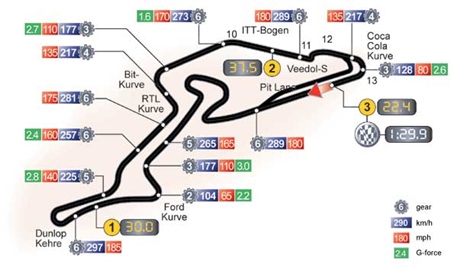
Nurburgring
The (newer) Nurburgring is in use this weekend for the
German Grand Prix. Up in the mountains, it is close to Michael Schumacher’s
home town of Kerpen, so I am sure he has done many laps of the famous “old”
Nurburgring. Unfortunately, the days of the old circuit through the forest
have gone, as far as F1 is concerned. Following claims from the drivers that
the classic old circuit was too dangerous, this alternative five km circuit,
with little character, was constructed in 1984, close to the original track.
It is of interest to note that the first thing that the new generation of F1
drivers do on arrival at the circuit is to shell out a few Deutschmarks to
drive the famous old circuit, the Nordschleife!
Nobody could ever claim to be the absolute master of the
Nordschleife, which is still used today for Touring Car and Sports car
categories. Any driver who has driven on the old circuit speaks in terms of
awe of what is possibly the most demanding circuit ever constructed. I have
driven it! Totally mind blowing! A circuit that keeps you on your toes for
the entire lap. The laconic ex-F1 driver Aussie Frank Gardner, with a total
disregard for political correctness, claimed it was designed by Adolf Hitler
for Jewish drivers!
I will be watching from my perch at Jameson’s Irish Pub
Soi AR, in front of the big screen. Join me at 6 p.m. for a meal before the
action starts at 7 p.m. We watch the BBC on the new super biggest screen and
enjoy good commentary and we don’t have to suffer the adverts either!
And will Sebastian (the finger) Vettel excel at his home
Grand Prix? Will Mark (I’m deaf) Webber turn his radio off? Can Fernando
(the eyebrows) Alonso pull another rabbit from the helmet? We will know by 9
p.m. on Sunday night.
|
|
 |
Forget the Chinese on bicycles - they’re now in Bugattis
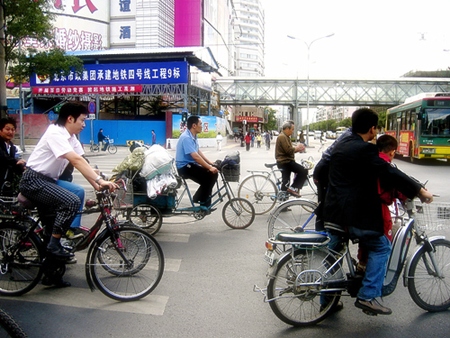
China by bicycle
Apparently the new Chinese traders are so rich, the
German automakers are ramping up production of the luxury models as demand
is greater than supply.
Daimler AG (Mercedes-Benz), and Volkswagen AG, which
makes Audi, Bentley and Bugatti, have outlined nearly $20 billion in
investments in China for the near future.
Volkswagen, one of the first foreign automakers to
establish a joint venture in China, plans to invest around $15 billion in
China between now and 2015.
VW will build two new plants with its partners, FAW and
Shanghai Automotive Industry Corp. (SAIC), which will expand its existing
production capacity in China to 3 million vehicles. It is also planning to
launch two electric cars in China.
The reason for all this is simple. China is now the
biggest market for VW, selling 1.92 million in 2010 and expecting this will
increase to 2.2 million vehicles this year, despite some fluctuations in the
global market.
Daimler intends to invest $4.2 billion in the next few
years, and plans to increase the number of models it builds in China with
its joint venture partner Beijing-based BAIC Group.
Volkswagen Chief Executive Martin Winterkorn said, “The
Volkswagen Group intends to play a major role in shaping this growth, with
new environmentally compatible models and the expansion of local production
capacity.”
But it is not just Mercedes-Benz and the luxury VW brands
that are riding this wave of demand. BMW reported a 61 percent rise in
half-year sales in China too.
Luxury car sales increased close to 30 percent in China
in the first five months of the year, according to consulting firm J.D.
Power and Associates, but this production level will ease, but positive
growth is still expected. One market analyst, IHS Automotive, expects annual
light vehicle sales to increase in China to 30 million by 2020, a 72 percent
increase from 2010 sales levels.
|
|
|
What makes a classic?
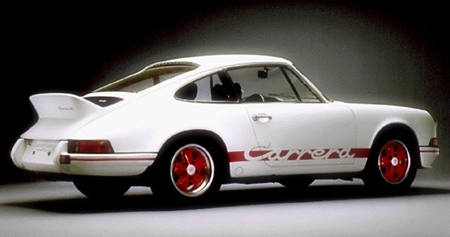
Porsche RS Carrera 1973
For me, a classic is a car which has had significant
impact on motoring history. It is also a vehicle which has been out of
production for a number of years, so that the manufacturer’s advertizing
claims and slogans have been forgotten. “Safety Fast” was on all the
brochures about MG cars, but when you think about it, very few of the very
early ones (J2 through to TC) were ‘fast’ and even fewer were ‘safe’.
I believe there is a tendency in countries such as
Thailand to confuse ‘old’ and ‘classic’. For example, Fiat must have sold
very well in the late 1950’s and early 1960’s judging by the number of
battered old Fiat 1100’s that are still around. Some of these are now half a
century old - but does that make them a ‘classic’? Were the Fiat 1100’s of
that era special motor cars in some way or other? Were the later Fiat 1100 D
Riviera’s with the finned tail lights some technological breakthrough?
The simple answer has to be a resounding “no” on all
counts. They were just mass-produced utilitarian transport, the Italian
equivalent of similar motor cars built by BMC, Renault or even Datsun
(before they moved themselves upmarket and called themselves ‘Nissan’).
In Thailand, these older cars have also suffered from the
fact that to keep going, there has been no manufacturer’s spare parts pool,
and when you lift the bonnet on many of them, you will find that the
original in-line four has been replaced by that from a Toyota Corolla, or
even more shuddersome, the ubiquitous Isuzu diesel!
For interest, here are some of my entries for a classic
car category: 1973 Porsche RS Carrera (the forerunner of the ultimate
Porsches), 1964 Mustang 289 V8 (the first of the really powerful Mustangs),
1966 Morris Cooper S (the first of the mass market pocket rockets), 1946 MG
TC (first introduced sports cars for the masses to America - but ‘safety
fast’?), 1958 Ferrari LM 250 (what a shape, what a noise, what a car), 1936
Cord 810 (classic Gordon Buerhig design with the coffin nose and hydraulic
shifter), 1931 Mercedes SSKL (the first road car you could race and win) and
the 1955 Citroen 2CV complete with canvas seats (? First car made from
roofing iron!).
Of course there’s lots more, but there are not too many
in Thailand, I’m afraid (though there used to be a V8 Tatra in Chiang Mai).
|
|
|
Now here’s a real classic
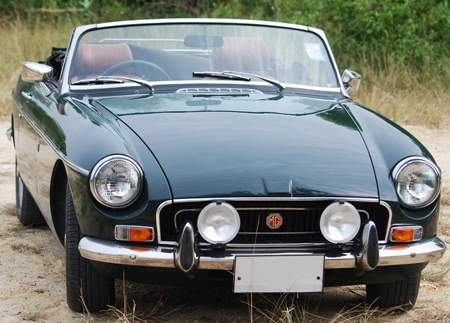
Thailand’s finest MGB
If you have a penchant for British sports cars, here is
the ultimate in Thailand. I have known this car since its importation, where
it attracted 300,000 baht in duty! The current owner describes the car as
“Probably the finest example of this beautiful car in Thailand. Absolutely
immaculate condition throughout, in British Racing Green, with tan interior.
Superb, original 1800cc engine, with 4 speed manual gearbox, and overdrive
on 3rd and 4th gears. Recently serviced, there is nothing to be done to the
car, other than drive it, and enjoy it. 1972, chrome bumper model, with boot
rack, tonneau cover, spare wheel cover, leather seats, original
radio/cassette and electric aerial, air con, etc. Interior, and hood also in
perfect condition. All service receipts for the last ten years plus, with
correct Blue book, tax and insurance. Baht 1,250,000. Telephone 081-834-3260
or serutiovs @yahoo.com” Buy it!
If American iron is more your style, you will find a Mustang at a small
shop at the T junction where the extension of Third Road meets Soi Potisan.
There is the purple Mustang outside, along with a BMW and a Toyota Crown
wagon. Ask for Joe and he’ll tell you what he’s got. Most have Japanese
engines, so the purists should stay away, but if you just want something
which will go better than the original, and more reliable too, it is worth
dropping by. Ask for Joe - phone number is 087 030 1045 - but no time
wasters please for either of these cars!
|
|
|
Autotrivia Quiz
A couple of weeks back I asked which European country
switched side of the road to drive on in September 1967. The first correct
was Bobby Pearson who wrote, “If my memory serves me the answer to which
Euro Country stitched driving sides in Sept. ’67 is Sweden. The countrywide
switch-over was made at midnight. I’m a Yank but all my Swedish cousins tell
me that everyone was so eager to try driving on the other side of the road
there was a monumental traffic jam at midnight at switchover time.” Thought
you might like that little bit of trivia.
Last week was another easy one. I asked what is the
connection between Simon and Garfunkel and Alfa Romeo? Remember the 1960’s?
Remember the movie, The Graduate? What was the car driven by Dustin Hoffman?
It was an Alfa Romeo Duetto, and the music was by Simon and Garfunkel!
So to this week. Which auto manufacturer began making
covered wagons in 1852, made electric cars in 1902 and didn’t make a petrol
engined car till 1911?
For the Automania free beer this week, be the first
correct answer to email [email protected].
|
|
|
|
 |
|
 |