Now I don’t want to bore you comatose in the first paragraph
with geeky technical stuff, but I assume that you know what the word “latitude”
means. If you don’t, or for some reason you have temporarily forgotten (for life
can be like that) then I can give you a neat one-sentence definition. Feel free
to copy it out. Latitude is a geographical coordinate that indicates the
north-south position of any point on the Earth’s surface and ranges between 0°
at the Equator to 90° at the North and South poles. I could elaborate on this,
but it’s the weekend and I want to keep things simple for both of us.
Of course, it’s possible that you know about latitude already, in which case you
may as well skip the previous paragraph. Nevertheless, you may be wondering why
I am telling you all this. (The thought had occurred to me – Ed.) Well, it’s all
about wine grapes, because they tend to be rather particular where they grow.
They need cool winters, but not too cool and they need warm and wet springs, but
not too warm and wet. They also need hot summers, but not too hot. They’re fussy
little things.
Traditionally, wine grapes are grown between the latitudes of 30° and 50°
degrees in both the Northern and Southern hemispheres. The climate in those
regions suits them best. The great wine capital of Bordeaux for example, lies at
about 45° N; Beaune at 47° N; Rome at about 42° N and California’s Napa Valley
about 38° N. On the other side of the Equator, the capital of the Chilean
wine-making industry is Santiago, which lies at 35° S.
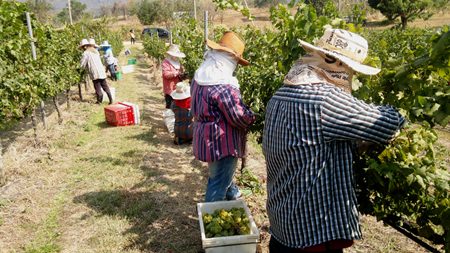
In contrast, most of Thailand’s vineyards are found in a narrow band between
14°N and 18° N. For a long time it was assumed that wine grapes simply wouldn’t
grow so close to the Equator, until a royal project began experiments with grape
planting about thirty years ago. It turned out that certain parts of Thailand
were ideal for growing wine grapes, because the climate was actually more
Mediterranean than tropical.
The first Thai wines emerged from Loei Province in 1995, under the label Château
de Loei. Several years earlier in 1989, the visionary Dr. Piya Bhirombhakdi had
begun his mission to produce world-class wines from his first vineyard in the
hilly Khao Yai district of Nakhon Ratchasima province. He planted Shiraz and
Chenin Blanc and with the harvest of 1998, the winery celebrated its first
milestone. The 1999 vintage proved that Thailand could indeed produce quality
wines. Although the vineyards are at about 14° N, the altitude compensates for
the latitude, because the vineyards lie at between 900 and 1,200 feet above
sea-level.
Unless you live a reclusive existence in a cave somewhere, you must have heard
that in September this year there was a staggering increase in duty on alcoholic
beverages. Both these wines were on sale a couple of months back at around Bt.
450 and as low as Bt. 365 in some places. Thailand has become a very expensive
place to buy wine. A good many years ago I once visited Helsinki (60° N) and was
alarmed to see so many drunks staggering about. I asked someone the reason and
was informed that drunkenness is often caused by depression. When I enquired as
to what might be the cause of the depression, I was told in all solemnity, “They
are depressed because of the extremely high price of alcohol in Finland.”
Sawasdee PB Valley Shiraz 2011 (red),
Thailand (Bt. 670 @ Villa and others)
PB Valley, in case you’re wondering, takes its name from the
initials of Dr. Piya Bhirombhakdi, the founder of the winery. The Shiraz grape
(SHEE-razz) is also known as the Syrah and it has a long history in the Rhône
region of France. This dark-skinned, tannic grape will grow in most wine regions
and especially those with warmer climates although strangely, no one seems to
know exactly where it originally came from.
This deep red wine has a lovely rounded fruity aroma of black cherries, spice
and black pepper, with just a faint reminder of mint and pear drops. If you
swirl the wine glass around, you’ll see those little rivulets (known as “legs”)
running down the inside of it. The wine has a seductively soft texture with a
pleasant dash of crisp acidity. There’s plenty of rich black fruit on the
palate, a touch of very soft tannins and a satisfying long finish.
It’s an interesting and quite assertive wine and at 13.5% alcohol content I
think it would make an excellent food partner. It would pair well with a wide
range of dishes because Shiraz is like that. You could try it with beef, lamb,
barbecued meats or spicy Mexican food. It worked perfectly with a red-hot pasta
sauce that I’d tarted up with tiny red chilies. Contrary to popular belief,
Shiraz doesn’t always go well with cheese.
The good news is that both these wines come with screw caps. I have to admit
that the sight of a screw cap brings a sigh of relief. Even after decades of
practice at pulling corks, twisting a screw cap is just so much easier. And as
far as I’m concerned, at this time of the week the less effort, the better.
Sawasdee PB Valley Chenin Blanc 2011
(white), Thailand (Bt. 670 @ Villa and others)
The green Chenin Blanc grape originated in France’s Loire
Valley and was first mentioned in various abbey records in 845 AD. Chenin Blanc
(SHEN-ihn BLAHN) is used for making anything from sparkling wines to dessert
wines and over the years, found its way to the New World. It’s often considered
one of the most versatile white grapes of all and seems to show up in every
country where wine is made. You can even find it in such unlikely places as
Missouri, Wisconsin, Minnesota, Arizona, Idaho, and Texas. The grape has over
thirty other names but I shall resist the burning temptation to list them all.
(That’s a relief – Ed.)
Chenin Blanc has proved very successful in Thailand and this one from the Khao
Yai Winery is a real charmer. It’s a very pale gold with a slightly oily, silky
appearance. Legs too, since you asked. It looks good in the glass, which is
always a promising start. There’s an attractive floral, slightly honeyed aroma
of tropical fruits, and like the Shiraz, this classy little wine was made by
Prayut Piangbunta, Director & Chief Winemaker at Khao Yai. It’s dry and
light-bodied with a lovely touch of citrus acidity and a long, dry and fruity
finish. There’s just enough fruit on the palate to keep the balance and you
might pick up reminders of pineapple, pear and peach.
At just 13% alcohol, this would make a lovely apéritif. It’s light, fresh and
crisp which is just what’s needed to perk up the taste buds before dinner. An
attractive easy-drinker, it would be perfect as a welcome wine for your next
social event, if you can still afford to have them. I’d suggest that you serve
this wine really cool and give it time to breathe. The makers suggest 11-14°C
but a few degrees lower won’t do it any harm. Take off the screw cap and stick
it in the fridge for an hour. The bottle I mean, not the screw cap.