|
Finance Ministry concedes weakened economy
Thailand’s Q3 economy has slowed down due to declining domestic consumption,
reflected through shrinking value added tax (VAT) collection, according to
the Finance Ministry.

Kulaya Tantitemit.
Kulaya Tantitemit, executive director of the Macroeconomic Policy Bureau,
said VAT collection decreased by 7.3 percent in Q3 while private sector
investment in machinery declined by 7.9 percent annually.
On the positive side, investment in construction expanded 3 percent/year,
reflecting a growth in the property market which is recovering, she said.
Kulaya said Thai export values to the US and European Union markets
increased by 0.7 percent and 8.5 percent/year respectively despite an export
slowdown by 1.7 percent/year in Q3.
Though the government has heavily relied on local consumption, its
dependence on exports cannot be abruptly disrupted, she said.
Tourism was another economic driving force for Thailand which enjoyed a 26.1
percent growth, or arrivals of 6.75 million tourists, in Q3, she said,
adding that public debt ratio against gross domestic product (GDP) was at
44.6 percent, as of August.
Thailand’s economic growth should be 3.3 percent in the second half of the
year while the Finance Ministry will adjust the GDP projection again in
December from an earlier forecast at 3.5-4 percent, she said.
The Bt2.2 trillion investment for infrastructure development and spending on
water management projects next year should be vital in stimulating the
country’s economy, she concluded. (MCOT)
|

|
Thai gold traders subject
to added controls

The Thai government will impose stricter control on
domestic gold transactions after discovering unscrupulous trading by some
gold traders, Deputy Commerce Minister Yanyong Puangrach said at the end of
last week.
He discussed the new measure with representatives of the Bank of Thailand
(BoT) and the Gold Traders Association.
Some traders were found to trade gold at a daily value of Bt100 million when
their registered capital was only Bt1 million, he said, adding that the
tougher controls were for consumer safety and would not affect the country’s
overall economy.
The Commerce Ministry earlier instructed gold traders nationwide to register
with the Internal Trade Department to enable the authorities to closely
monitor their trading activity, especially online speculative trading and
gold purchases by letters of credit.
Thailand’s total gold trading is over Bt1 trillion each year - much higher
than the import value at only Bt30 billion, said Yanyong.
He said the Business Development Department reported that 1,866 traders were
granted business registrations and the registered capital of some traders
was only Bt1 million while their trading value amounted to Bt100 million per
day.
Some foreigners also unscrupulously bought gold through Thai nominees, he
said.
He added that registered traders would be required to report their daily
gold holdings to prevent possible fraud between traders and buyers.
Trade in gold bullion and ornaments continues to rise and the risk of price
volatility was high given the dependence of domestic trading on foreign
markets, Yanyong explained. (MCOT)
|
|
PTT renews Cambodian
airports fuel concession

Thailand’s PTT Plc has received a concession extension
from the Cambodian government to sell aviation fuel in the country.
Attapol Rerkpiboon, PTT vice president, said the company will continue
selling fuel at Phnom Penh and Siem Reap airports for another five years
until 2017.
The company is planning to open its first one-stop-service gas station next
month in Phnom Penh with an investment budget, exclusive of land, at Bt30
million. The station will be like PTT gas stations in Thailand where a
convenience store, a coffee shop, a food court, or even restaurants are also
located in the same premises.
Attapol said the plan is in accord with the company’s business expansion to
make the PTT brand to become the top brand in the region and to welcome the
ASEAN Economic Community (AEC) in 2015.
There are currently 15 PTT gas stations in Cambodia. Fifty stations are
expected to open for the retail oil trade by 2017, from an original plan of
45 stations.
Attapol said the fuel sales volume in Cambodia is increasing, for the market
is growing, thanks to the country’s infrastructure investment and setups of
power plants and factories.
PTT’s oil sales volume there in all sectors - aviation, industries, retail -
has grown 10 percent, or a total sales volume at over 200 million
liters/year. (MCOT)
|
|
Thai exports grow 1 percent for 2013
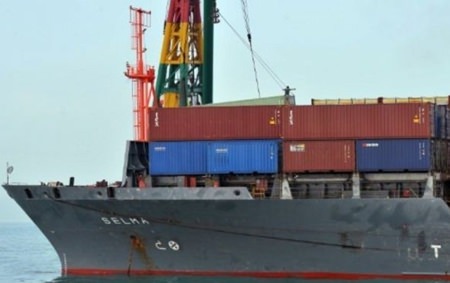
Thailand’s exports will end with grim results this year
with only 1 percent growth, the Thai National Shippers’ Council (TNSC)
announced last week.
TNSC president Nopporn Thepsitha said the unclear US fiscal policies on
economic stimulus and debt ceiling and currency volatility which led to
diminishing orders for Thai products played vital roles in the disappointing
exports.
Thailand’s export value in the last three months of this year will amount to
US$20 billion - lower than the latest estimate in August for a 2.5 percent
growth, he said.
He added that export value in the first nine months this year was US$172.1
billion, representing a growth at only 0.05 percent, and the export ratio to
the US, Europe and Japan has continued to decline.
Compared to other Southeast Asian countries in the first three quarters,
Thai export growth was better than Malaysia, Indonesia and Singapore, all of
which suffered deficits of 5.36 percent, 4.96 percent and 1.35 percent
respectively.
Nopporn was optimistic that Thailand’s exports would expand 5-7 percent next
year thanks to strengthened economies among significant trading partners
including the US, Europe and Japan.
He expressed concern that the current political tension would affect
Thailand’s export capability since the government has concentrated more in
trying to solve political problems rather than the country’s long-term
economic policy.
Wallop Vittanakarn, TNSC vice president, said internal political conflicts
would not have an impact on this year’s exports but they could jeopardize
next year’s performance as political rallies naturally affect investment and
logistic costs.
Protesters should not block roads, but the government must take immediate
action, he said.
He said obsolete regulations which obstructed international trade and
transportation should be revised quickly for strengthened and sustainable
export growth.
In the long run, the public sector must adjust the export structure to cope
with global market volatility and the government should set an export
strategy to enable public and private sectors to work closely together and
encourage exporters to invest overseas, he said.
Thailand’s agricultural and industrial agricultural standards should be
improved together with the logistic system, he concluded. (MCOT)
|
|
Gov’t mulls extending soft loans for Deep South entrepreneurs
The Thai government is considering using a soft loan
program to revive the economy in the Deep South, which has been marred by
the decade-long violence.
On Thursday, Oct. 31, the Southern Border Provinces Administrative Center
(SBPAC) invited representatives from local banks and entrepreneurs in the
southern border province of Yala to brainstorm on monetary measures to help
inject low-cost funds to local businesses.
According to Pol. Maj. Tavee Sodsong, SBPAC Secretary General, the current
soft loan program has many restrictions; therefore fewer entrepreneurs have
been able to obtain the funds.
The result of Thursday’s meeting will be submitted to the Ministry of
Finance to consider how to adjust the loan conditions to better reach out to
those local investors. (NNT)
Gov’t sees growth potential
in Thai food industry
The Commerce Ministry has assured that the government has
a policy to boost the Thai food industry as it sees growth potential in the
sector.
In a speech delivered at a food fair held at the Impact Arena, Deputy
Commerce Minister Yanyong Phuangrach said the government is keen on pushing
the Thai food industry forward, as it is the main industry that drives the
country’s economic growth. According to him, the value of Thailand’s food
trade each year is estimated at around 2 trillion baht, 1 trillion of which
comes from exports and the other trillion from domestic consumption. The
government is also keen on making Thailand the world’s kitchen, he added.
The deputy minister also expected prices of food products to increase next
year due to the decrease in raw materials and food supply caused by natural
disasters. However, Yanyong said the government would not let the increasing
food prices affect the country’s consumption. (NNT)
Unemployment decreases in August
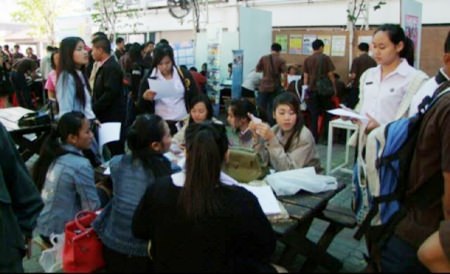
Thailand’s unemployment in August fell by 38,000 persons
from July, when there were 355,000 without jobs, but increased by 97,000 to
317,000 from 220,000 without work year-on-year, according to government
spokesman Teerat Ratanasevi.
He said the Cabinet acknowledged the report of the National Statistics
Office.
Currently, there are a total of 39.3 million persons in the workforce, of
whom 38.9 million are employed, 0.32 million unemployed, and 0.04 million
waiting for the next employment season. The unemployment rate is 0.8 percent
of the total workforce.
However, compared to the same period last year, the size of the Thai
workforce decreased from 39.8 million in 2012. (MCOT)
Thai Lion Air to launch
maiden flight next month

Thai Lion Air, a new no-frills airline, will launch its
first commercial flight this December.
Thai Lion Air (TLA) Chief Executive Captain Darsito Hendro Seputro told the
media on Friday, Nov. 1, that the airline will inaugurate its first
Bangkok-Jakarta flight in early December; follow by Bangkok-Kuala Lumpur as
well as Bangkok-Chiang Mai flights. All flights will be based at Don Mueang
Airport in the Thai capital.
TLA’s Boeing 737-900ER will initially serve the Bangkok-Jakarta route,
operating twice daily, followed by Bangkok-Kuala Lumpur route, operating
daily and the Bangkok-Chiang Mai route, operating three times a day.
The company plans to boost its fleet from two to 50 to cater for increased
route expansion to China, India and Thailand’s major tourist cities within
five years.
The airline CEO said Thai Lion Air is following the low-cost model and it
will offer the lowest fare all year round. He said he was confident that the
airline will be able to compete with other budget airlines holding a large
market share in Thailand. (MCOT)
|
|
|