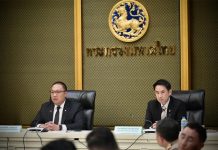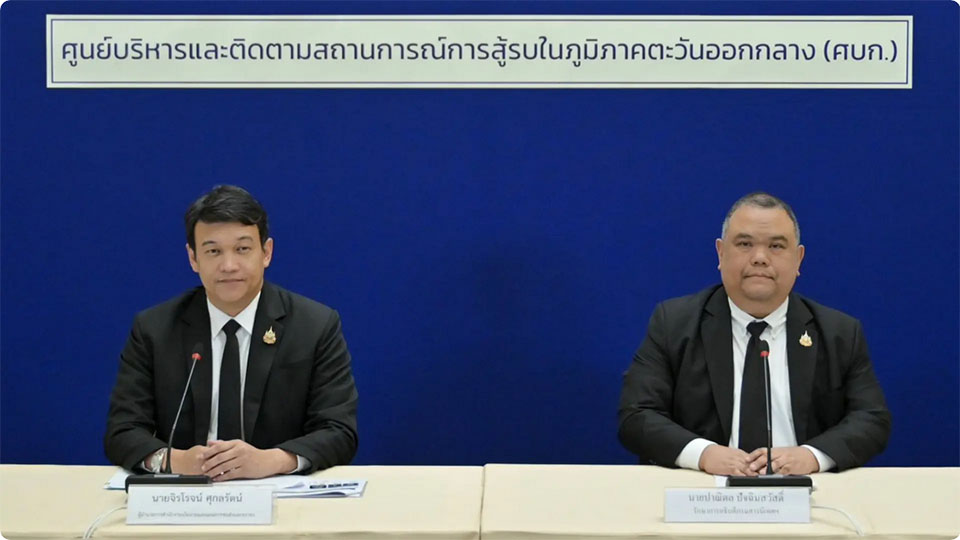
BANGKOK, Thailand – The Joint Management and Monitoring Center for the Situation in the Middle East held a press briefing at Government House in Bangkok on March 7, 2026, to provide updates on regional developments, support for Thai nationals, economic preparedness, and national security measures.
The briefing was delivered by Panidone Pachimsawat, acting director-general of the Department of Information and deputy spokesperson for the Ministry of Foreign Affairs, and Jiraroth Sukolrat, Director-General of the Office of Transport and Traffic Policy and Planning from the Ministry of Transport.
Panidone reported that the Middle East remains volatile as Israel, the United States, and Iran continue to exchange attacks. The conflict has affected neighboring areas, with reports of airstrikes in Azerbaijan resulting in civilian injuries and infrastructure damage. Several countries, including the United Arab Emirates, Israel, Syria, Iraq, Iran, Bahrain, Kuwait, and Qatar, have temporarily closed their airspace. Saudi Arabia and Oman remain open and are serving as hubs for aerial evacuation.
Authorities confirmed that no Thai nationals have been injured or killed. However, Thai citizens in high-risk areas are advised to leave as soon as possible. In Iran, 125 Thais have requested evacuation. Evacuations will proceed in two groups, traveling by land to Van, Türkiye: 69 people on March 7 and 56 on March 10. The Royal Thai Embassy in Ankara will open a temporary operations center in Van to support the evacuation.
Jiraroth reported that Deputy Prime Minister and Minister of Transport Pipat Ratchakitprakarn chaired an urgent meeting to assess the situation. The Ministry of Foreign Affairs, the Ministry of Energy, and the Royal Thai Police are coordinating the government’s response.
The Ministry of Energy confirmed that Thailand has oil reserves sufficient for approximately 95 days of use. The government has directed oil traders to increase legal reserve levels from 1% to 3%, and diesel prices are temporarily capped for 15 days starting March 3, 2026. Additional measures include securing more LNG imports, increasing natural gas production in the Gulf of Thailand, and expanding electricity generation from renewable, biomass, and coal sources.
Prime Minister Anutin Charnvirakul has ordered all agencies to maintain 24-hour operational readiness. The Royal Thai Police have strengthened security at key locations, including embassies and consulates, enhanced border monitoring, and increased oversight of social media to prevent misinformation that could affect national security or international relations. (NNT)