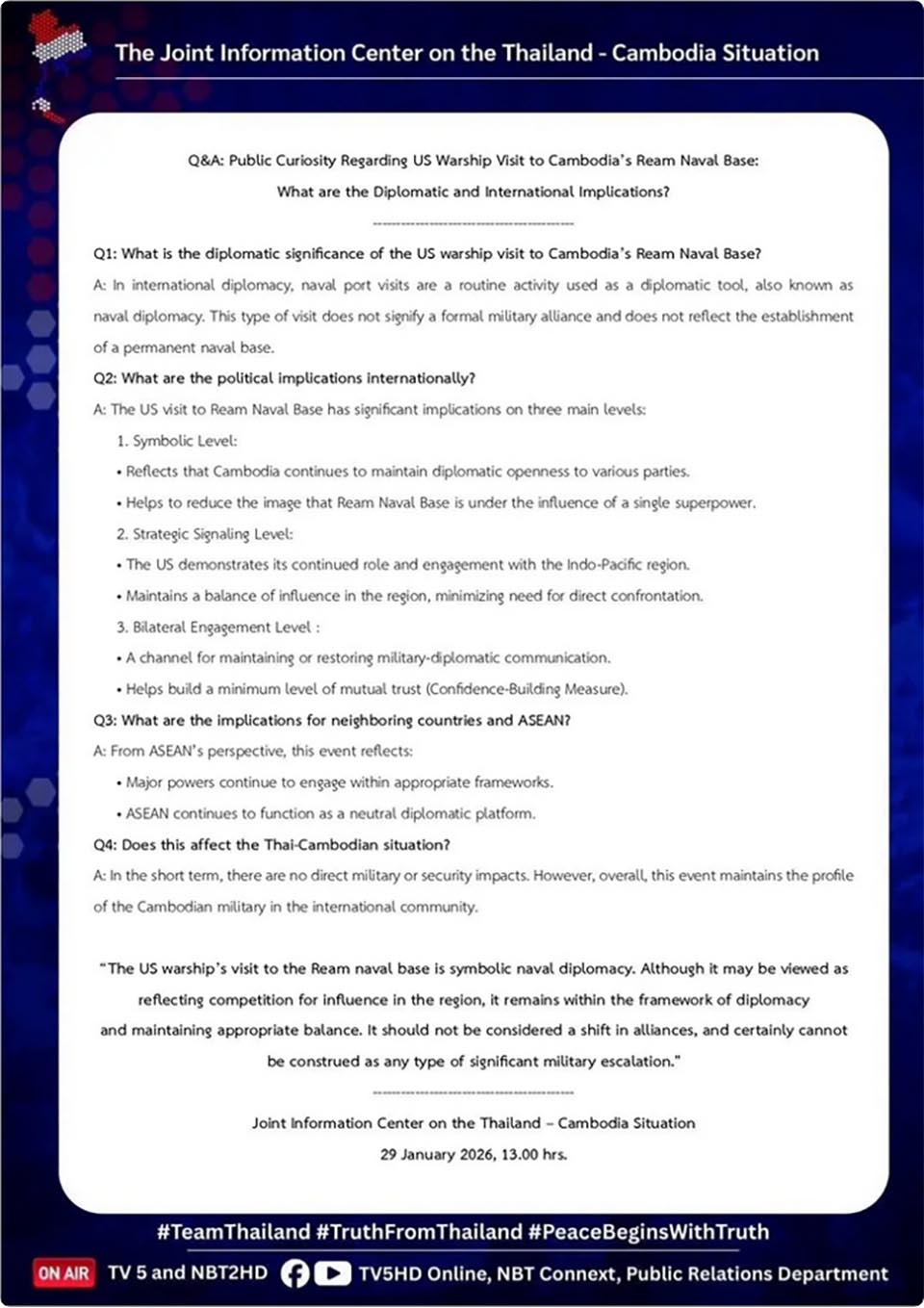
BANGKOK, Thailand – The Joint Information Center on the Thailand–Cambodia situation has addressed public interest surrounding the recent visit of a United States warship to Cambodia’s Ream Naval Base, outlining its diplomatic and international implications. The center said the port call falls within the scope of routine naval diplomacy practiced worldwide.
From a diplomatic standpoint, the center explained that naval visits are a normal instrument of international relations and do not signal the formation of a military alliance or the establishment of a permanent foreign base. Such engagements are intended to maintain communication and interaction between countries rather than indicate long-term military arrangements.
At the international level, the visit carries several implications. This indicates Cambodia’s continued openness to engagement with multiple partners and helps counter perceptions that the Ream Naval Base is aligned with a single major power. The visit also signals the United States’ continued engagement in the Indo-Pacific region while maintaining a balance of influence without confrontation. At the bilateral level, it provides a channel for military and diplomatic communication and helps build basic confidence between the two sides.
For neighboring countries and ASEAN, the center said the event shows that major powers continue to engage through accepted diplomatic channels. It also confirms ASEAN’s role as a neutral platform that supports regional stability amid broader geopolitical competition.
Regarding Thailand and Cambodia, the center said the visit has no immediate military or security impact. While it raises Cambodia’s visibility in the international military sphere, the center stressed that the event remains within diplomatic norms and should not be viewed as a shift in alliances or a sign of heightened regional tension. (NNT)