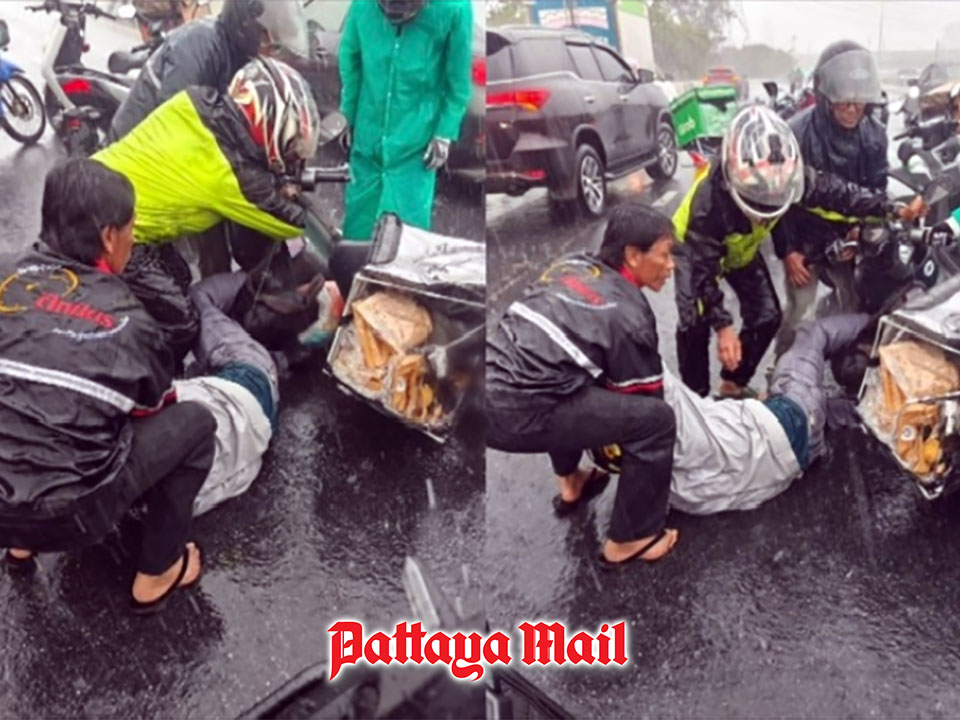
BANGKOK, Thailand – The wife of a food delivery rider struck by lightning on an elevated expressway in Bangkok on June 3, says his condition is steadily improving, although he remains in intensive care under close medical supervision. The rider, Piya, was severely injured after a lightning strike hit his motorcycle while he was travelling on the Ratchavipha elevated road on Vibhavadi Rangsit Road toward Ratchayothin intersection in Chatuchak district. The strike reportedly hit the center of his helmet, burning the surface, while a metal necklace he was wearing snapped and left burn marks on his neck.
His wife, Namtan said his condition has gradually improved, but doctors continue to monitor potential electrical effects on his body due to the extreme voltage involved in lightning strikes, which far exceed household electricity levels. Before arriving at the hospital, emergency responders reported that Piya experienced severe cardiac arrhythmia inside the rescue vehicle, with his heart rate dropping critically low before paramedics successfully revived him.
He regained consciousness the same evening during an MRI procedure and is now able to communicate and respond normally. While he still experiences pain and tightness in his face and chest from burn injuries, doctors say his hearing and cognitive responses are normal. However, further brain scans, MRI tests, and detailed cardiac examinations are still required. Doctors have not yet confirmed whether there will be any long-term effects, and his condition remains under daily evaluation while he stays in the ICU.
According to his wife, Piya is mentally stable and not showing signs of stress, though he reportedly believed at one point that he might not survive the incident. He also has no memory of the moment of impact, recalling only a flash of lightning before everything went black. She emphasized that the incident was a scientific accident, not related to superstition or luck, and urged the public to understand that lightning strikes are natural physical phenomena. She also reiterated that objects such as metal necklaces and mobile phones do not attract lightning. Instead, the risk comes from being in an exposed, elevated area such as a highway overpass during a thunderstorm, where electrical discharge can occur unpredictably.
Scientist Assoc. Prof. Dr. Jessada Denduangboripant from Chulalongkorn University also explained that neither helmets nor metal accessories “attract” lightning. He said the rider was simply in the wrong place at the wrong time, and that metal items only conduct electrical current after a strike occurs, often causing burn patterns along their contact points. He added that motorcycles are significantly more vulnerable during thunderstorms compared to cars, which can disperse electrical energy around the exterior body, whereas riders are directly exposed. The incident has been described as a scientific case study and a reminder for motorcyclists, especially delivery riders, to avoid riding during thunderstorms and to seek safe shelter immediately when lightning is observed.