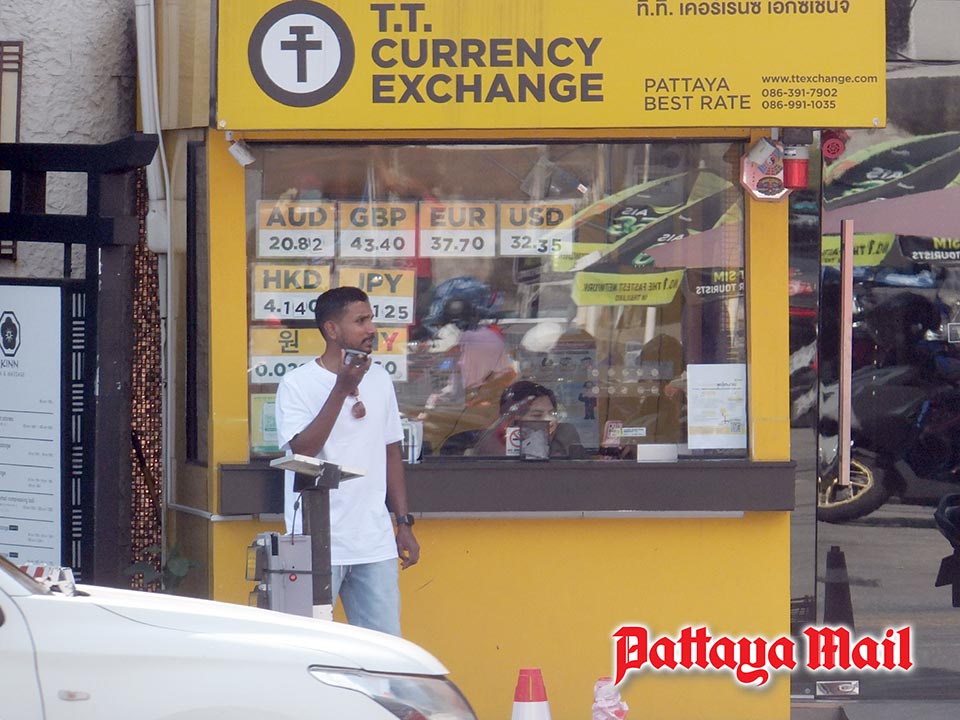
PATTAYA, Thailand – As the Thai baht continues to trade near multi-month lows against the U.S. dollar, foreign visitors and long-term residents in Pattaya are debating whether the currency’s strength in recent years has quietly dampened spending in one of Thailand’s most famous beach destinations.
On March 16, the baht closed at 32.50 per U.S. dollar, weakening slightly during the day after opening at 32.40, according to market data from Bangkok Bank. The currency fluctuated within a range of 32.35–32.54, marking its weakest level in nearly four months.
The movement came amid a stronger U.S. dollar and falling gold prices, while investors worldwide monitor interest-rate decisions from major central banks that could influence global currency trends.

But while financial markets focus on macroeconomics, many Pattaya Mail readers say exchange rates are felt in a much simpler way — through the spending power of tourists walking along Pattaya Beach.
“If the dollar was 36 to 38 again, Pattaya would be humming,” one reader commented, arguing that a weaker baht would quickly translate into more spending in bars, restaurants, and entertainment venues.
Others say the difference is already noticeable when withdrawing money locally. One frequent visitor said that although the dollar recently touched around 32.05, the effective rate tourists receive can be significantly worse due to ATM fees and bank markups.
“If you use the ATMs you pay the transaction fee and banks add about 5.5 percent markup, so the real exchange rate is terrible,” he wrote. “Back in 2017 and 2018 I didn’t see those markups when I lived here.”
Currency comparisons also vary widely depending on a visitor’s home country. While Americans often discuss the U.S. dollar, other readers pointed out that Americans represent only a small share of Pattaya’s tourism base.
“Why do people keep referring to the U.S. dollar?” another reader asked. “Americans are a small minority of visitors to Pattaya.”
For Australian travellers, the situation can feel even tighter. One reader noted that the exchange rate currently sits around 22 Australian dollars to the baht, leaving even less spending power once fees are deducted.
Despite the complaints, not everyone agrees that exchange rates alone explain fluctuations in tourism spending.
Some readers questioned whether visitors fully understand how currencies and inflation interact across economies.
“So they expect inflation to hit one country and not another with the exchange rate unaffected?” one commenter asked, suggesting that blaming the baht oversimplifies global economic forces.
Others pointed out the irony that discussions about the “strong baht” continue even on days when the currency is actually weakening.
“Strong baht, the experts said it was weak yesterday,” another reader joked.
Beyond economics, some comments veered toward nostalgia. One reader remarked that the city felt very different in the era before smartphones reshaped travel habits.
“You can’t beat Pattaya before smartphones,” he wrote. “That was the true Pattaya.”
Another reader argued that improving the visitor experience might matter as much as exchange rates, suggesting that issues like cleanliness in nightlife areas could also influence tourist perceptions.
Economists say currency fluctuations are only one piece of a complex tourism puzzle that includes airfare costs, inflation in visitors’ home countries, regional competition, and changing travel trends.
Still, for many regular visitors to Pattaya, the math remains simple: when their currency stretches further, they spend more — and the city’s nightlife and hospitality businesses tend to feel the difference quickly.
As global markets watch central bank interest-rate decisions this week, currency traders expect the baht to move within a range of 32.10 to 32.80 per dollar in the coming days.
For Pattaya’s tourism operators, however, the hope among some foreign visitors remains clear.
A weaker baht, they say, could make the difference between a quiet season and a bustling one.