PATTAYA, Thailand – Kasikorn Research Center says the United States’ decision to add Thailand to its currency policy monitoring list is expected to have little immediate impact on the baht, though the coming week is likely to see heightened volatility in both the currency and equity markets.
According to the research house, investors are closely watching Thai inflation data, foreign fund flows, movements in global gold prices, and the direction of the US dollar, as well as Thailand’s general election on February 8. The baht is expected to trade within a range of 31.00–31.80 per US dollar next week, while the Stock Exchange of Thailand (SET) is expected to see alternating buying and selling, with a key support level at 1,300 points.
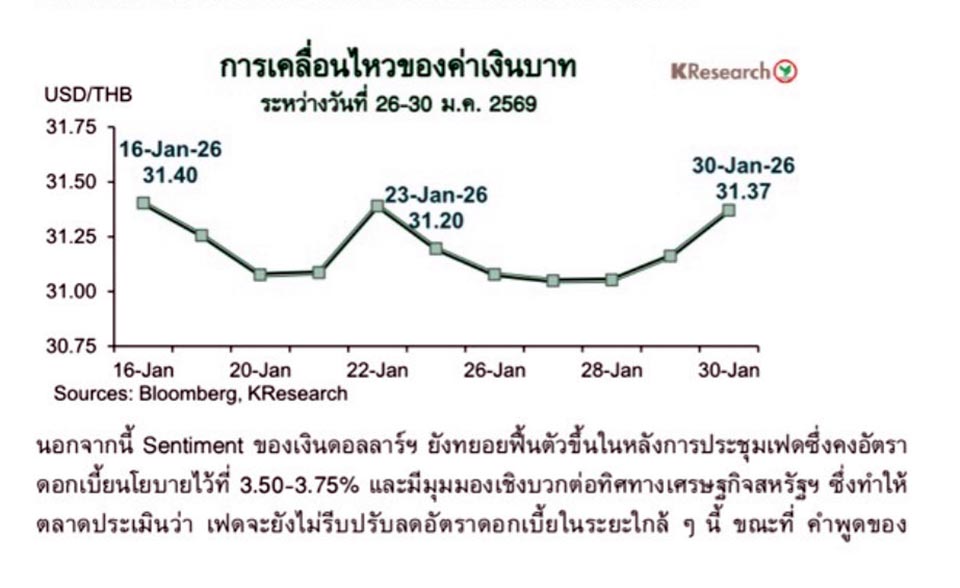
The baht strengthened during the early part of last week in line with most Asian currencies, supported by record-high global gold prices and a lack of support for the US dollar ahead of the Federal Reserve meeting. The Thai currency briefly broke below the 31.00 level, touching 30.866 baht per dollar, its strongest level in nearly five years.
However, the baht weakened again midweek as markets assessed possible official action to limit currency volatility and as gold prices pulled back on profit-taking. Additional pressure came later in the week as sentiment toward the US dollar improved following the Federal Reserve’s decision to hold interest rates at 3.50–3.75 percent and signal that it is in no hurry to cut rates.
The dollar also received support from comments by the US Treasury Secretary reaffirming a strong-dollar policy and from market speculation over the next Federal Reserve chair, with investors placing weight on Kevin Warsh as a potential candidate.
On January 29, the US Treasury released its report on the macroeconomic and exchange rate policies of major trading partners, adding Thailand to its monitoring list alongside Japan, China, Germany, Ireland, Singapore, South Korea, Switzerland, Taiwan, and Vietnam. Kasikorn Research Center noted that the announcement had limited impact on the baht, which closed domestic trading on Friday at 31.37 per dollar, compared with 31.20 a week earlier.
Looking ahead to the week of February 2–6, analysts say markets will focus on Thailand’s January inflation figures, foreign investor flows, movements in Asian currencies, and global gold prices. Key overseas data include US PMI and ISM indices, non-farm payrolls, unemployment data, weekly jobless claims, and job openings, as well as interest rate decisions by the Bank of England and the European Central Bank. PMI data from China, Japan, the eurozone, and the UK will also be closely watched.
The Thai stock market saw modest declines early last week amid concerns over geopolitical tensions and the risk of another US government shutdown. The SET Index later rebounded strongly, reaching a three-month high of 1,344.87 points, driven by foreign buying, particularly in technology stocks, energy shares benefiting from higher oil prices, and banking stocks following earlier sell-offs.
However, gains faded toward the end of the week after the Fed’s cautious stance on rate cuts and news of Thailand’s inclusion on the US monitoring list weighed on sentiment. The SET Index closed Friday at 1,325.62 points, up 0.85 percent from the previous week, with average daily turnover falling 14.33 percent to 48.07 billion baht. The mai Index slipped 0.88 percent to 209.29 points.
For the coming week, Kasikorn Securities expects the SET Index to find support at 1,300 and 1,285 points, with resistance at 1,345 and 1,355 points, as investors track inflation data, corporate earnings, foreign capital flows, and key global economic indicators. (TNA)