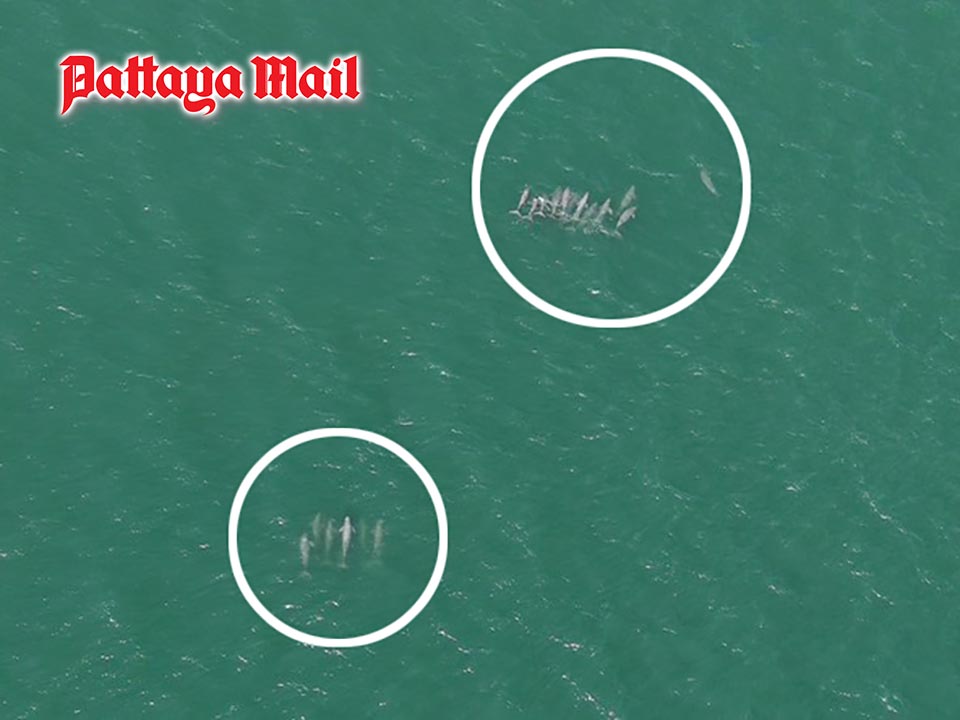
PATTAYA, Thailand – A recent marine survey in the upper Gulf of Thailand has recorded more than 40 Irrawaddy dolphins concentrated near the Bang Pakong River mouth, prompting authorities to step up proactive conservation measures, including the testing of acoustic deterrent devices designed to reduce fishing gear entanglement.
Dr. Pinsak Suraswadi, Director-General of the Department of Marine and Coastal Resources (DMCR), said the survey was conducted in line with the Ministry of Natural Resources and Environment’s policy to systematically protect rare and endangered marine species.
The survey, carried out between Jan 12 and 16, used direct counting methods and assessed dolphin responses to “Pinger” acoustic devices operating in the 50–120 kHz frequency range. The study covered coastal waters off Chachoengsao and Chonburi provinces in the upper Gulf.
Results showed 35–40 Irrawaddy dolphins (Orcaella brevirostris) displaying group foraging behavior, with an estimated 5–18 individuals exhibiting breeding-related behavior, within 3–5 kilometers from shore near the Bang Pakong River mouth. Drones were deployed to continuously monitor dolphin movement and behavior.

The Pinger devices are regarded as an important innovation aimed at reducing accidental entanglement in fishing gear, one of the leading causes of injury and death among rare marine mammals.
In parallel, authorities collected seawater and sediment samples to assess microplastic contamination and overall water quality at six river-mouth locations across Chachoengsao, Samut Prakan, Bangkok, Samut Sakhon, Samut Songkhram, and Phetchaburi provinces. Sediment samples were also taken from the Laem Luang coastline, while temperature loggers were installed at the Bang Pakong, Tha Chin, and Mae Klong river mouths to monitor environmental trends.
Preliminary findings indicate that seawater quality generally meets national standards for aquaculture and recreational use under the Pollution Control Department’s 2021 criteria. However, dissolved oxygen levels at the Tha Chin River mouth were found to be below standard, prompting authorities to intensify monitoring in the area.
Officials said the findings are a positive sign for the health of coastal ecosystems in the upper Gulf of Thailand and will serve as valuable data for long-term, sustainable conservation planning for rare marine species. (TNA)