Ah! Ma Chérie!
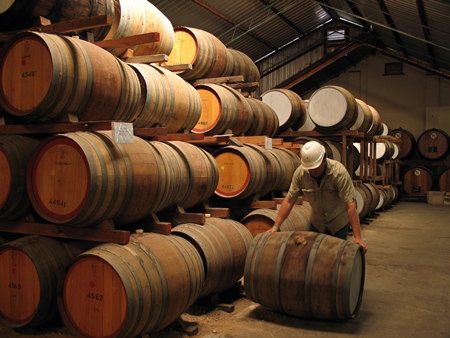
Part of Angove’s fortified wine solera system.
If there’s one wine in the world that is under-appreciated outside its home
country, it is Sherry. For a long time in Britain, Sherry was always regarded as
the preserve of country vicars and maiden aunts. In Spain, it has always been
the preferred drink of bull-fighters.
Let’s start with a quick take on Sherry, in case you are
unfamiliar with this most misunderstood of wines. Now, please try to pay
attention, especially those of you shuffling about in the back row. (1) Jerez de
Frontera is the biggest and most important of the three towns in Andalucํa that
produce Sherry. (2) There are basically five types of Sherry, ranging from bone
dry to staggeringly sweet. However, most Sherry sold today is dry. (3) Nearly
all Sherry comes from the white Palomino grape. (4) Sherry should always be
stored and served cold. (5) It differs from white table wine in that it’s
fortified with extra alcohol during the production process. (6) There is
normally no such thing as Vintage Sherry, because with very rare exceptions, new
Sherry is always blended with older wines.
The finest Sherry comes from companies like Croft, Sandeman,
Domecq, Hidalgo, Lustau and Gonzแlez Byass (makers of the renowned Tํo Pepe). In
this fair city, you’re usually limited to Tํo Pepe or Sandeman’s “Dry Fino”.
Fino is the driest of Sherries, followed by the slightly sweeter and richer
Amontillado, currently enjoying something of a revival.
The name Sherry derives from Jerez. In Shakespeare’s time, it
was known as “Sack” although it probably didn’t taste much like the sherry of
today. In George Rainbird’s book on the subject he writes, “As every schoolboy
knows, sherry was Falstaff’s favourite tipple.” These days, I doubt whether many
schoolboys would know who Falstaff was, let alone his drinking habits. But
perhaps Mr. Rainbird didn’t know very many schoolboys.
Consistency in Sherry is achieved by blending wines from
successive years in an extensive range of barrels known as a solera. After
blending, something strange happens. As the new wine waits in its cask, a layer
of natural yeast (called “flor”) develops on the surface and protects the wine
from oxygen. This phenomenon occurs almost nowhere else in the world.
Bookmark Dry Sherry,
Australia (Villa, Bt. 362)
This comes from Angove Family Winemakers, a well-established
Australian wine company. Although the name “Sherry” appears on the label, it
won’t be there for long. Matt Redin, the Marketing Manager for Angove told me
that “with the new EU rules regarding nomenclature…we are no longer able to call
it Sherry, but have adopted the term Dry Australian Fortified wine. The wine in
the bottle will be exactly the same.” It’s an extremely pleasant wine too and at
this price, quite a bargain. Like its Spanish cousins, it’s made using the
solera system. With a light straw colour, the wine has a rich nutty aroma with
almonds, marzipan, raisins, a hint of yeast and orange peel. The taste is full
and fruity with raisins and sultanas. It has a very soft - almost unctuous -
mouth feel with virtually no acidity. There’s an excellent long finish, with
floral overtones and hints of orange.
The wine is not as dry as a typical Spanish Fino and its rich
buttery fruit reminds me more of an Amontillado. Compared to Tํo Pepe, this wine
is fuller, softer and slightly sweeter. Wine critic Peter Forrestal described it
in true Ozzie fashion as “bloody good”.
Custer’s Fino Dry Sherry,
Spain (Foodland, Bt. 399)
Bottled in Jerez, this gold-coloured wine is several shades
darker than the Bookmark. Surprisingly, it’s much lighter in body, noticeably
drier and a dash more acidity. You’ll probably detect raisins, almonds and
olives on the aroma, along with delicate hints of white fruit. The wine has a
very long dry finish and is really rather elegant. If you prefer a typical dry
fino, especially as an ap้ritif, you’ll probably enjoy this wine. It’s a bit
lighter in body than Tํo Pepe. Incidentally, Friendship sells Tํo Pepe for just
over a thousand baht, but there are other supermarkets further north that will
be pleased to charge you an extra 300 baht for the same thing.
If you don’t normally drink Sherry, do give it a try some
time. I have always loved it since my first tentative sip. Tentative, because I
was only eleven at the time.