|
|
 |
| AUTO MANIA:
by Dr. Iain Corness |
|
|
|
Spa GP this weekend
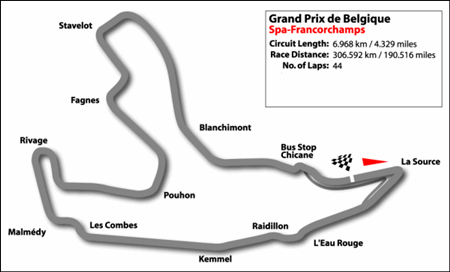
Spa-Francorchamps.
F1 resumes with Spa this weekend. After the mid-year four
week holiday, F1 returns to one of the best tracks on the calendar - Spa
Francorchamps in Belgium, a circuit that everyone enjoys (are you listening,
Bernie).
Now we get a real race circuit, with Eau Rouge being the
corner for those with big hearts (and large cojones). Remember Webber’s pass
on Alonso around the outside of Eau Rouge last year! Will Vettel find his
form again? Will Hamilton keep his hot blood in check? Will Button smooth
his way to the top, as there is plenty of chances for rain. We will know by
Sunday night.
The race will start at 7 p.m. our time and we watch from
Jameson’s Irish Pub on Soi AR, next to Nova Park. The big screen is great
and the dedicated F1 channel has good commentary with no breaks and no ads.
Come at 6 p.m. for a meal (the Sunday specials are great value) and a drink
and discussion and let’s hope for some real racing.
|
|
 |
Electric power steering
As mentioned in the piece about the new hybrid Jazz, this car
has electric power steering. About eight years ago, I made the prediction that
“European cars, because of their smaller sizes and lighter weight have utilized
electric steering sooner than across the Atlantic, but I expect electric power
steering will replace traditional hydraulic power steering units within the next
five to seven model years.” It now seems that I was right when I looked into my
crystal ball. (Unfortunately, it does not give out lottery numbers!)
Since hydraulically activated power steering has been around
since 1951 when the Chrysler Crown Imperial was the first car offered with the
new concept, we should have got it right by now. And we have got it right, to
the point that we have developed another system which uses less energy than
hydraulic pumps, and in today’s energy conscious environment, less energy used
is savings at the petrol pumps.
Today’s systems use electronics and electrics and has
dispensed totally with the hydraulics. This was first seen in the Honda NSX
sports car and Honda again introduced the system on the S2000 sports car.
Smaller, lighter electric units are also used on Honda’s Hybrid Insight sedan
(petrol saving, of course). And the Jazz!
However, Honda was not the lone pioneer here, as Saturn used
electric power steering on the Vue SUV and the Ion sedan. GM’s 2004 Malibu used
Delphi’s new E*STEER unit. Dephi’s system was also used in the 2000 Fiat Punto
and Volkswagen’s 2001 Lupo 3L TDI. Other OEM vendors of electric power steering
systems are Visteon with EPAS used in the MGF and ZF Freidrichshafen AG with ZF
Servolectric.
As opposed to electric power steering, four-wheel steer has
also been around for a while, but these have been mechanical systems. Honda
offered it on the Prelude but dropped it later, and more recently it was offered
on the full-size GM pickups and SUVs. For large vehicles like a pickup truck,
this reduced the turning circle from something akin to that of a sea-going oil
tanker to that of a small car. However, these mechanical systems were expensive
and physically complex.
Four-wheel steering systems of the 1980s were in essence,
essentially mechanical, with the wheels linked at pre-determined angles to make
up for a vehicle’s tendency to understeer. Towards the end of the 1990s,
manufacturers such as Nissan were beginning to develop solutions based on
electrically and even hydraulically-operated actuators to take the dynamic
performance of their vehicles forward. Electronic control of rear wheel steering
has enabled handling to be fine-tuned even further, notably in the case of
rear-wheel drive vehicles.
Auto engineers know there are many advantages with
electric/electronic systems in automobiles, and one significant savings lies
where electrical and electronic components actually replace conventional
mechanical and electromechanical components. Such is the case with electric
power assisted steering systems, steer-by-wire, and active steering systems,
including electro-hydraulic power steering, magnetic power steering, intelligent
steering systems, active rear-steer systems, four-wheel steering systems,
steer-by-wire, and multi-axle steering systems. This is a complex area of
engineering that covers active, passive, and semi-active suspension systems,
electromagnetics, damper suspension, digital suspension control, and vibration
and handling control systems.
These advances have been acknowledged, but complexity and
cost has stopped them becoming universally adopted, but as electronic systems
become more sophisticated and costs become more affordable, many of these
advancements are now becoming available in mid-range production automobiles.
|
|
Bira next weekend
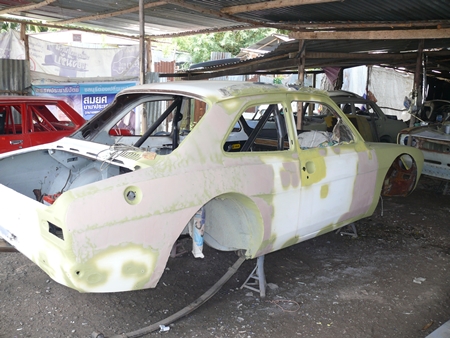
Mk1 Escort shell waiting paint.
The Nitto 3K meeting with the Retro cars is scheduled for
September 9. We are still hopeful that the Securitas Mk1 Ford Escort will be
rebuilt in time. Anybody got a spare quick steering rack in the bottom of their
cupboard? More next week!
|
|
The Thai-Australia FTA in action
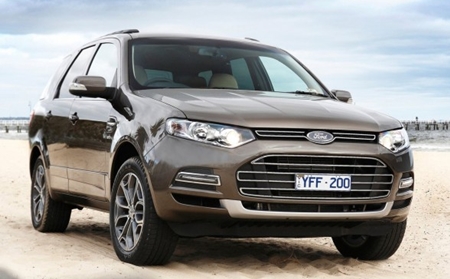
Ford Territory from Down-Under.
Everyone’s rough idea of what a Free Trade Agreement (FTA)
means, is that two countries can export/import to each other without duty,
keeping the costs down for both countries. Unfortunately, it doesn’t quite work
that way.
Despite the supposed FTA, Thailand imposes a 60 percent
“registration” penalty on foreign cars with petrol engines over 3.0 liters in
capacity, but this is reduced to 50 percent for diesel engines over 2.0 liters.
A ‘rose’ by any other name, it would seem.
However, Ford Australia has sent 100 of its locally built and
designed Ford Territory SUV to Thailand. These were all top of the line AWD
‘Titanium’ diesel variants with which FoMoCo is gauging public interest with an
eye towards more substantial export deals down the track. Apparently, Ford were
very pleased with the reception the Territory SUV received at the Bangkok
International Motor Show this year.
The Thai export deal is a slight reversal of a familiar flow
for Ford Australia, with a growing number of vehicles including the Fiesta,
Focus and Ranger - plus the forthcoming EcoSport and Escape SUVs - all sourced
from Thailand, the third-largest source of vehicles for the Australian new
vehicle market surpassing locally manufactured vehicles.
To the end of July, 84,508 Thai-made vehicles were sold in
Australia, only beaten by Japan (234,429) and Korea (84,724), but ahead of
Australia’s own domestic production (79,433).
Ford Australia president and CEO Bob Graziano said, “Building
on the success of the Territory in Australia and New Zealand, we expect the
Territory Titanium model to do well in Thailand. It’s clear Thai customers want
the roominess of a seven-seater and the features available in the Territory
Titanium.”
|
|
A USD 11 million Ford?
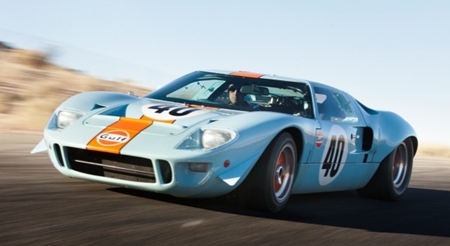
Gulf/Mirage GT40.
A 1967 Gulf/Mirage Ford GT40 was sold at auction in the US
for USD 11 million plus auctioneer’s fees. Before the auction, the vehicle was
estimated that it would reach upwards of USD 8 million.
These days, any GT40 will command huge dollars, and this
particular GT40 is one of only two surviving production lightweight GT40 models.
The car’s history also includes an extensive race career
throughout the late 1960s and early ’70s from Daytona to Le Mans, as well as the
Le Mans trials at the hands of Jacky Ickx. The car was also used as a camera car
in the classic 1971 Steve McQueen film, Le Mans, adding to the overall value.
It was presented in the Gulf team colors of Powder Blue with
a Marigold stripe, the GT40 lightweight had a 320 kW mid-mounted V8 engine and
five-speed manual transmission.
The list of cars which were sold by RMA Auctions of Monterey
California, will make you weep, as they sold more than USD 30 million in other
rare and collectable vehicles including a 1962 Ferrari 250 GT SWB California
Spyder (USD 8.58m); a 1955 Ferrari 410 S (USD 8.25m); a 1956 Ferrari 250 GT LWB
Berlinetta ‘Tour de France’ (USD 6.71m); a 1938 Horch 853A Special Roadster
(USD5.17m) and a 955 Aston Martin DB3S that reached USD 3.69 million.
|
|
Honda’s Jazz Hybrid goes the other direction
Honda Thailand released its hybrid version of it Jazz a few
weeks ago, and now has revealed that the hybrid version will also be exported to
Australia.
Thailand’s hybrid Jazz should make its debut at the
Australian International Motor Show in Sydney on October 18, the Australian-spec
model being produced in Thailand alongside the conventional-engined version,
taking advantage of the free-trade agreement between the two countries, where
Australia does not have a similar “registration” penalty as Thailand has for
importing vehicles.
Honda has said it is aiming to sell 10,000 Jazz Hybrids in
Thailand - where it starts from 768,000 baht - and an equivalent number in
Malaysia, once production commences there next year.
Thai specifications show the Jazz Hybrid is powered by
Honda’s familiar 1339cc four cylinder i-VTEC engine producing 65 kW of power at
5800 rpm and 121 Nm of torque at 4500 rpm, combining with a 10 kW/78 Nm electric
motor and driving the front wheels through a continuously variable transmission.
Idle-stop technology and a low-speed EV mode are fitted,
helping the Jazz hybrid deliver combined-cycle fuel consumption of 4.7 L/100 km
and CO2 emissions of 110 grams per kilometer (if you are interested in these
numbers), based on internal company figures.
The hybrid chassis set-up is as the conventional model,
including the use of a MacPherson strut front suspension, torsion beam rear
axle, electric power steering system and standard 15 inch alloy wheels.
In Thailand, Honda is the first to offer a hybrid car in the
sub-compact segment and has put a five year/unlimited mileage warranty on the
hybrid system, including the electric motor, IPU (intelligent power unit),
battery and wiring.
The driver can activate an ECON switch that takes the car
into “super economy” mode, resulting in a four percent reduction in torque,
smoother CVT shift pattern, increased regenerative braking and altered
air-conditioning operation.
The IMA system, battery pack and power control unit are
located under the rear cargo floor, which according to Honda has meant no change
in either seating flexibility or cargo space.
Thai-spec models come with dual front airbags and ABS brakes
with electronic brake-force distribution, although Australian models will have
traction and stability control and curtain airbags to enable a good ANCAP rating
down-under.
|
|
Autotrivia quiz
Last week, I asked what pre-war race car weighed in at 750 kg
and had an engine that developed around 600 plus horsepower from its eight
cylinder engine? It was the mighty Mercedes W 125, from the era when men were
men and cars were cars. None of this auto-paddleshift, and turning the engine
down from the pit wall.
So to this week. I mentioned the mighty W 125. They ran a
leather strap over the bonnet at Donnington and not at the German GP. Why?
For the Automania free beer this week, be the first correct
answer to email [email protected]
|
|
 |
|
|