|
AEC 2015: the AFG consults
a ‘mor doo’
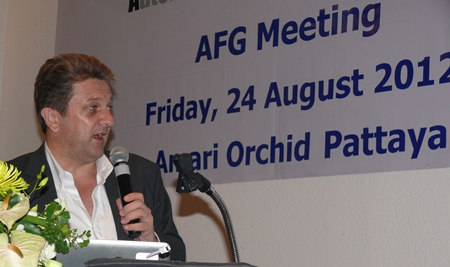
Andrew Durieux
Dr. Iain Corness
The dynamic (and rapidly expanding, now 200 members)
Automotive Focus Group (AFG) held its monthly meeting at the Amari. The
topic was very salient to the industries covered by the AFG and was the
ASEAN Economic Community (AEC), looking at the threats and opportunities.
The AEC holds many promises for its member states and
peoples, with free flow of goods and services, free flow of labor,
harmonized policies ... but is this really what is going to happen, or is it
a Utopian dream?
The principal speaker was Andrew Durieux, a past
president of the Australian Chamber of Commerce, and currently chairman of
the Joint Foreign Chambers of Commerce Thailand (JFCCT) AEC Committee, who
spoke on the AEC and how it will affect us, our businesses and our industry.
Some history was in order, with ASEAN having been formed
in 1967, and receiving its charter in 2007. The original ASEAN is now joined
with a group known as CMLV (Cambodia, Myanmar, Laos and Vietnam), but these
latter four are somewhat behind in their employing the statutes enshrined by
ASEAN.
With the AEC in place, and operating smoothly, there will
exist policies to allow skilled labor groups to move freely around ASEAN.
This includes doctors, dentists, accountants, engineers, nurses and
architects. This relies on MRA’s (Mutual Recognition Agreements), and Andrew
Durieux brought out the fact that there are many “get out of jail cards
fee”, as the MRA’s have to be agreed upon, and some of the ASEAN countries
do not have such legislation. He also pointed out that these skilled worker
groups have to be ASEAN citizens, and if they want a license to work in
Thailand will need to have literacy in the Thai language. “Free” movement
would appear to be a pipe dream.
He pointed out that ASEAN is not really united, and
Thailand has adopted a somewhat protectionist attitude with its plethora of
regulations and laws, spanning many different government departments. (A
festival of red tape!)
There are opportunities for the ASEAN countries provided
by a “working” AEC, such as in the stock markets, ASEAN bonds, Customs
agreements, a single Tourist visa, which Andrew Durieux said could be a
“Flagship Project” which is needed give the disparate ASEAN countries a
common focus.
He finished stating that for Thailand, the possibilities
are good, IF the Thai government were to focus on the advantages that the
AEC could bring. But will it? The “mor doo” (fortune teller) was not sure!
|

|
PM wants more use of research in
country’s energy, development sectors
Prime Minister Yingluck Shinawatra on Monday expressed
strong support for research for national development given Thailand’s
limited energy and natural resources.
In her opening speech at a forum on industrial
development in Bangkok, she said Thailand should make full use of the
country’s research on energy and natural resources to give the country a
competitive edge in the coming ASEAN Economic Community (AEC) in 2015.
She called on higher-education institutes to more fully
utilize their research results by joining together with the public and
private sectors.
Future research, she pointed out, should be conducted in
accord with the needs of the state and private sectors for the sake of
agricultural and industrial development.
Research scholarships should aim at subjects that enhance
the country’s development, she said. (MCOT)
ASEAN spells out its tourism priorities ahead of 2015
ASEAN countries are now implementing a clear road map to
achieve their tourism objectives for the ASEAN Economic Community, due 2015.
There will be a new ‘ASEAN for ASEAN’ campaign and special promotions, along
with enhanced strategic cooperation with the growth markets of China, Korea,
Japan, India and Australia.
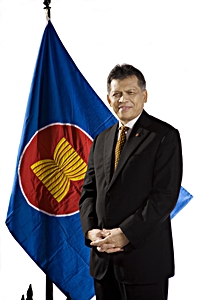
ASEAN Secretary-General Dr
Surin Pitsuwan.
ASEAN Secretary-General Dr Surin Pitsuwan and the ASEAN
Tourism Ministers have endorsed the plan, which includes a swathe of
initiatives such as the creation of a new website and digital promotional
campaigns targeting the mass markets of China and India.
ASEAN will also go for niche markets such as
experiential, creative, adventure, business, senior, and long stay visitors.
Further, there will be special promotions for the cruise market.
“Our strategy is designed to help build global
recognition of Southeast Asia as a competitive, world-class tourism
destination,” said Dr Surin. “Our focus is on drawing visitors to the region
and encouraging them to visit more than one country. As each has its own
unique attractions, we will capitalize on the sophisticated marketing
capacity and resources of our individual national tourism organizations to
spread the word.”
The ASEAN Tourism Strategic Plan 2011-2015 is the
foundation of the ASEAN Tourism Marketing Strategy (ATMS) 2012-2015, adopted
by ASEAN Tourism Ministers in January 2012. It is the plan with which ASEAN
national tourism organizations (NTOs) seek to achieve the objectives of 2015
and maintain double digit tourism growth, an ASEAN hallmark for much of the
last 14 years.
ASEAN destinations attracted 81.2 million visitors in
2011, an average increase of a million visitors each year for the last two
decades. Three out of four visitors to ASEAN come from Asia; 46.5% from
within ASEAN and 27.6% from other Asian markets. According to ASEAN NTOs,
Europe is the next largest group of visitors to ASEAN at 12.2%, followed by
Oceania (including Australia and New Zealand) at 5.3%, and the Americas at
4.4%.
Niche and mass market promotions will go hand in hand.
ASEAN Tourism Marketing Working Group chairperson, Sansern Ngaorungsi, who
is also deputy governor of the Tourism Authority of Thailand said, “…
Tactical campaigns will … show the diversity of ASEAN, and mass tourism
demand for mainstream attractions is expected to keep growing and bring
important economic benefits to ASEAN destinations.”
One niche sector, cruise, is being favored by ASEAN
because riverine and sea cruise ships usually visit more than one
destination. To promote cruise ship activity in ASEAN, Singapore is
organizing the “Cruise Shipping Asia Pacific 2012” forum on 17 September in
Singapore.
Southeast Asia NTOs will also be emphasizing the
grouping’s marketing plan at the ASEAN Tourism Forum which will take place
in Vientiane, Laos 17-24 January 2013. Over 1,600 delegates will include
some 150 ASEAN tourism ministers and officials, 800 ASEAN exhibitors, 400
international buyers, 150 international and local media and 100 tourism
trade visitors.
|
|
Real estate business improves after last year’s floods
Housing Business Association chairman Isara Boonyang said
the real estate business has expanded some 10-15 percent after last year’s
floods, thanks to remedial measures implemented by the government.
The Bank of Thailand is offering Bt300 billion in soft or
low interest loans for those affected by floods, while the government’s
‘first house’ scheme provides home buyers with interest-free loans for three
years.
The expansion of so-called horizontal residential
projects has been overtaken by vertical housing, high rises or condominiums,
for many pieces of land have not been developed, he said.
The construction cost for a residence as well as real
estate prices have moved up about 5 percent as a result of higher prices of
land and the minimum wage rise of Bt300.
Many housing projects have adjusted home planning designs
to be able to cope with future floods, he noted, such as dyke construction.
Isara believes Thailand will not face a flood crisis this
year, for he thinks the government has measures to deal with such situations
despite its as yet unclear water management plan.
Chairman Kitti Pattanapongpiboon of the Housing Finance
Association said the overall amount asked for in applications for loans in
the second quarter reached Bt270 billion, which was an improvement. The
whole-year figure is expected to reach Bt300 billion.
The Housing Finance Association and Home Buyers’ Guide
Company have joined together to sponsor a ‘Home Buyers’ Expo 2012, NPA Grand
Sale 2012, and Home Loan 2012' to boost the housing market at Queen Sirikit
National Convention Center from today through Sunday with special conditions
offered to potential buyers.
Around 80,000 visitors are expected to join the four-day
event. (MCOT)
|
|
Thai massage industry
expected to blossom in AEC
The Ministry of Public Health has reported that the Thai
massage industry last year generated up to 30 billion baht of income for the
country and it is expected to expand further when the ASEAN Economic
Community (AEC) is opened.
Minister of Public Health Wittaya Buranasiri recently
held a press conference on the 9th National Herb Expo, which will be held
from September 5-9 with an aim to support the Thai massage industry. During
the conference, he stated that related authorities are now campaigning for
people to get a Thai massage when they experience body aches, instead of
taking analgesic or anti-inflammatory drugs.
He also disclosed a financial overview of the Thai
massage industry, which showed that as much as 20-30 billion baht was
generated for the country last year. It has also been discovered that nearly
2,000 people are working in this field.
Wittaya said the Ministry of Public Health is aiming to
make Thailand the world’s ultimate destination for massage, with plans to
improve the quality of the workers, offer more massage classes to the public
and set up a massage center in every hospital.
With the AEC to be established in three years’ time, the
minister expressed confidence that the Thai massage industry will flourish
and bring in even more income for Thailand. (NNT)
|
|
Finance Ministry not proposing changes in vehicle tax structure
Deputy Finance Minister Thanusak Lek-uthai said the
ministry will not yet propose vehicular tax structure changes for Cabinet
consideration linked to the quantity of carbon dioxide (CO2) released by
newly-produced vehicles.
Such a method of tax adjustment is intended to reduce
environmental problems.
Thanusak said that the auto industry has only just
recovered from last year’s flood, and is installing new machinery in its
production lines, and the government recently launched its ‘First Car’
scheme to boost sales and car ownership in the auto sector.
Changing the vehicular tax structure should not be done
now, he said, as it could require the auto industry to change its production
lines, which will be a burden for the sector.
In case of a structural change, the Excise Department has
studied how to collect motor vehicle excise tax in accordance with the
quantity of carbon dioxide released.
A 50 percent tax collection applies to an engine higher
than 3,000cc, while a 30 percent tax would be applied to vehicles with an
engine smaller than 3,000cc.
In that case, the tax collection structure for vehicles
with the usage of ethanol, gasohol (a gasoline and ethyl alcohol mix), and
electric and eco cars will be annulled. (MCOT)
|
|
|