
Duensing Kippen Tax and
Law
According to Section 1012 of the Civil and Commercial
Code of Thailand (the “CCC”), the purpose of forming a limited liability
company is to make profit. However, in Thailand, especially in its resort
destinations, such companies have frequently been used for a different
purpose.
Many investors have chosen to use a limited company as a
vehicle to own a villa or condominium “holiday home” in the Kingdom. The
choice of a Thai corporate holding vehicle is most often explained as being
due to the stringent laws relating to freehold ownership in the Kingdom. The
legality of such an undertaking will not be discussed in this article.
Instead, in the following, we present Part I of a two part article in which
we take a brief look at the, unfortunate and unnecessary tax consequences
that may result by owning a holiday home in Thailand by means of the all too
common but nonetheless ill-advised use of a Thai company limited.
Even though the said investor may set up and use a local
corporate vehicle only for the purposes of owning a holiday home in
Thailand, the Revenue Department does not see it that way. The Revenue
Department will treat such a company as if its purpose is as provided in the
CCC: making profit. The Revenue Department will, therefore, interpret all of
the company’s actions in light of such purpose. And this, when combined with
the Revenue Department’s power to upwardly assess income, can result in
severe consequences not only for our investor’s company but also for the
investor personally. This is because the Revenue Department is empowered to
tax our investor’s corporate home owning structure in two ways.
First, our investor will obviously use the asset as a
holiday home. He will stay in the acquired villa during his holidays in the
Kingdom. Typically such a person will not pay any rent to “his” company
during his stay. However, if it is as typically the case that our investor
is also a director of his corporate vehicle that owns the villa or
condominium, it will be deemed that such company is providing accommodation
to its director. In such a case the Revenue Department has the power to
assess such a rent free stay as taxable personal income for such a director.
Section 40(1) of the Thai Revenue Code (“RC”) defines assessable income as
“monetary value of rent-free residence provided by the employer”.
The person liable for tax in Thailand that received the
assessable income is required to report and remit income using the personal
income tax return form PND 91 by the last day of March after the year in
which the income was paid. If the director fails to do so, he might be
assessed by the Revenue Department and penalized for failing to file an
accurate return or any return at all. Apart from having to pay the assessed
taxes, a penalty is payable in accordance with Section 22 of the RC in the
amount equal to the tax payable. In event the failure to file any return at
all, the penalty is twice the tax payable (RC: Section 26).
Second, not only the individual, but also the company
might be penalized as result of the director’s rent-free accommodation.
Please note that the company is required to deduct and remit a specified
withholding tax on any assessable income, including such rent-free
accommodation income. If the company fails to deduct and remit the relevant
withholding tax, the company is jointly liable with the tax payer for the
unpaid amount.
Failure to report such income can result in an assessment
by the Revenue Department resulting in a penalty equal to the amount of the
additional tax payable and a surcharge of 1.5% per month on the tax payable
(but not to exceed the total tax payable).
One might think that an obvious solution would be to
ensure that the person that uses the company’s asset for a rent-free stay is
not an employee of the company. However, such is not the case. This is
because the Revenue Department has the right to assess rental income of the
company. In case the asset of the company is used for a rent-free stay or a
stay whereby only a proforma rental amount is declared, the Revenue
Department is entitled to assess a higher rental amount. This might occur if
such proforma rental amount is below market rate. The company will be
subject to corporate income tax on such assessed amount even though such
amount was not actually paid.
Finally, it should be noted that a further tax, the house
and land tax (“HLT”) is applicable to such holiday home rental income. In
Part II of our article we will point out the additional unfortunate and
unnecessary HLT liabilities that result from the all too common but
nonetheless ill-advised use of a Thai limited company to own a holiday home.
|
DUENSING KIPPEN is a
multi-service boutique law firm specializing in property and
corporate/commercial matters and is also the only such firm in
Thailand that compliments its property and corporate/commercial
legal expertise with a core tax law practice. DUENSING KIPPEN can be
reached at: [email protected] or for more information please
visit them at: www.dktaxandlaw.com
|
Well known property developer Kobi Elbaz changing the Pattaya skyline with a number of very high profile projects
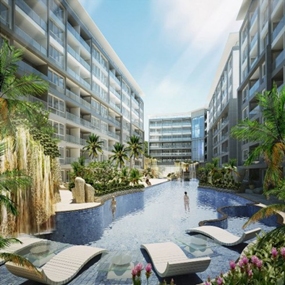
Centara Avenue Residence & Suites.
In recent weeks there has been a hive of activity coming
out of the offices of Tulip Group in Pattaya Thailand. Early in June it was
announced that they would be launching Centara Avenue Residence & Suites- a
fabulous 300 room condominium and 100 room Centara Hotel.
This project really caught the eye of the buying public.
The innovation about this project is that the Centara name is being used in
connection with a condominium project in the city for the first time.
Centara is the largest hotel chain in Thailand with currently a total of 57
properties, 43 of them nationwide and 14 overseas.
Then late last month at the Centara Grand Mirage Hotel,
Eli Papouchado, Chairman of Park Plaza Hotels and Kobi Elbaz CEO of Tulip
Group held a high profile press gathering with both local and international
journalists to advise them that they would be reviving the former Waterfront
project in the heart of Pattaya. The newly named Park Plaza Waterfront will
be a 52 Floor building rising to a height of 183 meters and will be located
at Bali Hai in downtown Pattaya. The project will feature a 100 room hotel
and 315 residential condominium units.
The building will offer stunning facilities and amazing
views of the ocean and surrounding islands. Park Plaza Hotels will provide
full management upon completion and opening of the project.
Pattaya-based Tulip Group, founder Kobi Elbaz is
well-known both in Thailand and internationally is also a partner in
numerous other projects including– The Cliff– Amari Residence Pattaya-
Novana Residence-Nova Ocean View-Centara Grand Pattaya-Centara Boutique
Collection and Centra Bangkok.
However it seems these two latest project launches are
just the start of a series of stunning new projects that will be launched by
Tulip Group.
Plans are being finalised for the launch of a landmark
beach front Tower on Jomtien Beach and further land parcels have been
acquired or are being sourced ready for upcoming launches during the rest of
this year and into early next year. (Press Release)