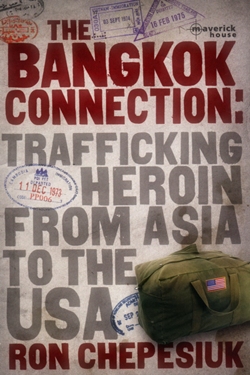
 The
last few weeks have brought books to the reviewer’s table dealing with the
American involvement in other parts of the world. This week it is a book
called The Bangkok Connection written by Ron Chepesiuk, (ISBN
978-1-905379-74-3, Maverick House, 2011). It covers the life of Ike
Atkinson, a drug baron, also known as Sergeant Smack. It also covers, in
much depth, the ‘heroin in the cadavers’ issue, on which everyone seems to
have had some input or ‘first hand’ knowledge.
The
last few weeks have brought books to the reviewer’s table dealing with the
American involvement in other parts of the world. This week it is a book
called The Bangkok Connection written by Ron Chepesiuk, (ISBN
978-1-905379-74-3, Maverick House, 2011). It covers the life of Ike
Atkinson, a drug baron, also known as Sergeant Smack. It also covers, in
much depth, the ‘heroin in the cadavers’ issue, on which everyone seems to
have had some input or ‘first hand’ knowledge.
Its origins were in the film ‘American Gangster’, a
typical celluloid tale, using the small-time gangster Frank Lucas’ claims
that heroin was shipped back to the US in the body bags (and body cavities).
Chepesiuk convincingly (for me at least) debunks the entire myth that this
ever happened. In fact, Ike Atkinson describes it as “a big lie... the
biggest hoax ever perpetuated.” And Ike should know. He was, at that time of
the Vietnam War, running the largest drug smuggling ring bringing Thai
heroin to the USA.
Author Chepesiuk is certainly an investigative
journalist. Amongst other interesting facts he dug up, were items such as
the famous fighter Joe Louis who spent his entire life paying off his back
taxes, and was denied deductions such as the $3,000 he gave away in ticket
sales to servicemen.
He details the corruption in the military and in war
zones. “Saigon was also awash with corruption. Just around the corner from
the US Embassy was the black market known as ‘PX Alley’ where one could find
anything from vintage champagne to exotic cameras.” The racketeering was
shown in a six-part Associated Press series, showing that both the Americans
and the Vietnamese were creaming off 40 percent of the 1.2 billion USD ‘aid’
coming from America.
Chepesiuk explains the rationale behind corruption in
Thailand and shows that it is steeped in history, ending up where, “This
created a situation where the wealthy controlled the government.” Has
anything changed, I wonder? But that corruption additionally existed in the
US, and is also brought to the surface.
It was a fascinating book in many ways. Author Chepesiuk
has done his homework well. The interviews with Ike Atkinson show the now
octogenarian to be a well mannered gentleman, who should best be called an
opportunistic hedonist, rather than a hardened criminal. That he would use
underhanded means to gain wealth for himself is without a doubt, but it
would seem the American military system left itself so open that anyone with
half an eye for an opportunity could abuse the system. Atkinson at no time
questions the morality of his involvement in heroin trafficking, but when
you read of the corruption which allowed the Bangkok beginning of the
connection, and the corruption in the American end of the connection
(including the DEA itself), it is difficult to see any aspects of morality
in either side.
If you are into real-life stories of just how low
societies will go in the pursuit of the almighty dollar, you will enjoy this
book. At B. 530 on the Bookazine shelves, it is a very good read.