I remember once seeing a newspaper cartoon, in which a nun whispers to a
crone-like Mother Superior, “I think you should know that we’ve found a case of
syphilis in the Convent.”
“Thank God!” comes the reply, “I’m fed up with the
Chardonnay.”
Now I’ve got nothing against Chardonnay mind you, for in
Burgundy it makes some of the finest (and most expensive) white wines anywhere.
Unfortunately, it is also used elsewhere to make dull commercial wines for mass
consumption. Anyway, if you feel like a change, here are a couple of Italian
alternatives.
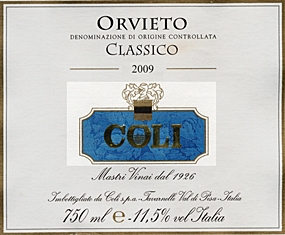
Orvieto wine (ohr-VYAY-toh) comes from the land
surrounding the medieval city of the same name, perched on a hill in the
province of Umbria. Wine has been made in this region for centuries and Orvieto,
originally a sweet wine, has been described as “liquid gold”, because it was so
frequently served at the tables of the rich and famous. So valuable were the
vineyards, that in 1600, a law was passed to inflict heavy penalties upon anyone
who damaged the vines. Today though, Orvieto is not sweet but is dry and
clean-tasting, usually blended from three or four local grape varieties.
Coli Orvieto Classico DOC, 2009 (white), Italy. (Villa and
others, Bt. 495)
The respected firm of Coli has been making wine since 1926
and today produces about 12 million bottles annually. This one is a delicate
yellow colour with the faintest greenish tinge and although dry, it has a sweet
aroma of tropical fruits and rich pineapple. There’s a firm authoritative body,
an alcohol content of 11.5% and a pleasing touch of acidity, giving it a sharp
clean flavour.
Incidentally, if the mention of “acidity” conjures up vague
images in your mind of steaming test-tubes in the school chemistry lab, fear
not, for acids occur in almost everything we eat or drink. Milk and jam are
quite high in acids; beef, pork, tea and coffee are even higher. There’s even
acid in cornflakes. Acidity is what “turbo-charges” a wine and kicks up the
flavour.
This Orvieto has a lingering spicy aftertaste and would be an
ideal partner for white meats, most kinds of fish and even some egg dishes. It’s
a DOC wine (it stands for Denominazione di Origine Controllata) but I’ll
resist the temptation to describe what that’s all about. Suffice it to say that
“DOC” basically means that the wine is made to specific standards and what you
see on the label is what you get in the bottle. The addition of the word
“Classico” means that the grapes were grown in the oldest production areas of
Orvieto and considered superior quality.
Lungarotti Pinot Grigio 2007 (white), Italy. (Villa and
others, Bt. 745)
Lungarotti is one of Umbria’s top wine producers, founded in
the 1960’s and based in the town of Torgiano. If you decide to try this wine,
open the bottle and stick it in the fridge for an hour. You’ll be rewarded by a
sweet, delicate floral and pineapple aroma. Let me just add that to appreciate
the aroma, you actually have to get your nose right into the glass (but not into
the wine) and take a few quick sniffs, like a dog. Then take some more. If you
don’t bother to smell the wine, you’re missing a huge part of the enjoyment.
The wine is a lovely straw-yellow colour; there’s a zesty,
dry taste with sweet overtones and a faint tang of citrus fruits. They’ve gone
easy on the acid too, just enough to hold the body together. It’s a pleasingly
balanced wine with 13% alcohol, so if you prefer soft whites which are not tart
and acidic, you’ll probably love this one. There’s a very long, refreshing,
almost spicy aftertaste that lingers in the mouth nearly a full minute after
swallowing the wine. That’s a really good test of high quality. Oh, I nearly
forgot to tell you; Lungarotti also make a jolly good Chardonnay.