|
Pattaya Sea-Sand-Sun Resort and
Spa appoints new resident manager
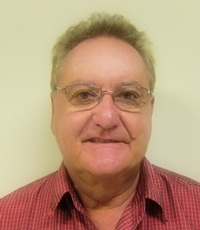
John Healey.
Nitipat Patchimnan, managing director of Pattaya
Sea-Sand-Sun Resort and Spa has announced the appointment of John Healey as
resident manager with immediate effect.
Healey is Australian national and has a bachelor degree
from the Education Institute of American Hotel and Motel, Australia and
Sydney Technical College.
He has more than 20 years of managerial experience in
hotel operations. Prior to joining Pattaya Sea-Sand-Sun Resort and Spa,
Healey was a general manager and building manager with the Mantra Group,
Australia for two years.
Richard Wallace appointed as general
manager of Rayong Marriott Resort & Spa
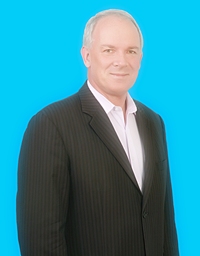
Richard Wallace.
Richard Wallace has been appointed opening general manager of
the new 206 rooms Rayong Marriott Resort and Spa.
Wallace takes on his new role with 23 years of industry
experience and hospitality expertise. He had been long associated with ANA
Hotels when they had a presence in Australia prior to joining Marriott
International. From there, his experiences in Australia has been of the GM role
and as an area director of training for Marriott accounting for some of his past
16 years with Marriott International. In Thailand, he opened the Courtyard by
Marriott Hua Hin at Cha Am Beach and his most recent assignment, the 300 room
Marriott Executive Apartments Sukhumvit Park Bangkok.
Wallace looks forward to this opportunity of putting Rayong
on to the map as an alternate destination for people who are looking for a
beachfront holiday or conference in a less chaotic environment. We wish him the
best of luck and continued success with his new posting at the new Marriott
property.
|

|
‘Thai Smile’ approved as name of THAI’s new low-cost carrier,
in operation next year
Thai Airways International’s executive board (THAI)
meeting this week approved ‘Thai Smile’ as the name of the national flag
carrier’s lost-cost airline, set to be in operation in the middle of next
year, according to airline president, Piyasvasti Amranand.
‘Thai Wings’ was previously selected but changed, as THAI
staff participated in choosing the new name.
Thai Smile will have 11 new aircraft, four of which will
be 174-seat Airbus A320s, to be received early next year.
THAI’s low cost business unit managing director, Capt
Woraneti Lahprabang, said the airline will use Suvarnabhumi Airport as its
main hub to operate flights to provinces such as Chiang Rai, Surat Thani,
Ubon Ratchathani, and Udon Thani.
The unit’s airline is expected to start making profits in
2013 of Bt5 billion on average, while it is also to consider opening
international flights and indicating routes in the same year.
Personnel for the unit will be from THAI and from THAI’s
subsidiary companies.
Meanwhile, there has been no progress regarding the
setting up of low cost ‘Thai Tiger Airways’, an earlier proposed joint
venture of THAI and Singapore’s Tiger Airways. THAI executives will consider
the matter again at a later date. (MCOT)
|
|
|
Singapore’s Cedar Holdings sells part of its Shin Corp stake
Singapore’s Cedar Holdings has sold 253.5 million shares
or about 7.9 percent of its Shin Corp shares, the Shin Corp-Thai telecom
group said in a letter to the Stock Exchange of Thailand (SET).
Sixty percent of the shares were sold to Thai investors
and 40 percent were sold to Thai NVDR Co., Ltd.

After the sale, Cedar holdings, 49 percent owned by
Singapore state-owned firm Temasek Holdings, now holds 1.488 billon shares
or 46.44 percent of Shin Corp.
Meanwhile, Aspen Holdings, which is owned by Temasek,
holds another 41.68 percent in Shin Corp, told Shin Corp that it has no plan
to sell its shares in the company at the moment and it is still confident in
the business and management of the company, the letter said.
Cedar Holdings Ltd sold 254 million Shin Corp shares at
Bt36 each, for a total worth of Bt9.1 billion.
Singapore-based Temasek Holdings, a government-related
corporation, bought Shin Corp, the family business of now fugitive
ex-premier Thaksin Shinawatra in 2006.
The telecommunications firm also owns Thaicom Pcl,
founded in 1991 with a 30-year Build-Transfer-Operate concession from
Thailand’s Ministry of Transport and Communications to operate the country’s
first communications satellite. The concession expires in 2021.
The selling of Thaicom by the Shinawatra family in
connection with the Shin Corp deal with the Singapore state-owned investment
company was one factor triggering street demonstrations by anti-Thaksin
protesters leading to the military coup in Sept 2006 that ousted Thaksin
from power. (MCOT)
|
|
|
Sukhothai and Samui Airports
win energy conservation awards
Sukhothai and Samui Airports have recently won awards at
the Thailand Energy Awards 2011 and the ASEAN Energy Awards 2011
respectively. The distinctions have been bestowed upon both airports in
recognition of their commitment to energy conservation and operation
efficiency.
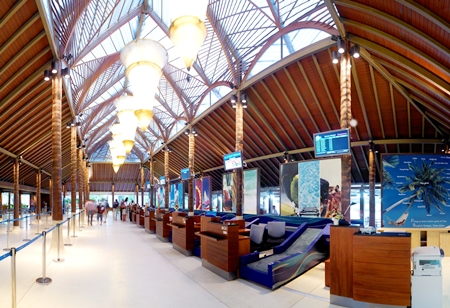
Samui Airport.
Privately-owned and operated by Bangkok Airways, both
Sukhothai Airport and Samui Airport have won several green awards in the
past. For 2011, Sukhothai Airport won the Outstanding Award in Thailand
Energy Award 2011’s Energy Conservation category; while Samui Airport also
won the 1st Runner-Up of the Energy Efficiency and Conservation Best
Practice for Energy Efficient Buildings in Tropical Building category from
the ASEAN Energy Awards 2011 organized by ASEAN Centre for Energy (ACE).
Thailand Energy Award 2011 is organized by the Department
of Alternative Energy Development and Efficiency, Ministry of Energy, with
an aim to show appreciation and recognition to those organizations who put
into practice the energy saving policy.
General Komkrich Sriyabhandha, Bangkok Airways’ vice
president of airports said, “With our decades-long expertise in running
airports, our commitment to lessen illicit impacts from the environment
issues is the priority to our airport management and operations. We’re truly
honored with these recognitions and will continue doing our best to cherish
our airports’ green concept.”
Bangkok Airways has invested in building and maintaining
its own privately-operated airports at Samui, Sukhothai, and Trat. These
developments provide Thailand with more air transportation hubs to in order
to facilitate increasing air traffic volume. For more information, please
visit www.bangkokair.com
|
|
|
|