Morning Fix
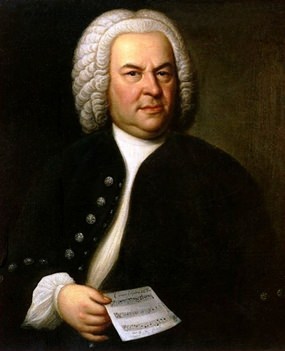
Haussmann’s portrait of Bach aged 61
As a young teenager, I
invariably used to listen to Bach’s music first thing in the morning before
going to school. A fix of Johann Sebastian would give me enough firmness of
spirit to deal with the dramas of school life which would inevitably unfold
during the course of the day. I suppose nowadays, this kind of behaviour would
be considered a bit nerdish, if not downright peculiar. But at the time, any of
the six Brandenburg Concertos, seemed an ideal way to kick off the
morning.
These are not concertos in
the sense that a single instrument is pitted against an entire orchestra, but
they’re a rather older form known as the concerto grosso or grand
concerto. The original title was Six Concerts à Plusieurs Instruments
which in 1721, Bach presented to Christian Ludwig, the Margrave of
Brandenburg-Schwedt. At about this time, the composer was job-hunting, and he
sent the concertos to the Margrave as an elaborate form of job application,
together with a groveling and long-winded dedication of toe-curling
obsequiousness. Although they were presented as a set, the music had actually
been cobbled together from earlier works that Bach had written at various times
during the previous eight years. Even so, they represented some of the finest
examples of orchestral Baroque music.
Perhaps Christian Ludwig
had been tipped off that he’d received a recycled offering. He was evidently a
bit miffed because – as far as we know – he didn’t bother to thank Bach for the
music let alone pay him, and he never had the works performed. Bach didn’t get
the job either. The concertos were consigned to the Margrave’s library and
remained unknown until they were eventually rediscovered and published in 1850.
Various Brandenburg
Concertos have appeared on the soundtracks of films such as Cruel Intentions,
Slaughterhouse Five, The American President, A Bridge Too Far,
Running on Empty and The Island of Dr Moreau. The third concerto
was used in Die Hard, Hannibal, Lucky Break and Moll
Flanders which incidentally was based on a novel by Daniel Defoe, an English
contemporary of Bach.
Johann
Sebastian Bach (1685-1750): Brandenburg Concerto No. 3 in G.
Munich
Bach Orchestra, dir. Karl Richter (Duration: 12:49; Video 720p HD)
This concerto, which was
probably written before the others, is scored for three violins, three violas
and three cellos with harpsichord and bass part. Unusually, there is no middle
slow movement, merely two sustained chords suggesting that a middle section
might have been improvised by one of the musicians in the ensemble. The two
chords (which if these things interest you, form a Phrygian Imperfect Cadence)
lead into the rollicking dance-like third movement full of brilliant
counterpoint. At one point, the violins play the note “G” twenty-four times in
succession which in the 18th century
must have seemed a daring piece of writing.
There is very little solo
playing because the three groups of strings hold a sparkling dialogue among
themselves. Sometimes the entire ensemble plays in octaves, a dramatic effect
which Bach borrowed from Vivaldi. This performance is directed from the
keyboard, a common practice in Baroque times and in any case, with such a small
ensemble a conductor is hardly necessary. The film shows its age but the music
is as fresh as ever.
Johann
Sebastian Bach: Orchestral Suite No. 3 in D.
Amsterdam Baroque Orchestra, dir. Ton Koopman (Duration: 20:47; Video: 360p)
Bach’s prolific
contemporary Georg Philipp Telemann churned out at least 135 orchestral suites
though that’s probably only a fraction of the total. Bach wrote only four such
works, despite the fact that the orchestral suite was a popular form at the
time, consisting of an overture followed by a handful of dance movements.
Today, Bach’s third suite is best known for its slow movement, which though only
eighteen bars long is one of the most recogniseable pieces of the Baroque.
This is because in 1871
the oddly-named German violinist August Wilhelmj (pronounced vil-HEL-mi)
made an arrangement of the slow movement for violin and piano. He transposed
the key from the original D major into C major and then shifted the melody down
an octave. All this effort made it possible to perform the piece on the lowest
string of the violin which led to the almost inevitable title, Air on the G
String. It’s been used in films such as After Hours, The Devil’s
Advocate, Runaway Bride and The Spy Who Loved Me. At
one time, almost everyone in Britain recognised it, because Jacques Loussier’s
jazz arrangement of the piece featured in a long-running series of amusing
television commercials for Hamlet cigars.
But now, I think I’ll
return to the splendid third Brandenburg Concerto, to remind me of the days when
its merry melodies used to jangle through my head as I pedalled my way to
school.