|
Economic slowdown causes
government revenue to fall short

The Ministry of Finance has announced that the economic slowdown resulted in
the state revenue falling short of the target by 8.8 percent in the 2014
fiscal year which ended September 30.
It expects economic growth will bring higher revenue next year.
Krisda Chinavicharana, director of the Fiscal Policy Office in his capacity
as Finance Ministry spokesman, said the net revenue of the government in the
2014 fiscal year (October 2013 through September 2014) was Bt2.07 trillion,
below the projected target by Bt201.08 billion or 8.8 percent.
He explained that lower imports cut the collection of tariffs and the
import-related value-added tax.
In addition, the domestic economic slowdown limited the growth of
operational results in the private sector and thus the collected corporate
income tax was lower than expected.
Lower domestic demand for automobiles dropped revenues from the excise tax
on automobiles and oil taxes.
The extended discount on the diesel tax to relieve the public’s cost of
living caused tax revenue to fall short of its target by Bt28 billion.
However, contributions from state enterprises and other agencies exceeded
their targets.
Krisda said that the reduced state revenue resulted from the slowdowns of
the national and the global economies.
He commented that the improving national economy should increase the
government’s revenue next year. (MCOT)
|

|
BoT confident Thailand’s GDP will grow in 2015
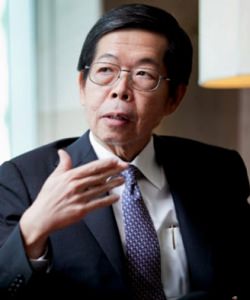
Bank of Thailand Governor Prasarn
Trairatvorakul.
Bank of Thailand (BoT) Governor Prasarn Trairatvorakul
has told foreign journalists that he is confident Thailand’s gross domestic
product (GDP) will grow next year due to its potential, according to BoT
spokesman Chirathep Senivongs Na Ayudhya.
Chirathep said Prasarn told foreign media in an interview on the sidelines
of the 2014 Joint World Bank-IMF Development Committee meeting in Washington
that Thailand’s political situation has now eased and it should help
domestic consumption return to normal.
Spending in Thailand, which had slowed earlier during the unrest, should
return to normal while the private sector should gain from government
investment, and both would assist in boosting the economy in 2015, Prasarn
was quoted as telling the international media.
In addition, the interim government is accelerating the reform of state
enterprises, local energy prices and shoring up agricultural products
without government subsidies, Prasarn said.
These measures should help strengthen the country’s competitiveness, he
said.
On worries by foreigners regarding foreign direct investment in Thailand,
Prasarn told the international media that projects seeking promotional
privileges from the Board of Investment had risen noticeably.
These are significant projects such as investment in manufacturing eco cars,
food processing and alternative energy. (MCOT)
|
|
Privilege-seeking investors reach record high in September
Investors seeking promotional privileges from the Board of Investment (BoI)
in September stood at 158 projects with combined value Bt176.3 billion,
highest in terms of number of projects and value since the beginning of
2014, according to BoI Secretary-General Udom Wongviwatchai.
Total investment in projects receiving BoI privileges during the first nine
months this year reached Bt592 billion baht.
Udom said signs of investment in Thailand have been positive, which could be
seen from the sharp increase in the number of projects and value seeking
promotional privileges in September.
September’s sharp increase was attributed to investors applying for five
electricity generation projects using natural gas with combined value of
Bt135 billion, he said.
It shows that investors are keen to invest in energy, a BoI industry target
and it also shows that investors have regained confidence in the country,
said Udom.
If positive investment directions continue, it is projected that value of
investment seeking privileges in Thailand this year may exceed the target at
Bt700 billion, he added. (MCOT)
|
|
BoT urges private sector to use yuan trade, investment in China
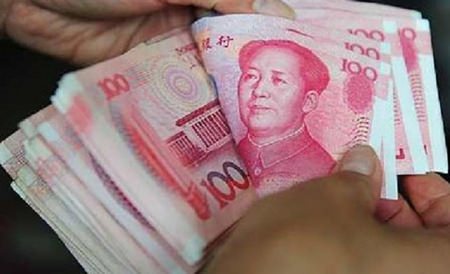
The Bank of Thailand (BoT) is encouraging Thai operators to use China’s yuan
currency for their trade and investment with China to cope with foreign
exchange risks.
It also recommended Hong Kong as a major yuan market.
Opening the Hong Kong-Thailand Renminbi Business Forum that BoT and the Hong
Kong Monetary Authority organized, Chantavarn Sucharitakul, BoT assistant
governor for the Financial Markets Operations Group, said the yuan was
playing more important roles and that Thai operators should use it as a tool
to manage their foreign exchange risks.
She also said that Hong Kong was the biggest yuan market and provides a wide
range of yuan-related services.
Vachira Arromdee, BoT’s senior director for the Financial Markets
Department, said Thai operators rarely use yuan to pay for products and
services as the proportion was less than 1 per cent.
However, she said that the use was likely to grow along with increasing
trade between Thailand and China.
Vincent Lee, executive director of the Hong Kong Monetary Authority, said it
is a good time to promote the yuan because trade between Thailand and China
is expanding steadily and many Chinese business operators have offices in
Thailand and elsewhere in Southeast Asia.
He said that the formation of the ASEAN Economic Community in 2015 would
further boost the value of trade between Thailand and China and between
ASEAN and China. (MCOT)
|
|
Consumer confidence index
rises for 4th straight month
Thailand’s Consumer Confidence Index increased in September for the fourth
consecutive month and peaked for 9 years and 7 months (115 months),
according to a survey by the Commerce Ministry.
Amparwon Pichalai, commercial advisor and acting deputy permanent secretary
for commerce, said the survey of 3,167 people nationwide found that last
month’s Consumer Confidence Index stood at 45.8, up from 44.9 the previous
month.
Respondents were asked about their economic situation, income and employment
opportunities.
The confidence index for the next three months was at 49.2, Ampawon said.
She pointed out that although the indices were climbing, they remained below
50.
This shows that people still lack confidence in the economic situation due
to the cost of living, rising unemployment, delayed tourism recovery, the
low prices of farm products, widespread flood damage, and exports negatively
affected by the global economic slowdown.
Consumer expectations for income (in the next quarter) reached a 20 month
high as its index peaked at 53.3.
Above the 50 level, the index reflects that consumers became confident of
their future incomes and expected the new government to improve the national
economy. (MCOT)
|
|
|