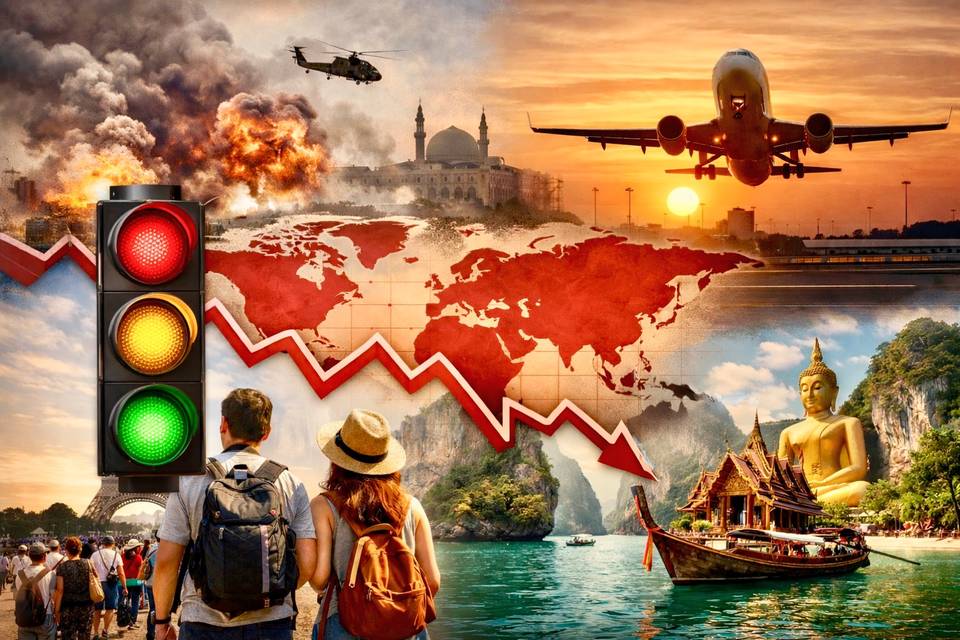
Conflict fears rise as diplomacy stalls, sending shockwaves through travel, aviation and confidence worldwide
BANGKOK, Thailand – April 13, 2026 – The collapse of high-stakes peace talks in Islamabad has sent a chill through global markets, but its deeper and more enduring impact may be felt across the travel and tourism sector. What happens next is no longer solely a geopolitical question — it is a tourism question.
Negotiations in Islamabad, aimed at easing tensions linked to the Middle East conflict, were fragile from the outset. Analysts had warned that Pakistan lacked the leverage to guarantee outcomes, with external pressures capable of derailing progress at any moment. With talks now faltering, the world enters a renewed phase of uncertainty. For tourism — an industry built on confidence, predictability and perceptions of safety — the implications are immediate and far-reaching.
Expert Warnings Signal Broader Risk
Respected geopolitical analysts have been consistent in their caution. Muhammad Faisal noted that Pakistan had invested significant political capital in mediation efforts, warning that failure risks undermining broader regional stability. Elizabeth Threlkeld described the negotiations as taking place in a “high-risk environment,” vulnerable to forces beyond national control. Meanwhile, Kamran Bokhari stressed that continued tensions could exacerbate instability across already fragile regions. The consensus is clear: this is not an isolated diplomatic setback, but a potential trigger point — and tourism is often among the first sectors to feel the impact.
Global Tourism: Confidence Under Pressure
The immediate effect is psychological. Tourism reacts as much to perception as to reality. Even limited regional instability can reshape traveller behaviour worldwide. Airspace concerns across the Middle East are raising the likelihood of longer flight routes, increased fuel consumption and schedule disruptions. Rising oil prices are already feeding into airline operating costs, placing upward pressure on ticket prices. In previous crises, long-haul travel demand typically softens first, followed by a shift toward shorter, more familiar destinations perceived as safer. Early indicators suggest similar patterns may already be emerging across parts of Asia.
Asia Watches Closely
Asia sits at a crossroads of risk and opportunity. Instability in the Middle East may redirect travellers toward Southeast Asia. However, higher travel costs and broader economic uncertainty could suppress overall demand. Travel patterns are increasingly sensitive to geopolitical flashpoints, with travellers reacting faster than ever to perceived risk. Should tensions escalate, airlines may reroute flights, insurance costs could rise, and tour operators may rapidly adjust itineraries. The duration of the crisis remains the critical variable. Short disruptions can be absorbed. Prolonged instability presents a far greater challenge.
Thailand: Resilient but Not Immune
Thailand remains one of the world’s most resilient tourism destinations, though not without exposure. Its strength lies in diversification — a robust domestic market, strong regional flows and a loyal base of repeat international visitors. The country’s long-standing reputation as a welcoming and culturally rich destination reinforces traveller confidence, particularly during periods of global uncertainty.
Rooted in a tradition of calm and hospitality, Thailand continues to position itself as a stable alternative when global tensions rise. However, vulnerabilities persist. Higher oil prices could dampen long-haul arrivals from Europe and North America, while economic pressures in key markets may curb discretionary travel spending. At the same time, Thailand may benefit from displacement effects, as travellers shift away from perceived risk zones toward safer destinations. The key question is not whether Thailand will be affected — but to what extent.
Three Scenarios: Red, Yellow, Green
To frame the outlook, three potential scenarios emerge:
🟥 Red — Escalation
Conflict intensifies, oil prices surge and airspace disruptions expand.
Impact: Long-haul travel declines sharply, airline capacity tightens, and global demand weakens. Thailand may see limited gains from diverted traffic but faces overall softness.
🟨 Yellow — Prolonged Uncertainty
Tensions persist without resolution.
Impact: Travellers delay decisions, demand shifts to regional trips, and price sensitivity increases. Thailand benefits moderately as a perceived safe haven.
🟩 Green — Return to Diplomacy
Diplomatic channels reopen and stabilisation begins.
Impact: Confidence rebounds, pent-up demand returns, and global travel recovers strongly. Thailand gains from both recovery and its strategic positioning.
Where This Leaves Tourism
Tourism reflects the mood of the world.The failure of peace talks in Pakistan is more than a diplomatic development — it is a signal that uncertainty is rising and confidence remains fragile. For Thailand, the strategy is clear: remain stable, visible and prepared. Because in times of uncertainty, travellers do not stop travelling — they simply choose more carefully where they go.
 AUTHOR BIO
Andrew J. Wood is a British-born travel writer and former hotelier who has lived in Thailand since 1991. Originally from Yorkshire, England, he graduated in hotel management from Napier University in Edinburgh and began his career in London before taking his first international posting with Hilton International in Paris.
He relocated to Bangkok in 1991 to join the Shangri-La Hotel as Director of Marketing, marking the start of a long and distinguished career in Thailand’s tourism and hospitality sector. Over the years, he has held senior leadership roles with prominent hotel groups including Thistle Hotels, Shangri-La Hotels and Resorts, and Minor Hotels, as well as the Landmark Lancaster Hotel Group and the Royal Garden Resort Group, now operating as Anantara under Minor Hotels. He later served as Vice President before moving into General Manager positions with the Royal Cliff Hotels Group in Pattaya and the Chaophya Park Hotel Bangkok and Resorts.

A long-standing member of Skål International, Andrew has served as a Director at global level and held presidential roles across multiple tiers of the organisation. He is a former President of Skål Asia, National President of Skål Thailand, and a two-time President of Skål International Bangkok.
In recognition of his contributions to global tourism and the Skål movement, he has been awarded Skål’s Order of Merit and the President’s Award. In 2019, he received the organisation’s highest honour, Membre d’Honneur.
Andrew writes extensively on tourism and hospitality trends across Asia and is a regular guest lecturer at universities throughout the region.