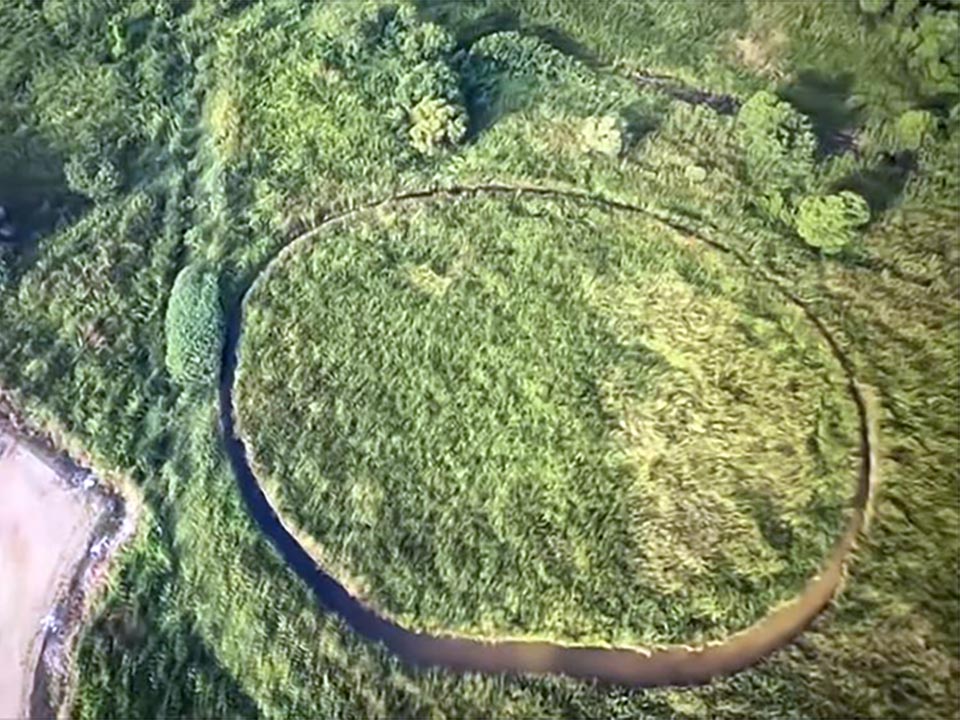
BANGKOK, Thailand —A striking circular island formation hidden within the wetlands of central Thailand has drawn national attention after aerial footage revealed a near-perfect ring-shaped landscape resembling a giant eye. The site, now widely referred to as “The Eye of Thailand,” is located in Pathum Thani near the banks of the Chao Phraya River. The discovery was first publicized by Assoc. Prof. Dr. Prinya Thewanaruemitkul, who shared aerial photographs and drone footage showing the unusual formation. The structure appears as a circular wetland island surrounded by a narrow water channel, creating a striking “eye-like” shape when viewed from above.
Dr. Prinya stated that close-range inspection and aerial analysis show no evidence of human construction. A GoPro camera mounted on a paramotor pilot’s helmet captured low-altitude footage over the site, revealing dense wetland vegetation—mainly reeds and aquatic grasses—without signs of excavation, infrastructure, or artificial shaping.
Based on these observations, he suggested the formation is a natural phenomenon, likely a floating wetland ecosystem that developed after the severe flooding event in Thailand in 2011.
According to his hypothesis, the wetland mass may have gradually detached and begun floating, slowly rotating with seasonal water flow. Over time, continuous movement and friction against surrounding banks may have naturally sculpted the island into an almost perfectly circular shape.
He compared the phenomenon to “El Ojo,” a well-known circular floating island in Argentina, which has also been described as a rotating wetland system shaped by hydrodynamic forces.
The site shows no visible evidence of agricultural use, construction, or dredging. Instead, it appears to be composed entirely of naturally growing wetland plants, reinforcing the theory that this is an organically formed ecological system rather than a man-made structure or excavation.
Concerned about rapid industrial expansion and urban development in the surrounding area, Dr. Prinya has urged authorities to act quickly to protect the site before it is altered or lost.
He has reportedly shared the findings with local officials, including the Chairman of the Pathum Thani Provincial Administrative Organization, Lt. Gen. Kamronwit Thoopkrachang, and plans to coordinate further with local subdistrict authorities responsible for the land.
The formation is now being discussed online as a potential “Unseen Thailand” destination, with interest growing in its ecological and geological significance. Experts say further study is needed to confirm its long-term stability and understand the exact mechanisms behind its unusual geometry.
For now, “The Eye of Thailand” remains both a scientific curiosity and a fragile natural wonder—one that could disappear as quickly as it was discovered if not properly protected.