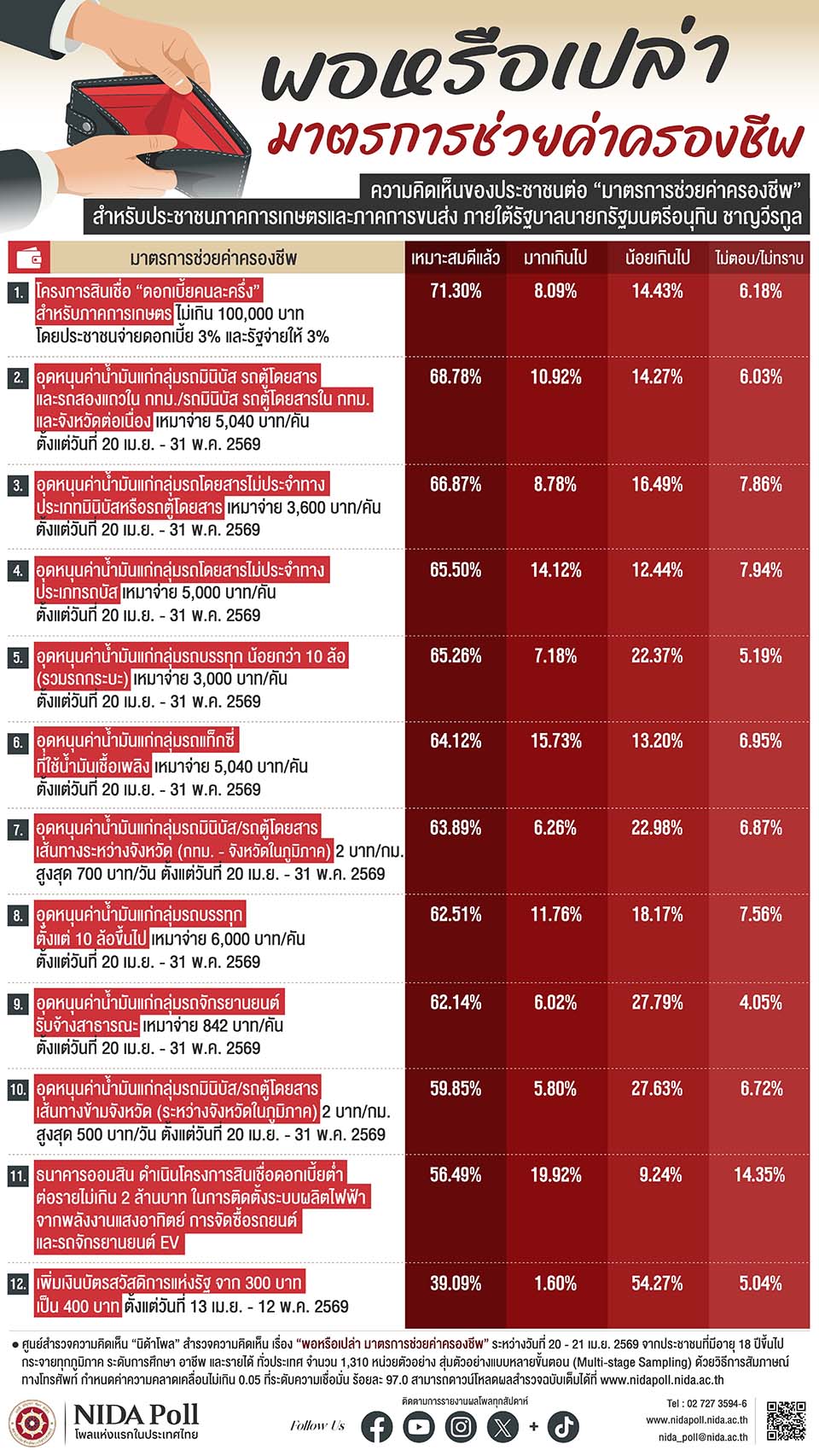
BANGKOK, Thailand – A comprehensive nationwide survey by NIDA Poll reveals that while the majority of Thais approve of the government’s cost-of-living relief measures, dissatisfaction remains over direct cash support, particularly the increase in the state welfare card allowance.
The poll, conducted by the National Institute of Development Administration on April 20–21, surveyed 1,310 respondents aged 18 and above from across all regions, income levels, and occupations. It assessed public opinion on economic relief policies introduced under Prime Minister Anutin Charnvirakul, with a strong focus on agricultural and transport sector support.
Strong Approval for Credit Access in Agriculture
The most positively received measure was the agricultural soft loan scheme offering a shared interest burden:
Loans up to 100,000 baht
Interest split equally: 3% paid by borrowers, 3% subsidized by the state
71.30% of respondents said this measure is appropriate, reflecting strong support for easing financial pressure on farmers through affordable credit access. Only 14.43% said it was insufficient, while 8.09% felt it was excessive.
Transport Fuel Subsidies Widely Seen as “Appropriate”
A wide range of fuel subsidy programs targeting public and commercial transport operators also received consistent approval ratings above 60%, suggesting broad public agreement with efforts to control logistics and travel costs.
Key results include:
Minibuses and passenger vans (Bangkok & surrounding provinces):
5,040 baht per vehicle → 68.78% appropriate
Non-fixed route minibuses/vans:
3,600 baht per vehicle → 66.87% appropriate
Non-fixed route buses:
5,000 baht per vehicle → 65.50% appropriate
Small trucks (under 10 wheels, including pickups):
3,000 baht per vehicle → 65.26% appropriate
Fuel-based taxis:
5,040 baht per vehicle → 64.12% appropriate
Interprovincial vans (Bangkok to regions):
2 baht/km (max 700 baht/day) → 63.89% appropriate
Large trucks (10 wheels or more):
6,000 baht per vehicle → 62.51% appropriate
Motorcycle taxis:
842 baht per vehicle → 62.14% appropriate
Interprovincial vans (regional routes):
2 baht/km (max 500 baht/day) → 59.85% appropriate
While most respondents supported these measures, a recurring secondary trend was that many still felt the subsidies were “too low,” particularly among motorcycle taxi drivers (27.79%) and regional van operators (27.63%), indicating cost pressures remain significant.
Mixed Views on Green Loans and EV Incentives
A separate measure by the Government Savings Bank offering low-interest loans (up to 2 million baht) for:
Solar power installation
Electric vehicles (EVs)
received more mixed feedback:
56.49% said appropriate
19.92% said too high
9.24% said too low
This suggests moderate support, but also signals that such policies may be seen as less directly impactful for lower-income groups compared to immediate subsidies.
Welfare Card Increase Emerges as Key Weak Point
The most critical finding centers on the increase in the state welfare card benefit:
Raised from 300 baht to 400 baht (April 13 – May 12, 2026)
Public response:
54.27% said the increase is too low
39.09% said it is appropriate
Only 1.60% said it is too high
This makes it the only measure in the survey where a majority expressed dissatisfaction, highlighting a gap between policy design and the real financial strain faced by vulnerable populations.
Interpretation: Structural Approval, But Pressure at the Bottom
The poll paints a clear pattern:
Targeted economic measures (fuel subsidies, loans) are broadly accepted
Direct cash assistance is where expectations are not being met
While transport and agricultural support may help stabilize prices and reduce systemic costs, respondents appear to be signaling that household-level relief—especially for low-income groups—remains insufficient.
A Subtle Warning for Policymakers
The findings suggest that while the government under Anutin Charnvirakul has managed to maintain public approval across multiple sectors, the pressure of rising living costs is still being felt most acutely at the individual level.
In simple terms:
People accept the structure of the support—but for many, especially welfare recipients, the money still doesn’t stretch far enough.