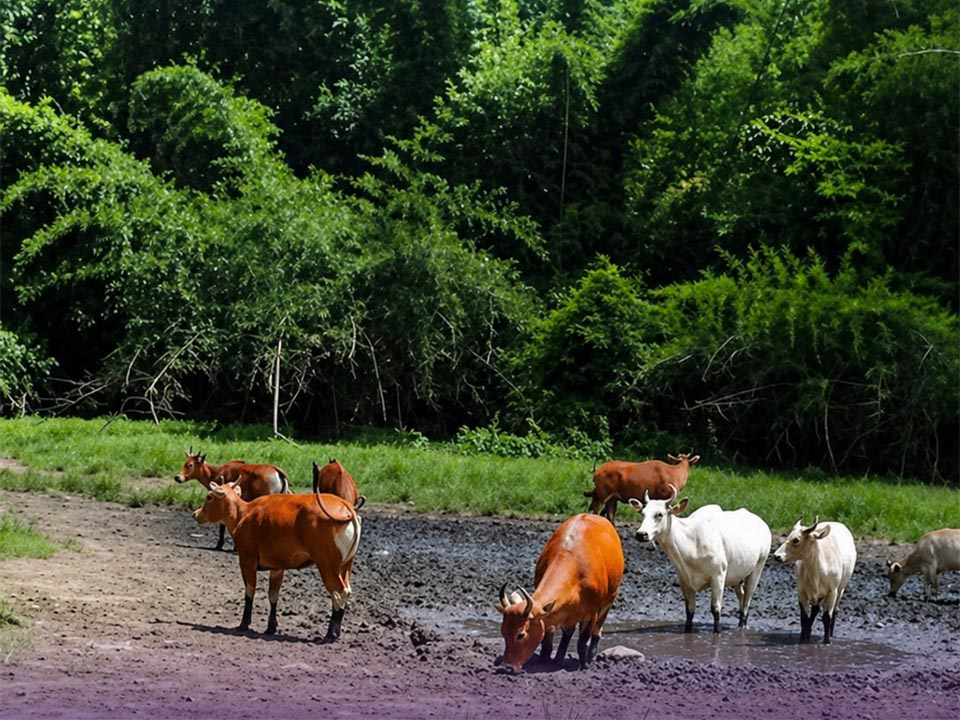
UTHAI THANI, Thailand – The Department of National Parks has reported the discovery of several unusually white-colored banteng in the Huai Kha Khaeng Wildlife Sanctuary, clarifying that the phenomenon is a genetic condition rather than a sign of ecological abundance. The animals were observed near the Huai Mae Dee Ranger Station, attracting public attention for their distinctive appearance.
Researchers have identified the condition as leucism, not albinism. Leucism results from defects in pigment-producing cells, leading to partial or full whitening of the coat while the eyes retain normal color. In contrast, albinism involves a complete absence of melanin, typically resulting in white fur, pink skin, and reddish eyes.
Scientists say leucism is caused by genetic mutations that affect pigment cell distribution during early development. The trait is often linked to recessive genes and appears only when inherited from both parents. The presence of several animals with similar characteristics within a single group may indicate inbreeding within a small population, allowing such traits to become visible.
Officials plan to monitor the group and work with research institutions to analyze genetic samples, such as hair or fecal samples. The findings are expected to provide insight into genetic diversity within the population and support long-term conservation planning, as the appearance of leucistic banteng presents both a rare biological occurrence and a potential concern for wildlife management.
Huai Kha Khaeng Wildlife Sanctuary is a 6,427 square kilometers UNESCO World Heritage site across Uthai Thani, Kanchanaburi, and Tak provinces in Thailand. Established in 1972, it is a crucial, remote conservation area known for harboring the “Big 7” wildlife species, including tigers, elephants, and leopards. It offers restricted eco-tourism, primarily in the dry season. (NNT)