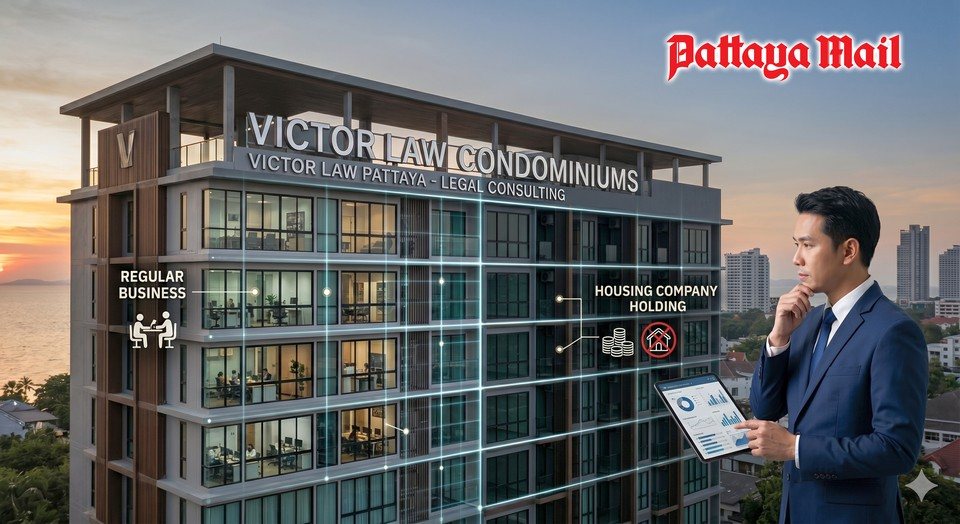
PATTAYA, Thailand – The nominee issue, or the use of Thai nationals as proxies to disguise foreign ownership of real estate, has been a chronic problem weakening Thailand’s economic stability for a long time. Especially nowadays, the government has elevated this issue to a national agenda through a memorandum of understanding signed by 23 state agencies on April 29, 2026, alongside strict financial tracking measures by the Department of Business Development, which mandate the investigation of actual control.
However, the issue of establishing limited companies with 51 percent Thai shareholding and 49 percent foreign shareholding for the hidden purpose of purchasing houses and condominiums for residential use or speculation, without running a real business, remains a loophole that traditional laws cannot keep up with. As legal professionals operating closely with foreign investments and properties in Pattaya, Victor Law Pattaya believes it is time for Thailand to introduce a specific legal concept called the Housing Company Law to separate genuine businesses from companies set up solely to conceal real estate ownership.
Global models regulating housing companies
Globally, several countries strictly regulate property purchases through corporate entities to prevent them from being used as vehicles for law evasion, each adopting different approaches.
One: The Singapore model – High taxation deterrence
Singapore strictly regulates property purchases through corporate entities by levying an exceptionally high additional buyer’s stamp duty on corporate purchases at 65 percent. This completely destroys the incentive to open a company just to buy a home, unless it is an authorized real estate development company.
Two: The New Zealand model – Blocking foreign corporations
New Zealand bans foreigners from buying second-hand homes entirely. To prevent corporate fronting, the law dictates that if any company has foreign shareholding or control exceeding 25 percent, it is immediately classified as an overseas person. Purchasing residential land then requires approval from the Overseas Investment Office, which is exceptionally difficult to obtain.
Three: The Hong Kong model – Buyer’s stamp duty suppression
Hong Kong previously faced issues with foreign investment groups establishing local shell companies to buy up apartments. The government responded by levying an additional buyer’s stamp duty on all corporate entities, including local ones, at a high rate to prevent individuals from using corporate guises to conceal property ownership for speculation.
Designing the blueprint: A housing company law framework for Thailand
If Thailand is to enact a new law to close this loophole, Victor Law Pattaya proposes that the legal framework should include the following core pillars.
One: Corporate classification and definition
The law must clearly distinguish between companies conducting actual commerce and asset-holding companies. A Housing Company should be defined as a limited company where over 70 percent of its total assets consist of residential real estate and it lacks tangible commercial or service revenue, earning only rental income or none at all. Such companies must be registered under a special category with the Department of Business Development.
Two: Actual control and ultimate beneficial owner measures
The regulatory focus must shift from checking the mere 51 percent Thai shareholding ratio to verifying actual control and ultimate beneficial ownership. If it is discovered that the Thai shareholders lack clear sources of funds, following the Department of Business Development guidelines, or if side letters exist transferring voting rights or dividends to foreign parties, the company must be deemed a de facto foreign entity and stripped of its land ownership rights under the Land Code.
Three: Tax incentives elimination
If foreign individuals choose to use companies to hold residential properties, the government must raise holding taxes higher than individual ownership. This includes charging progressive corporate property transfer taxes and stamp duties at 15 to 20 percent if the entity qualifies as a foreign co-owned Housing Company. Annual property taxes should also be set at a special rate for Housing Companies to increase holding costs until using a company to evade the law becomes financially unviable.
Four: Legal alternatives and transparent transition
The new law should not only focus on enforcement but must also provide a clear path for foreign investors who wish to reside in Thailand transparently. For instance, promoting a shift from nominee structures to legitimate 30-year leaseholds, which the government could consider extending to 50 years to boost confidence. Alternatively, investors can utilize the Long-Term Resident Visa program linked to real estate investments of US$250,000 to US$500,000 under Board of Investment regulations, which offers an official and secure residency path compared to setting up a front company.
The Housing Company legal concept targets the root cause of the property nominee issue by moving away from case-by-case company investigations, which exhaust state resources, toward an automated screening system driven by legal and tax mechanisms.
In the view of Victor Law Pattaya, when establishing a company to buy a home carries higher costs and more severe legal risks than leasing or using state-sanctioned investment pathways, the nominee issue in Thailand’s real estate sector will sustainably decline, thereby restoring fairness to the Thai housing market for its citizens.