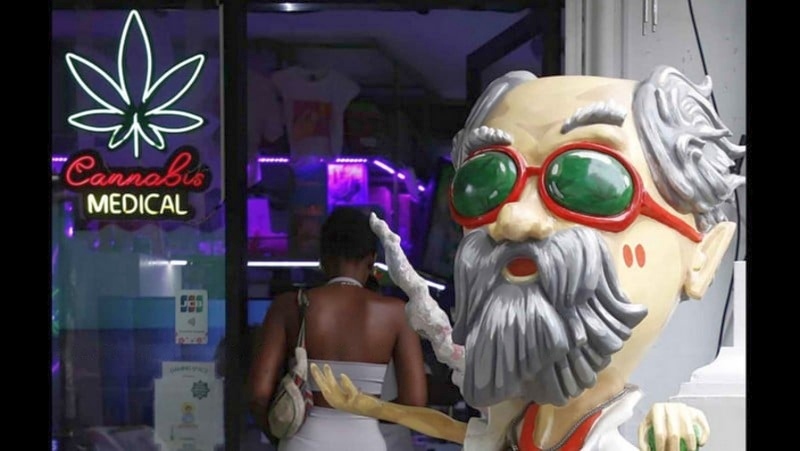
The Department of Thai Traditional and Alternative Medicine hosted a press conference on September 1 to fill in some of the missing detail from an earlier announcement last June. There must be no more casual buying of cannabis at dispensaries and absolutely no lighting up in public. Patients must be suffering from a specific medical condition, chosen from a shortlist of five: insomnia, chronic pain, migraine, Parkinson’s disease and anorexia. These are conveniently vague and subjective categories according to many observers.
A prescription, limited to 30 days but renewable, must be obtained from a licensed doctor or pharmacist and the buds must be bought at a licensed shop which has bought its stock from certified farms. Online selling, promotional advertising and vending machines are all now taboo. Weed cafes, hemp spas and massage parlors with a concluding kick are all out of bounds. Localities which include a hospital, school or a temple must not house businesses selling pot.
The entire system will be monitored by the Cannamed Connect Platform, a telemedicine data base to include every source-farm and licensed shop as well as all prescription forms and users. Government spokesman and Department head Dr Somlern Jeungsmarn did not elaborate on default penalty or punishment, but said that the data base would be a strong deterrent to abuse.
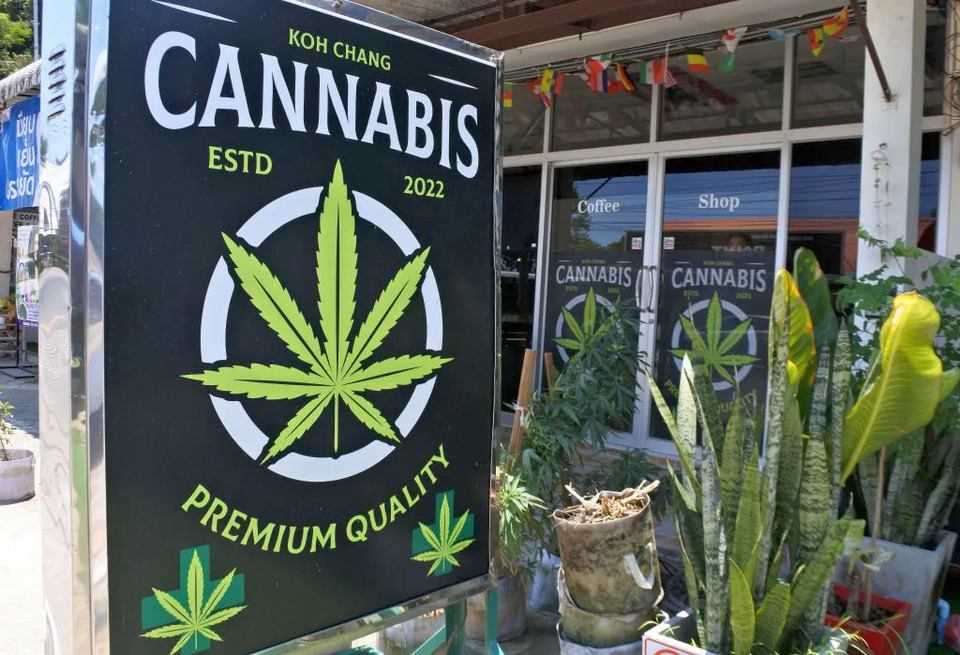
Cannabis was decriminalized in Thailand in 2022, but there was no legislative followup which has resulted in confusion ever since. A long-promised parliamentary act is still awaited. So it is currently not an offence to be in possession of cannabis which remains a controlled herb and absolutely not an illegal narcotic. Whether existing retail cannabis outlets will now implement the new system, or close down, or carry on regardless, will likely depend on local police forces up and down the country.
Since 2022, police spokespersons have often said that they are waiting for parliament to reclassify cannabis as an outlaw narcotic and that monitoring of the controlled herb is the responsibility of the Department of Health’s inspectorate which happens to be very short of officers. In cities such as Bangkok, Phuket and Pattaya a few cannabis businesses have closed, but most owners have adopted a wait and see approach as regards enforcement. None the less, they have toned down their publicity and some have changed their name from enticing titles such as The Stoned High to more salubrious alternatives such as Genuine Medical Clinic.
Meanwhile, there has been an upsurge in the number of cannabis mules taking suitcases full of quality cannabis through Thai airports. If stopped, they are usually fined for not having an export licence and their contraband is impounded. If found out in other countries, their fate varies enormously according to national rules. A hoard of 30 kgs of cannabis could risk a death sentence in some jurisdictions or a modest fine in others. The situation is unlikely to change unless and until Thai law recriminalizes the drug.