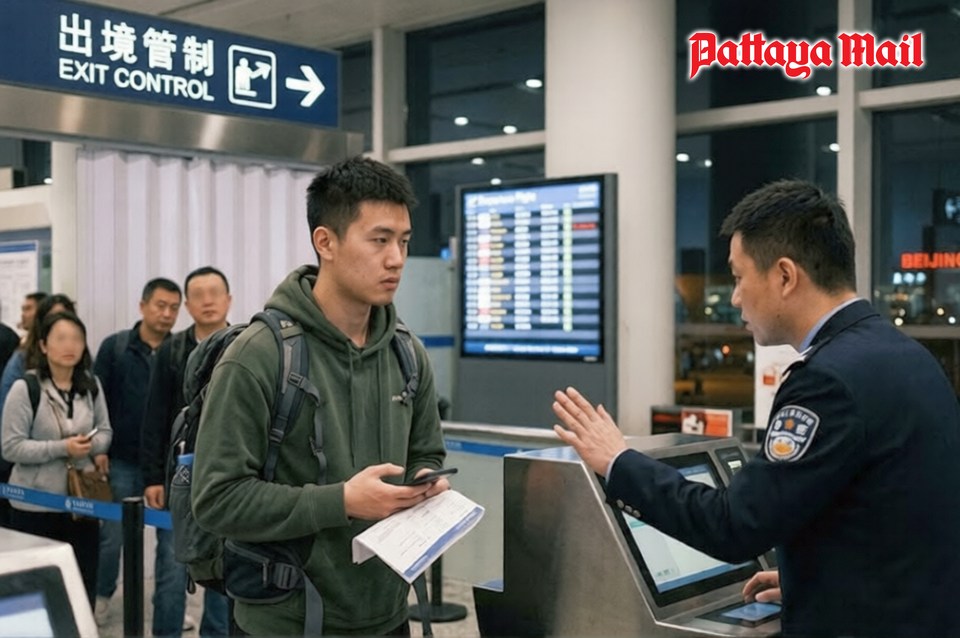
PATTAYA, Thailand – The global artificial intelligence race has entered a critical regulatory phase. In May 2026, reports confirmed that the Chinese government expanded its exit ban protocols to target top tier AI researchers, founders, and executives within the private sector. Historically reserved for state employees or military personnel, this policy shift redefines advanced computing talent as a vital state asset.
The legal framework and enforcement mechanisms
The restriction of private sector AI personnel relies on an integrated national security apparatus. Rather than deploying standard labor laws, Beijing utilizes a triad of comprehensive legislation to authorize interventions.
The national security law
Enacted in 2015, this statute governs economic and technological sovereignty. Under recent expansions, high capacity artificial intelligence algorithms and massive localized datasets are classified as core security interests, legally binding private personnel to state protection protocols.
The export control law
Passed in 2020, this law treats sophisticated source code and large language model architectures as dual use items equivalent to military technology. Consequently, engineers who manage these frameworks are treated as de facto custodians of state secrets.
The exit ban provisions
Amended immigration codes grant the Ministry of State Security the power to place individuals on travel blacklists directly within border control systems. This administrative measure requires no formal criminal charges and can be executed instantaneously at international transit hubs.
Quantitative thresholds and targeted criteria
The regulatory administration does not monitor all technology employees. Instead, the Cyberspace Administration of China utilizes specific operational metrics to identify individuals subject to travel screening.
Compute infrastructure threshold
Regulatory scrutiny triggers when a lead engineer or researcher manages a computing cluster that exceeds $10^{26}$ floating point operations. This compute volume represents the infrastructure required to train next generation foundation models utilizing thousands of advanced graphic processing units.
Venture capital funding scale
The travel screening framework applies to founders, equity partners, and chief scientists representing startups that have progressed past Series B financing or maintain an estimated corporate valuation exceeding five hundred million US dollars.
Passport custody metrics
Senior developers working within sensitive model architectures are subject to internal corporate custody policies. Human resource departments are directed to hold personal passports, which are only returned upon local government validation and verified corporate necessity.
Timeline of regulatory escalation
The implementation of these restrictions followed a structured timeline alongside the rapid evolution of China’s artificial intelligence capabilities.
In March 2025, the Ministry of Industry and Information Technology issued internal guidance to the boards of major technology firms including Alibaba, Tencent, and Baidu. The directives recommended limiting international travel for top tier research teams to Western academic conferences to mitigate intellectual poaching.
By July 2025, following the international success of open source architectures from emerging entities like DeepSeek, the passport custody mandate expanded. Core architecture teams in private startups were integrated into the passport retention framework previously reserved for public officials.
In March 2026, the policy manifested in a high profile administrative intervention. The co founder and chief scientist of Manus, a prominent AI startup, faced an immediate travel suspension. The Ministry of State Security initiated the freeze during an official investigation into a proposed two billion US dollar acquisition offer by Meta, preventing the immediate cross border transfer of intellectual property and core personnel.
Structural market and ecosystem impacts
This regulatory enforcement creates significant structural adjustments across the international technology ecosystem.
Global venture capital firms have adopted a highly cautious investment strategy regarding Chinese AI startups. Investors face heightened liquidity risks since startup founders cannot participate in international roadshows or execute cross border mergers and acquisitions as exit strategies.
The policy accelerates global technological decoupling. Chinese researchers are reducing their physical presence at major international conventions such as NeurIPS and ICML, which limits reciprocal academic exchanges and creates isolated development tracks.
Private technology firms are shifting corporate strategies inward. Barred from seamless global expansion, companies are optimizing their models to serve domestic demand, working closely with municipal governments and state owned enterprises.
In the current geopolitical climate, the Chinese government views artificial intelligence as a paramount sovereign foundation rather than a commercial product. As the technological competition intensifies, advanced computing specialists are regulated with the same strategic density applied to nuclear scientists in previous generations.