A Special Analysis by Victor Law Pattaya, The professional international lawyer
PATTAYA, Thailand – The historic three-day summit between President Xi Jinping of the People’s Republic of China and President Donald Trump of the United States, held from May 13 to 15, 2026, has been widely analyzed through a purely transactional lens of trade deficits and manufacturing quotas. A comprehensive examination of the diplomatic discourse, particularly the private engagements within the gardens of Zhongnanhai, reveals a much more profound philosophical dichotomy with critical implications for international commercial and legal strategy.
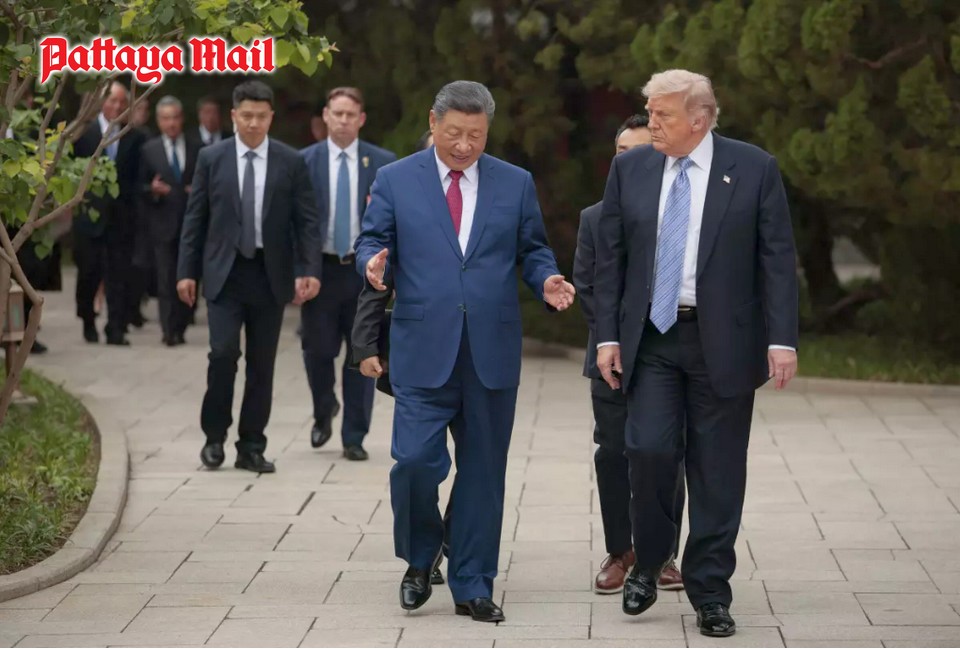
It was within this specific, secluded setting on the afternoon of May 15, following intense official deliberations that a critical philosophical exchange occurred. In an exceptional diplomatic gesture, President Xi Jinping guided President Trump through the intricate pathways and historical installations of the imperial garden complex, using the environment itself to illustrate fundamental concepts of national and corporate strategy.
This encounter, which involved a pointed metaphorical comparison between a rigid, uncompromising pine and a flexible, enduring bamboo, should be viewed by the international business community not as mere rhetoric, but as a framework for understanding global trade compliance, regulatory maneuvering, and long-term legal sustainability.
This diplomatic maneuver by President Xi was significantly preceded by his formal opening remarks on May 14 at the Great Hall of the People, where he directly addressed the geopolitical tensions by referencing ancient Greek intellectual history. He explicitly invoked the profound concept of Thucydides’s Trap, a foundational tenet of international relations theory describing the dangerous instability when a rising power challenges an established one, and pointedly asked if both nations could transcend this ancient, seemingly inevitable paradigm to establish a cooperative global architecture based on partnership rather than rivalry.
President Trump responded in his characteristic bilateral transactional manner, praising the personal connection and emphasizing a specific deal structure involving substantial agricultural and industrial purchases by China in exchange for significant tariff relief, thereby demonstrating a fundamental preference for Immediate, quantifiable outcomes over long-term structural alignment.
It is critical to analyze how these divergent approaches, illustrated in the garden and at the negotiating table, impact international law and corporate governance. Many corporate structures, analogous to the pine tree or the transactional style of the Trump administration, prioritize unwavering rigidity in negotiations and market positioning, mistaking inflexibility for strength. Victor Law Pattaya emphasizes that this operational model introduces severe risks when exposed to sudden, significant shifts in trade regulations, geopolitical tariffs, or regional conflicts.
The failure of numerous entities to adapt to localized data protection laws, such as Thailand’s Personal Data Protection Act (PDPA), or to the re-imposition of US export controls on advanced technologies, underscores the inherent vulnerability of this rigid model. In direct contrast, the bamboo metaphor represents a superior paradigm of resilience based on strategic flexibility and systemic endurance.
This model does not advocate for structural weakness but rather for a highly responsive adaptability where an enterprise possesses a robust, interwoven root system of legal compliance that remains deeply anchored while its operational and logistical elements adjust to the prevailing geopolitical winds.
This bamboo philosophy of strategic flexibility relies fundamentally on a robust compliance foundation, as a resilient enterprise must be firmly rooted in established international legal norms. Victor Law Pattaya counsels its transnational clients that compliance is not an optional expense but the very bedrock of the corporate root system.
A successful transnational enterprise must establish a multi-layered legal infrastructure that addresses cross-border tax compliance, anti-money laundering protocols (AML), and sophisticated international arbitration clauses, particularly as regulatory environments in jurisdictions like Thailand and Greater Southeast Asia become increasingly aligned with international standards. Without this comprehensive legal foundation, any attempt at business model pivot during a geopolitical crisis will likely result in a disastrous legal collapse.
The summit in Beijing, through its blend of private garden philosophy and hard economic bargaining, provides an indelible lesson for modern corporate leadership. The organizations that will achieve sustained profitability and market relevance in this inherently volatile century are not those that attempt to stubbornly resist the inevitable currents of geopolitical and technological change.
Rather, enduring success belongs to those enterprises that leverage sophisticated legal and strategic counsel to cultivate operational flexibility, thereby ensuring they can adjust their commercial strategies with the same resilience as the bamboo while remaining perpetually anchored in a compliant and robust legal framework.