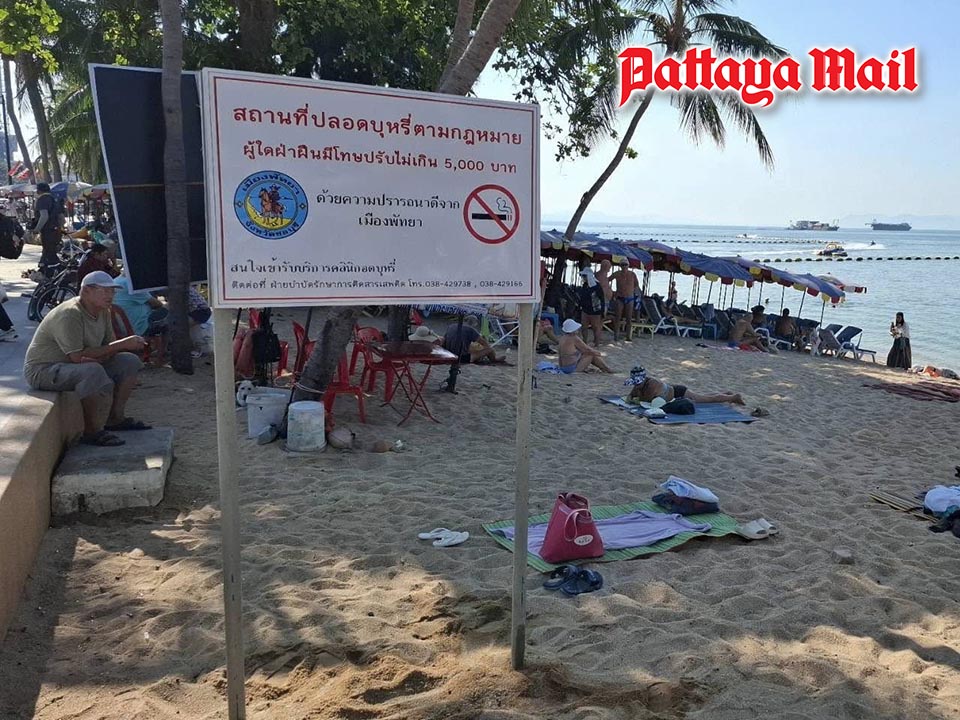
PATTAYA, Thailand – Pattaya’s long-standing “smoke-free beaches” policy is once again under scrutiny, as resident and reader reactions reveal growing frustration not just with smoking itself, but with what many see as selective enforcement and misplaced priorities.
While some commenters welcomed the idea of cleaner, healthier beaches, many argued that the policy exists largely on paper. Calls to “stop the stinking dope smokers” and ban smoking outright were quickly countered by others who questioned whether any rules are meaningfully enforced at all.
Several residents said they rarely see authorities intervening unless it involves traffic stops along Beach Road. “Is anything enforced?” one reader asked, adding that police seem far more visible pulling over helmetless tourists than addressing ongoing public nuisance issues.
Others took a more nuanced stance. Smokers themselves weighed in, saying they support designated smoking areas and basic courtesy, but oppose blanket bans. Some cited the UK experience, where indoor smoking bans pushed smokers outside and hurt certain businesses, arguing that weed smoke, not cigarettes, has become the real flashpoint.
Air quality emerged as a broader concern. With morning pollution levels reportedly so high that Koh Larn was barely visible from Pratamnak Hill, several readers questioned the logic of targeting beach smokers while ignoring vehicle emissions, open burning, construction dust, and sewage odors. “Stop the noise and fuel pollution before picking on a few smokers,” one comment read.
Others proposed practical solutions rather than outright bans, such as employing beach patrols to warn violators first and issue fines only for repeat offenses. “The patrols would pay for themselves,” one reader suggested, while another dryly asked whether there is even a Thai word for “enforcement.”
Not all comments stayed constructive. A small number veered into discriminatory or abusive territory, drawing criticism from other readers who stressed that environmental and public health policies should apply equally to everyone, regardless of nationality.
Some residents also pointed to what they see as the real source of smoke pollution: uncontrolled fires on abandoned land, roadside burning, and neglected plots filled with dry vegetation. In their view, tackling these issues would do far more to improve air quality than policing beachgoers.
The overall tone of the backlash suggests that while many support cleaner beaches in principle, confidence in implementation is low. Without consistent enforcement — and without addressing wider pollution problems — residents fear the smoke-free beaches policy risks becoming yet another regulation that exists in name only.