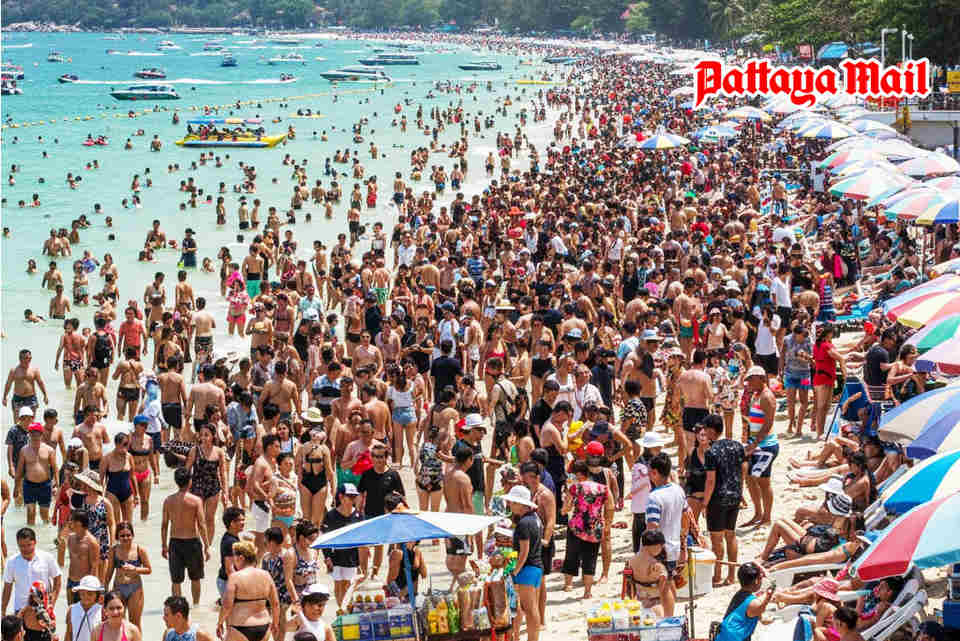
PATTAYA, Thailand – Thailand’s proposed 300-baht tourist entry fee has once again entered public discussion, not because the amount is controversial, but because the policy surrounding it remains unresolved. At issue is not the fee itself, but the uncertainty over when it will be introduced, how it will be applied, and what the revenue will ultimately be used for. Thailand is no minor player in global tourism. It is a heavyweight.
Official reporting shows that the country welcomed approximately 28 million foreign visitors in 2023, rising sharply to around 35 million in 2024. Forward-looking estimates suggest that arrivals in 2025 will reach between 37 and 38 million. These numbers place Thailand firmly back among the world’s top tourism destinations, with foreign tourism revenue already exceeding 1.6 to 1.8 trillion baht annually.
Seen in this context, a 300-baht charge is economically insignificant for most travellers. However, when applied at scale, it becomes meaningful. Based on current travel patterns, where the majority of visitors enter Thailand by air and would be subject to the full charge, annual revenue from the fee is conservatively estimated at around 10 billion baht. While modest relative to overall tourism income, it represents a stable and predictable source of funding.
The government has consistently stated that the fee is not intended as a general tax. Rather, it is designed to fund specific tourism-related costs. These include a proposed tourist insurance scheme covering accidents and medical emergencies, improvements to tourism infrastructure and safety systems, and the administrative costs of managing high visitor volumes as Thailand moves toward digital, stamp-less border controls.
Internationally, Thailand would not be acting in isolation. Countries that Thailand competes with and often seeks to emulate already impose similar charges. Japan applies a 1,000-yen departure tax. New Zealand collects a visitor levy of 35 New Zealand dollars. Bali charges a 10 US dollar tourism fee, while city-based tourist taxes are routine across much of Europe. None of these destinations suffered a decline in tourism as a result. The decisive factor has not been the existence of a fee, but the clarity of the policy and the efficiency of its implementation.
This is where Thailand faces its greatest challenge. Despite repeated media reports suggesting that the fee could be introduced as early as February 2026, there has been no official government announcement confirming a start date. Statements from relevant authorities indicate that the policy remains under consideration, pending further system testing and inter-agency coordination. There is also increasing recognition that final implementation may depend on the priorities of a future government rather than the current administration.
In an era of digital travel authorisations and automated border systems, uncertainty matters. Travellers, particularly frequent visitors and long-term residents, expect entry requirements to be clear, consistent, and predictable. Confusion over who must pay, when payment is required, and what benefits are provided in return risks undermining confidence far more than the fee itself. Handled properly, with transparent communication, defined exemptions, and visible use of funds, the 300-baht fee could support sustainable tourism management without deterring visitors. Handled poorly, it risks becoming another source of friction at Thailand’s increasingly digital borders.
Ultimately, the question is not whether Thailand can collect 300 baht from its visitors. It is whether the country can align policy, technology, and timing in a way that reflects its status as one of the world’s leading tourism destinations.