In the Pink
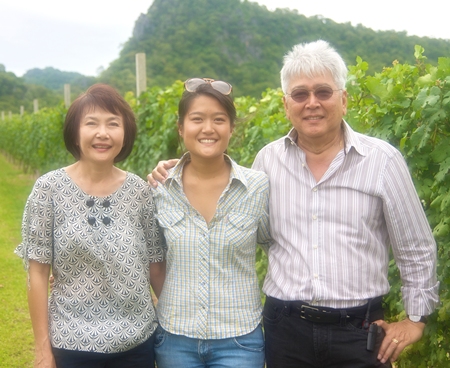
Winemaker Nikki Lohitnavy (middle) with parents;
Visooth and Sakuna Lohitnavy
Call me old-fashioned, but I always think there’s something terribly romantic
about rosé wine. It always conjures up images of high summer and a leisurely
al fresco lunch in a luxuriant garden somewhere in the South of France: a
blue check tablecloth, a bowl of olives, Mediterranean salads and plates of
cheese, hunks of crusty French bread and of course, cold bottles of rosé
glistening with condensation in the sunlight.
With its fruity lightness and low alcohol, rosé seems more of
a lunchtime drink than something for the evening meal, but I suppose in our hot
seasons, you could drink rosé at any time of day. Rosé wines have no pretensions
to greatness and are best consumed young when the freshness is at its best.
Despite the name, rosé wines are not necessarily pink.
Although they’re normally made from red grapes, they come in a variety of
colours ranging from pale orange to purple, depending on the grapes used and the
method of vinification. But it takes skill to make a really good rosé. Here’s an
exceptional one that is a real winner.
GranMonte Sakuna Syrah Rosé, 2010 (pink), Thailand. (Central, Bt. 490
for 500 ml bottle)
The first thing you’ll probably notice about this wine is the
lovely colour. It’s a very pale orangey-pink that gradually fades to transparent
at the edges of the glass. The aroma is a bit shy at first, but then so am I, so
I can’t really complain. When the bottle has been open for a time, very subtle
fresh fruit aromas begin to emerge. The mouth-feel is soft, gentle and inviting
with plenty of fruit on the palate. I thought I detected a faint taste of
raspberries and pears and although the wine is dry, there is a pleasing touch of
sweetness.
The Syrah (see-RAH) grapes were evidently hand-picked
early, to preserve their freshness and the wine has an attractive dry finish
with mineral hints. It has a kind of feminine elegance which perhaps is why
winemaker Nikki Lohitnavy, rather charmingly named it Sakuna after her
mother.
It comes in an attractive cylindrical 500ml bottle (as
distinct from the usual 750ml) but it’s too good to knock back as a party wine.
For one thing, it won a Silver Award this year at the AWC International Wine
Challenge in Vienna. At just 12% alcohol, it would make a brilliant apéritif
just to enjoy it on its own. Don’t forget to chill it first.
Terre des Anges Rosé, 2009 (pink), France. (Villa, Bt. 444)
This wine is a Vin de Pays d’Oc, which means “a
country wine from the South of France”. This too, is made from Syrah grapes,
harvested at night to keep the freshness of the fruit. With a clear rich,
orange-pink colour and tiny reflections of purple, this wine has a fresh and
delicate aroma suggesting strawberries, raspberries and a hint of mandarin
oranges. Although it’s quite dry with citrus overtones, the wine has a light,
elegant body with a soft silky mouth-feel. There’s plenty of fruit on the
palate; a good balance of acidity with a hint of spritziness and a refreshing
citrusy finish.
This is a really good little wine from south west of the
Languedoc, not far from the ancient walled city of Carcassonne. It was made by
Pierre Degroote, the first Belgian wine-maker the South of France. At only 12%
alcohol it would make a pleasant apéritif, but it would be lovely with smoked
salmon, omelette or quiche. Serve it as cold you dare.
By the way, if a wine’s aroma is not very forthcoming, here’s
a trick I learned at wine tastings years ago. Pour a little into a small glass
and place the palm of one hand firmly over the top. Then with the other, give
the glass a vigorous shake. This dramatically intensifies the aroma. However,
the technique requires some practice and can be a bit messy, especially if you
manage to drop the glass in the process.