Pentax is one of those camera manufacturers that always seems to be just on the
second tier, and not the top one. This may not be really correct, but is the
impression one gets when talking with other photographers, where the spoils are
generally shared by Canon and Nikon.
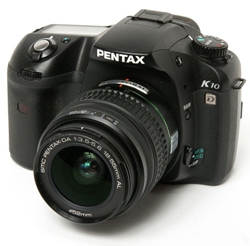
However, if you are looking for a camera with many advanced
features and inexpensive to purchase, then perhaps you should be considering
something like a secondhand Pentax K10D rather than a new model from the Big
Two. The K10D was released in 2006 and ran through till 2009, and these days can
be purchased for around $300.
Let’s look at the K10D’s basic features:
10.2 megapixel CCD
Pentax K AF bayonet lens mount compatible with the full range
of Pentax K lenses, plus M-series lenses via an adapter
Digital SLR design with true optical viewfinder
2.5 inch color LCD monitor for image and menu review
Full Manual through Automatic exposure available, including
Aperture and Shutter priority
Built-in flash with five modes and an intensity adjustment
Topside external flash hot shoe
SD/SDHC memory storage (no card included)
JPEG, RAW, DNG file formats
USB 2.0 High Speed computer connection
D-LI50 Rechargeable lithium-ion battery and charger
Software for Mac and PC
But on top of those features, found in many cameras these
days there are special features:
Shake Reduction technology to minimize blurring from camera
movement
Digital filter options for creative effects post-capture
Continuous shooting mode and Auto Exposure Bracketing
Self-timer for 12 or two-second delayed shutter release
Optional remote control (wired and IR)
Shutter speeds from 1/4,000 to 30 seconds, plus a Bulb
setting for long exposures
Image Sharpness, Saturation, and Contrast adjustments
Post-capture filters for color, black and white, sepia
Metering modes with Spot, Center-Weighted, and
Multi-Adjustable AF area and two AF modes
Auto ISO setting or 200, 400, 800, 1,600 ISO equivalents
White balance (color) adjustment with 10 options, including a
manual setting with each white balance mode adjustable
Adobe RGB and sRGB color space options.
32 Custom Menu settings, including options for non-CPU Pentax
lenses
DPOF (Digital Print Order Format) and PictBridge printing
compatibility
With 10 megapixels, it covers a handy range, and is good to
hold, but here comes the first negative. It is not just handy, it is downright
hefty at over 700 gm and that’s just the body. I almost gave up testing because
of the weight, but I’m glad I persevered.
Photographers who are after the tops in quality are turning
to RAW images more and more. JPEG is a fine ‘utility’ image, but you can do more
with RAW. Simple switching gets you into RAW and you can alternate with the
format.
Another feature which is not obvious, but very important, is
that the K10D has a dust-proof, weather resistant body with a stainless steel
chassis and 72 seals that allow the camera to be used in dusty and/or rainy
environments.
Shake Reduction is attained by the sensor sitting on a
free-floating electromagnetically controlled platter that can move horizontally,
vertically, and even rotationally (the same principle as the MAGLEV trains).
This is the basis for the Shake Reduction, where the K10D can offer image
stabilization with every Pentax-branded lens that can be fitted to the camera.
Pentax says you will get from 2.5 to 4 stops of compensation. In other words you
could, in theory, hand-hold at 1/8th second exposure.
The 2.5" LCD display has 210,000 pixels and a 140 degree
horizontal/vertical viewing angle. The viewfinder is a pentaprism TTL optical
design with 95 percent field of view, 0.95x magnification, diopter adjustment
from -2.5m-1 to +1.5m-1, and a Natural-Bright-Matte II focusing screen. With 95
percent field, you get a little more than what you see, and that’s not a bad
thing.
The K10D autofocuses with 11 autofocus points, while auto
exposure metering choices are 16 segment multi, center-weighted, and spot.
Shutter speeds from 30 seconds to 1/4,000 second are possible, and there’s also
a bulb mode if you want really long exposures.
No, as I wrote at the beginning, if you are ready to move up
into something which really is an advanced camera, a secondhand K10D could be
your answer.