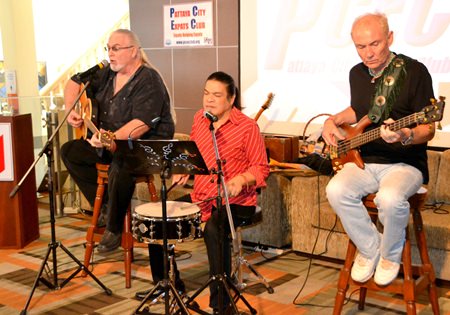
Slow Ride entertains PCEC
members and guests with Ken (Snowman) on Guitar, Somchai (Oi) on drums, and
Tony (Tone) on Bass.
Do you know the origin of the term “racy”? Read on and
you shall find out. This was one of the many interesting bits of information
imparted by the jazz, blues, and rock & roll group, Slow Ride, when they
made a return engagement at the October 5 meeting of the Pattaya City Expats
Club.
Slow Ride performed several songs and Ken Snowman talked about the origins
and evolution of the blues. The group consists of Tony (Tone) Stevens on
Bass, Ken (Snowman) Minahan on Guitar, and Somchai (Oi) Sihaapai on drums.
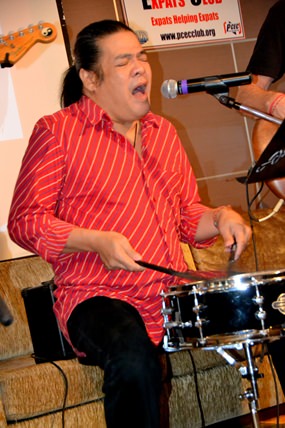 With
Somchai (Oi) on vocals, the group performed Sam Cooke’s 1964 song, “Change
has gotta come.”
With
Somchai (Oi) on vocals, the group performed Sam Cooke’s 1964 song, “Change
has gotta come.”
Slow Ride first performed for the club last July. The group started the
current concert with Ken on vocals singing “Sitting on Top of the World,”
Howlin’ Wolf’s version of a song written by Walter Vinson and Lonnie
Chapman. The song has been described as a “simple, elegant distillation of
the Blues,” and has become a standard of traditional American music,
according to an article in Wikipedia. The lyrics of the original song convey
a stoic optimism in the face of emotional setbacks. The song has been widely
recorded in a variety of different styles - folk, blues, country, bluegrass,
and rock; often with considerable variations or additions to the original
verses.
Ken explained that the blues was created by slaves in the American South and
that with limited time and resources at their disposal, the musicians had to
be very creative just to come up with instruments to play on. When the
slaves were emancipated by Abraham Lincoln, many became sharecroppers on the
same plantations where they had been slaves; they were paid in plantation
dollars which could only be spent at the company store, so they were
effectively still tied to the plantations.

PCEC member Judith Edmonds
prepares to conduct the drawing to win a basket of goodies. After the
drawing, won by member Richard Silverberg, Judith announced that the raffle
proceeds were 5,320 baht which will go toward Christmas gifts for children
at the Pattaya Orphanage and at the Mercy Center.
However, Ken said, the ones who left were often the
musicians, many of whom went to cities in the North. They brought their
acoustic instruments with them, but that didn’t work that well in the noise
of the big city clubs; thus they adapted to electric guitars which became
part of blues music.
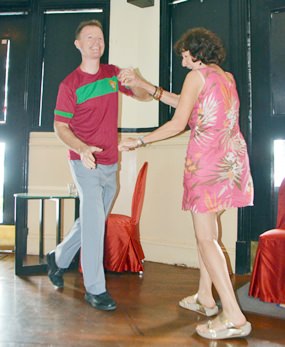 Some
PCEC members just couldn’t resist Slow Ride’s great music and took advantage
of it to do a few dance steps.
Some
PCEC members just couldn’t resist Slow Ride’s great music and took advantage
of it to do a few dance steps.
The blues evolved differently in different cities. Slow Ride performed
“Messin’ with the Kid;” a rhythm and blues-style song originally recorded by
Junior Wells in 1960. Ken explained that this was an example of the Chicago
style of Blues. Jazz, like all other forms of American music, originated
from the blues. Ken said that blues musicians in New Orleans, who couldn’t
read music, would improvise based on the marching band songs for which the
city was famous. This led to Dixieland music which, in turn, led to jazz.
Slow Ride performed “Willie and the Hand Jive,” a Johnny Otis song. Ken said
that it was an example of “second line rhythm.” An article in Wikipedia
explains that “Second line” is a tradition in brass band parades in New
Orleans, Louisiana. The “main line” or “first line” is the main section -
i.e. the members of the actual club with the parading permit as well as the
brass band. Those who follow the band just to enjoy the music are called the
“second line.”
Ken said that gospel music is a combination of the blues and European
Christian hymns; and that from gospel music comes rhythm and blues, soul and
even funk. With Somchai on vocals, the group performed Sam Cooke’s 1964
song, “Change has gotta come.” The song concerns African-Americans and
contains the refrain, “It’s been a long time coming, but I know a change is
gonna come.” According to an article in Wikipedia, the song was inspired by
various personal events in Cooke’s life, most prominently an event in which
he and his entourage were turned away from a whites-only motel in Louisiana.
Slow Ride performed an example of Texas blues with “Pride and Joy,” a
blues-rock song written and originally performed by Stevie Ray Vaughn. Then,
in what Ken called the “Three Kings” section of their performance, Slow Ride
performed three songs written by different “Kings” - “I’m Tore Down” by
Freddy King; “Dangerous Mood” by B.B. King (now 89 years old and still
touring); and “Crosscut Saw” by Albert King. The Albert King song has a New
Orleans sound, combining blues and Latin music. The song has a lot of double
entendres. Ken explained that radio was segregated at that time, and that
the term “race” was used to denote black music. The lyrics of black music
often had sexual overtones, so this is where the term “racy” comes from.
As they did for their last visit, Slow Ride finished the concert with a
rousing version of an audience participation song, “The Blues is Alright.”
Slow Ride is presently featured at Pattaya’s MOOD Cafe and Night Club at
Thepthip Mansion Condo on Pratamnak Soi 6 every Friday, Saturday and Sunday
evenings.
Master of Ceremonies Richard Silverberg then brought everyone up to date on
upcoming events and called on Tony Heron to conduct the always informative
Open Forum where questions are asked and answered about Expat living in
Thailand, especially Pattaya.
For more information on the PCEC’s many activities, visit their website at
www.pcecclub.org.