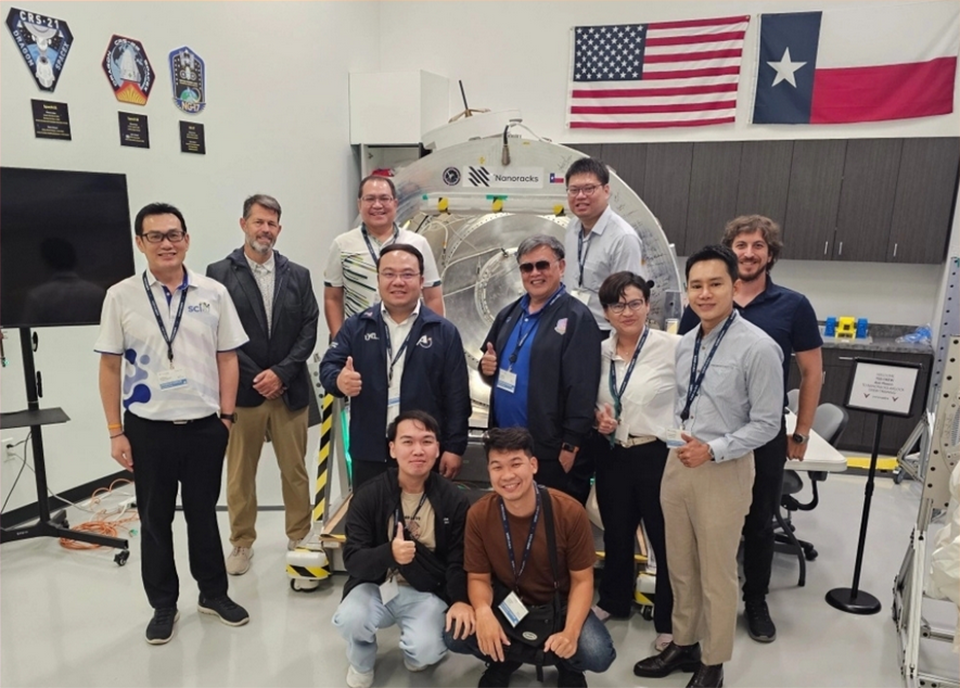
BANGKOK, Thailand – SpaceX’s Falcon 9 rocket successfully carried the Thailand Liquid Crystals in Space (TLC) experiment to the International Space Station (ISS).
Developed by researchers at Kasetsart University in collaboration with Geo-Informatics and Space Technology Development Agency (GISTDA) and NASA, the project will study how liquid crystals behave in microgravity. The focus is on defect formation in thin films—knowledge that could help create more advanced LCD technologies in the future.
Launched on 15 September 2025, 05:02 AM (Thailand time) from Cape Canaveral, Florida, aboard the Cygnus NG-23 resupply spacecraft, the experiment will run for about 3 months with 144 hours of observation time on the ISS.
Data and samples are expected to return to Earth in early 2026 for further analysis by Thai scientists.
This marks a proud milestone for Thailand’s space research, demonstrating the nation’s role in advancing global science and technology beyond our atmosphere. (NNT)