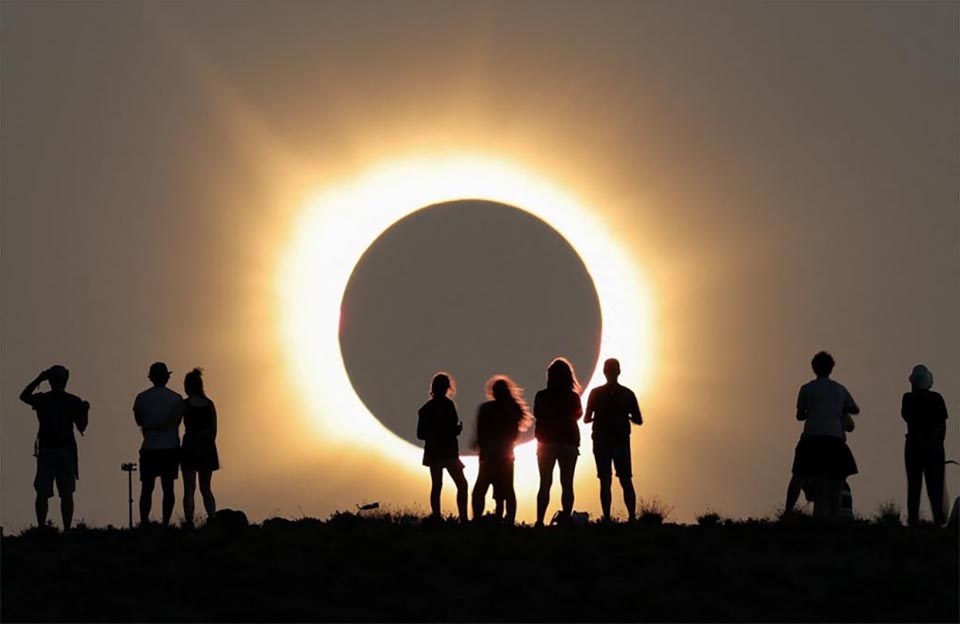
SPAIN – Spain briefly plunged into darkness on Wednesday (August 12) as a total solar eclipse crossed the country, marking the first total eclipse visible from Spain in more than a century and one of the year’s most spectacular astronomical events. The glowing outer corona of the Sun appeared around the edge of the Moon’s dark silhouette, prompting cheers and emotional reactions from crowds gathered across Spain. “It’s something I never thought I would see,” said Isabel Troiano, 56, who watched the eclipse with her son in Tarragona on Spain’s Mediterranean coast.
Alejandro Cuesta, a 30-year-old nanoscience researcher, described the experience as incredible and said he was moved to tears. The August 12 eclipse was the first total solar eclipse visible from mainland and central Europe since August 11, 1999. The Moon’s shadow travelled from parts of Greenland southward across Iceland before sweeping across the Atlantic and reaching northern Spain. In Iceland, Reykjavik experienced its first total solar eclipse since 1433, with the next one not expected until 2196.
In Spain, the narrow path of totality stretched from the northern coast toward the Balearic Islands, drawing large crowds of residents and tourists to beaches and viewing locations.
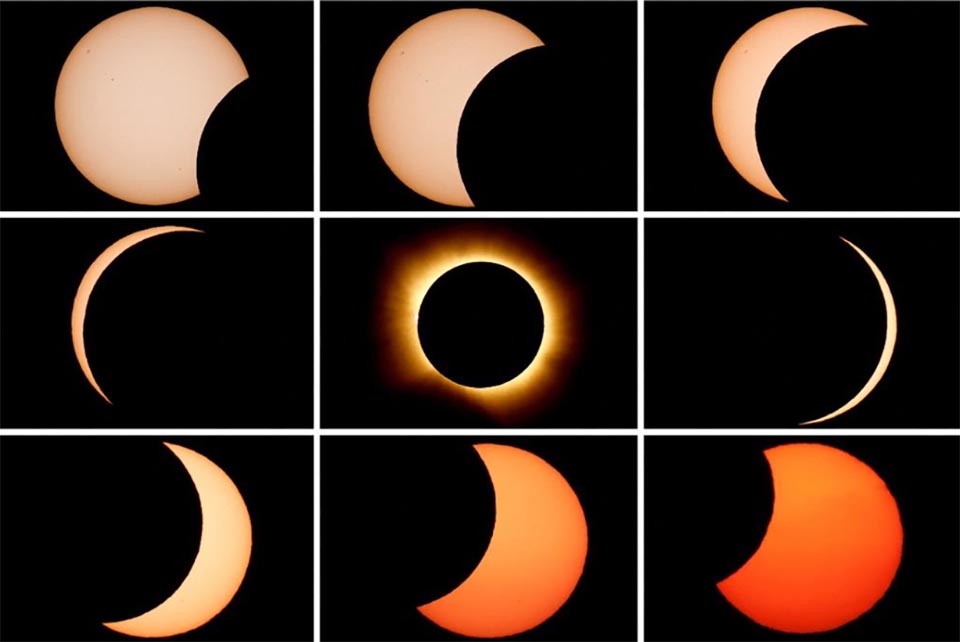
People across Europe, as well as parts of Canada, the northern United States and northwestern Africa, were able to see a partial eclipse. At Pic du Midi in France’s Pyrenees, thick clouds cleared only minutes before totality, allowing spectators to witness the event. Large crowds also gathered in London, Paris and other locations across Europe.
Throughout human history, solar and lunar eclipses have inspired wonder, fear and fascination as they temporarily alter the normal appearance of the natural world. During totality, the Moon’s shadow, or umbra, creates an unusual twilight, temperatures can fall and animals may respond to the sudden darkness.
Totality lasts only a few minutes, with the Moon’s shadow travelling across Earth’s surface at around 3,430 kilometres per hour, according to the Paris Observatory. The partial phases, when the Moon gradually moves across the Sun, lasted about one hour and 45 minutes. The eclipse was also streamed live by NASA and the European Space Agency, giving scientists a rare opportunity to study the Sun’s outer atmosphere and corona while investigating the solar wind and magnetic fields.