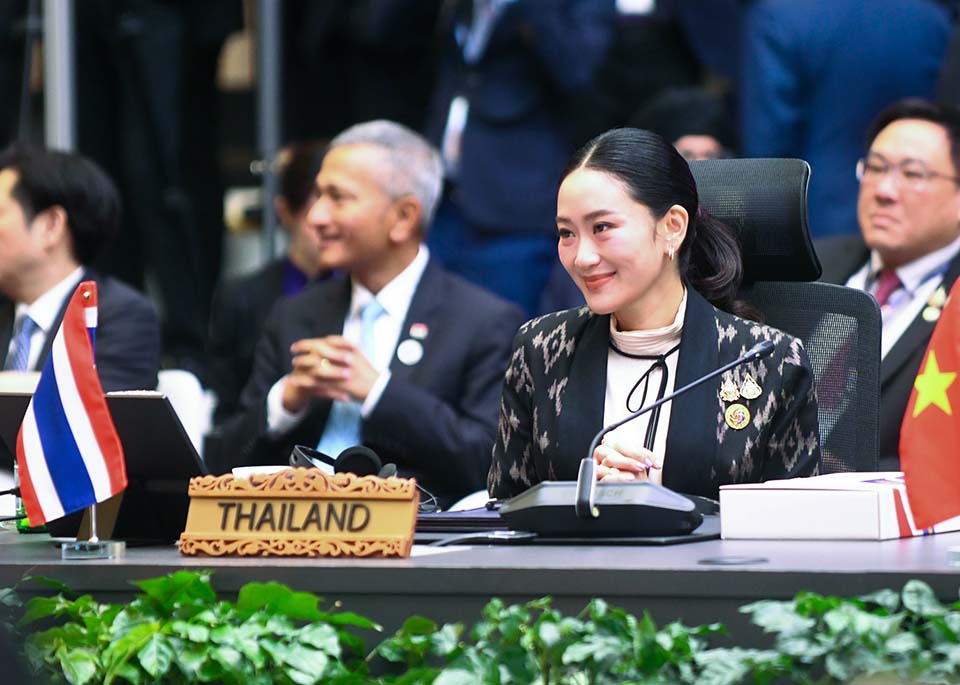
KUALA LUMPUR – Government Spokesperson Jirayu Houngsub disclosed that Prime Minister Paetongtarn Shinawatra attended the plenary session of the 46th ASEAN Summit at Kuala Lumpur Convention Center (KLCC), Kuala Lumpur, Malaysia.
The 46th ASEAN Summit and related meetings are held under the theme of “Inclusivity and Sustainability”. Participating in the plenary session of the 46th ASEAN Summit were leaders of 9 ASEAN member states, namely, His Majesty Sultan of Brunei Darussalam, President of the Republic of Indonesia, President of the Republic of the Philippines, Prime Minister of Malaysia, Prime Minister of the Republic of Singapore, Prime Minister of the Socialist Republic of Vietnam, Prime Minister of the Lao People’s Democratic Republic, Prime Minister of the Kingdom of Cambodia, and the Thai Prime Minister, as well as Dr. Kao Kim Hoan, ASEAN Secretary-General. The Prime Minister of Timor-Leste also attended as observer.
The Malaysian Prime Minister Dato’ Seri Anwar Ibrahim invited ASEAN leaders to take a group photo. The meeting then started with discussion on various issues, including strengthening and stabilizing ASEAN Community in the face of global uncertainties, and forging ASEAN’s relations with external partners. On this occasion, the Prime Minister delivered an intervention, gist of which is as follows:
According to the Prime Minister, this Summit is very timely at the time of the shifting of global landscape towards more assertive and transactional policies, with a move away from multilateralism to unilateral actions. The unprecedented imposition of tariffs by the U.S., in particular, has far-reaching impacts not only on global trade dynamics but also on ASEAN’s economic outlook. These developments challenge long-standing norms of global cooperation, which compel ASEAN to re-evaluate its strategies and strengthen collective resilience. The Prime Minister commended Prime Minister Anwar’s personal effort to advance ASEAN’s united position on this matter.
To grapple with the volatile global economic landscape, ASEAN must build an integrated supply chain network and work towards deeper regional integration to remain relevant, attractive, and competitive. Intra-ASEAN trade should be promoted, fully leveraging existing FTAs, and actively pursuing new FTAs with potential partners, while strengthening MSMEs to withstand future challenges.
The Prime Minister reaffirmed Thailand’s full support for predictable, transparent, free, fair, inclusive, sustainable, and rules-based multilateral trading system. The country will expedite the conclusion of Digital Economy Framework Agreement (DEFA) this year to unlock new growth avenue. While this marks a significant step forward in the near term, it also demonstrates that ASEAN will not stand still in its pursuit of progress, as the region continues to respond to the ever-evolving landscape of global trade and investment.
To realize effective integration, ASEAN must foster frank, inclusive, constructive, and solution-oriented dialogue, within and beyond the region. In doing so, ASEAN must reinforce its centrality and unity and make sure that all its engagements are firmly grounded in ASEAN’s core principles, centered on its shared priorities, and driven by what truly serves the interests of ASEAN citizens. Thailand will continue to be an active promoter of peace and common prosperity, working closely with ASEAN family and partners to achieve “Inclusivity and Sustainability” for the region as reflected in Malaysia’s ASEAN chairmanship theme.
To build an inclusive future for the region, ASEAN Community must not only be rules-based but also people-centered and people-oriented, so that the people enjoy a higher quality of life. ASEAN must redouble efforts to safeguard human security in all dimensions — from health and food security to combatting transnational crimes, such as drug trafficking and online scams. The worsening transboundary haze and recent earthquake in Myanmar are also a stark reminder that ASEAN cannot afford to delay action to provide stronger protections for its peoples.
ASEAN should undertake initiatives that collectively promote the region’s growth engines, such as the tourism sector which benefits various other sectors of the societies. Thailand, therefore, looks forward to closer collaboration on enhancing cross-border infrastructure, streamlining travel protocols, and promoting shared heritage and diverse cultures, including through Thailand’s tourism cooperation initiative.
To advance sustainability, ASEAN should focus more on promoting sustainable practices in all sectors and in daily life, as well as advocating for policies that support a sustainable future. In this regard, the Prime Minister reaffirmed Thailand’s commitment, as the ASEAN Coordinator on Sustainable Development Cooperation, to playing a catalytic role in driving ASEAN towards a greener and more sustainable future. Thailand will work with all partners to develop a strategy that will help realize a “green ASEAN”, one of the shared aspirations outlined in the ASEAN Community Vision 2045, by focusing on such key areas as green finance, climate resilience, energy transition, and digital transformation.
Lastly, the Prime Minister expressed pleasure to join other ASEAN leaders in adopting the “ASEAN 2045: Our Shared Future”. She trusted that the new Vision would serve as ASEAN’s guide in ensuring that the region continues to grow as a model of peace, partnership, and progress.
After the plenary session of the 46th ASEAN Summit, 9 documents were adopted by ASEAN leaders:
1. KL Declaration on the 10th Anniversary of the Establishment of the ASEAN Community
2. KL Declaration on ASEAN 2045: Our Shared Future
3. ASEAN Community Vision 2045: “Resilient, Innovative, Dynamic and People-Centered ASEAN”
4. ASEAN Political-Security Community Strategic Plan
5. ASEAN Economic Community Strategic Plan
6. ASEAN Socio-Cultural Community Strategic Plan
7. ASEAN Connectivity Strategic Plan
8. ASEAN Creative Economy Sustainability Framework
9. ASEAN Declaration of Commitment on ASEAN Drug Security and Self-Reliance (ADSSR) (PRD)