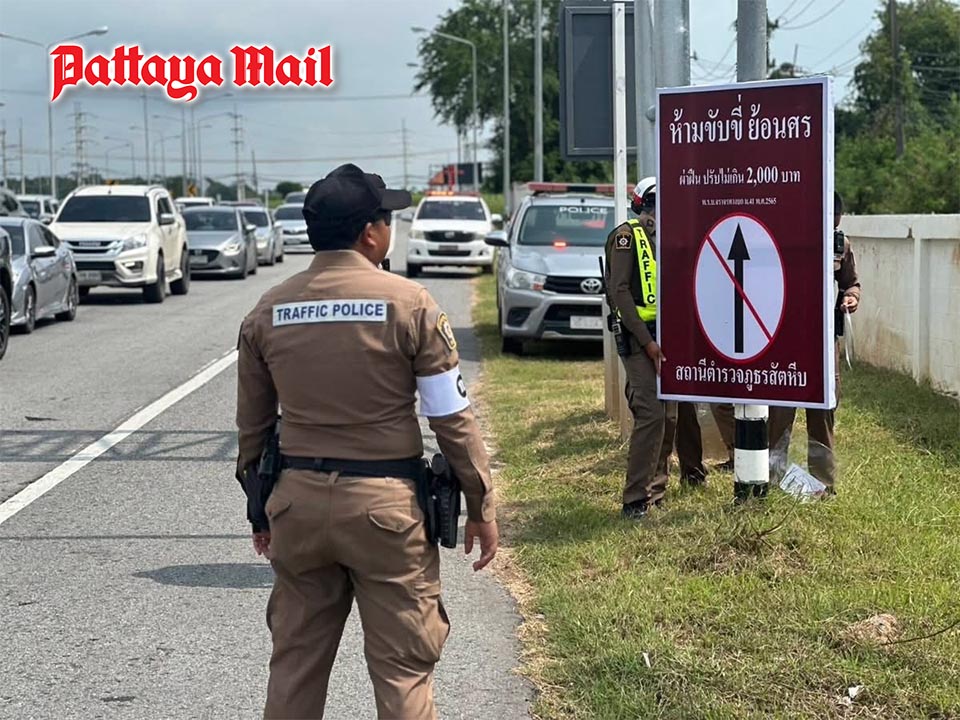
PATTAYA, Thailand – The local traffic police in Sattahip have stepped up efforts to prevent drivers from going the wrong way on roads, warning that violators face fines up to 2,000 baht. The campaign, emphasizing road safety and national discipline, comes amid growing concerns over traffic accidents and reckless driving in the district.
At first glance, the warning seems straightforward: obey traffic rules or pay a steep penalty. Authorities have relied heavily on public announcements and roadside signage to communicate the dangers of driving against traffic. While such measures are necessary, questions remain about whether signs alone can change driver behavior in an area where habits, shortcuts, and convenience often outweigh caution.
Sattahip, like many Thai towns, struggles with inconsistent enforcement. Drivers frequently ignore traffic rules, and police presence is often sporadic. Fines are threatened on paper, but the perception that violations often go unpunished undermines compliance. For signs to work, they must be backed by consistent monitoring, strict enforcement, and a culture that reinforces the importance of road discipline—not just temporary awareness campaigns.
Moreover, signage can only reach so far. Factors like unclear road markings, poor lighting at night, and high-speed traffic on busy routes reduce the effectiveness of even the clearest warnings. Drivers who habitually take risks or assume others will yield are unlikely to stop simply because a sign warns of a fine.
Education and awareness campaigns must accompany signage. Public programs, community engagement, and driver training can instill a real understanding of the consequences of reckless driving. Without these supporting measures, warnings risk being seen as formalities rather than life-saving rules.