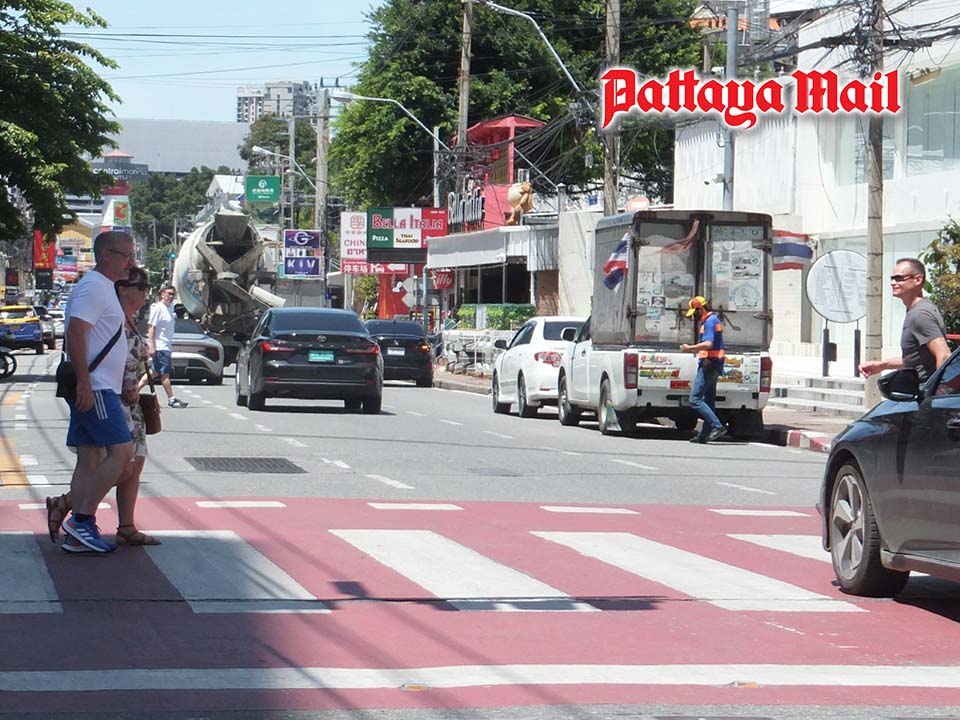
PATTAYA, Thailand – A growing wave of frustration is spilling across local forums after yet another pedestrian crossing incident reignited debate over road safety in the city — and the verdict from many residents and long-term visitors is harsh.
For some, the issue can be summed up in one line: “Red light means go faster.” Others pushed back slightly, saying it’s not even about speed anymore — “more like meaningless.”
The discussion, sparked on Pattaya Mail forums, quickly turned into a flood of personal experiences, with one long-term visitor writing: “In my 20 years visiting Thailand, I’ve never once seen vehicles stop at a zebra crossing unless there is a red light.”
Even then, confidence remains low.
Another commenter described daily life on Pattaya’s streets as “highly dangerous,” adding: “People run red lights, go before lights turn green, drive on the wrong side of the road, speed — you name it. It’s like playing Frogger in real life.”
Specific danger zones were repeatedly named — Beach Road, Second Road, and Soi Buakhao — with one user warning: “Crossing 2nd Road opposite Mike’s Mall can be tricky,” while another pointed to crossings near Central Festival, saying vehicles “do not stop when you try to cross.”
For vulnerable pedestrians, the risks feel even more severe.
One visually impaired commenter shared: “I use the crosswalk because I struggle to see what’s coming. It feels like Russian roulette even when pedestrians have the right of way.”
The criticism wasn’t directed at one group alone.
While some blamed local driving habits, others were quick to point out that foreigners contribute to the problem too: “It’s not just Thai people — expats are just as bad. They think if Thais do it, they can too.”
Motorbikes, however, were singled out repeatedly as the biggest concern. One commenter laid it out bluntly: “A motorbike is just a way to get from A to B as fast as possible — ignore all road rules.”
Others pointed to deeper structural issues — lack of enforcement, limited driver training, and what they see as inconsistent policing.
“Most drivers here are selfish and have no training,” one wrote. “Until rules are enforced, they’ll be ignored.”
Another added: “Nothing’s changed in 13 years… red lights are just a suggestion.”
There were also claims of uneven enforcement, with one user alleging: “For a foreigner, run a red light = 4,000 baht. Thai = free of charge.” — though such claims remain anecdotal.
Some comments turned toward solutions, calling for stricter crackdowns similar to pandemic-era checkpoints. One user argued that firm enforcement — checking licenses, impounding uninsured vehicles — could dramatically reduce violations within weeks.
Yet not everyone placed the blame solely on drivers.
A minority argued pedestrians also take risks, noting that many cross regardless of signals. But even that point circled back to the same issue: “Why wait for green when vehicles don’t stop at red?”
Taken together, the comments reflect a broader sentiment — that Pattaya’s pedestrian infrastructure exists on paper, but not always in practice.
Zebra crossings, meant to offer safe passage, are increasingly seen by some as symbolic rather than functional.
And until behavior changes — whether through enforcement, education, or both — many say crossing the road in Pattaya will continue to feel less like a right… and more like a risk.