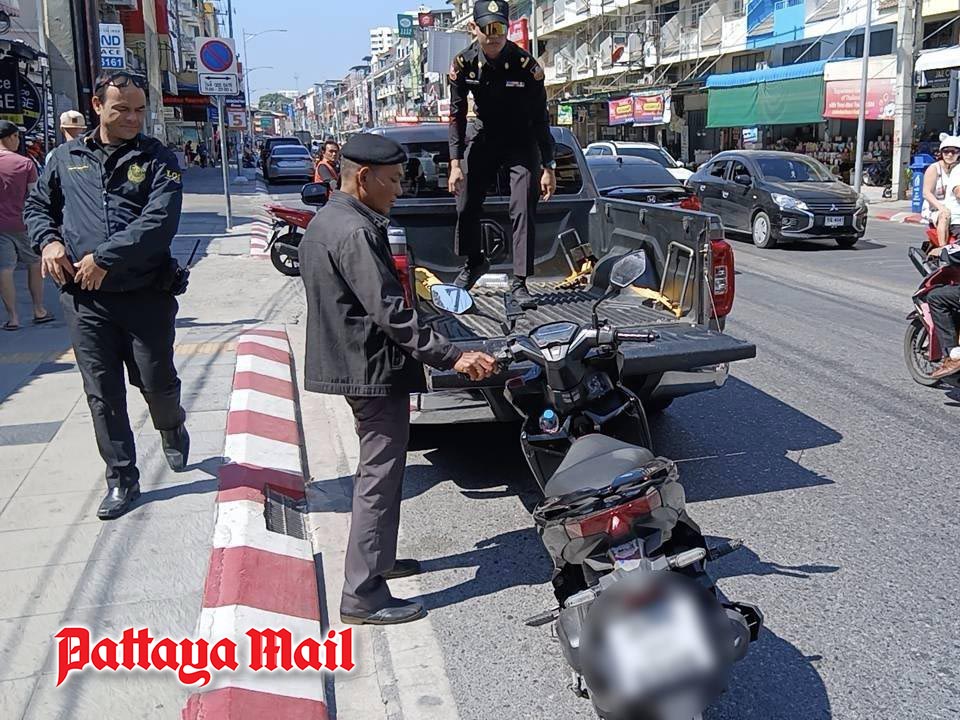
PATTAYA, Thailand – Pattaya authorities have stepped up enforcement against motorbikes parked on footpaths, issuing fines and towing vehicles as part of an ongoing drive to improve pedestrian safety and urban order. The message is clear: sidewalks are for walking, not parking.
Yet on the ground, many residents and long-term visitors say the crackdown exposes a deeper problem — and an uncomfortable inconsistency in how the rules are applied.
Just a few blocks from recently enforced zones, large sections of footpaths remain permanently occupied by vendor tables, carts, and makeshift stalls. In some areas, half the sidewalk is effectively unusable, forcing pedestrians — including the elderly, parents with strollers, and wheelchair users — onto busy roads. These setups are not temporary or occasional; many have been in place for years, becoming an accepted part of the streetscape.
Critics argue that while motorbikes are an easy and visible target, vendor encroachment represents a far larger and more persistent obstacle to walkability in Pattaya. Unlike parked motorcycles, which can be moved or towed quickly, vendor tables often remain in the same location day after day, creating permanent bottlenecks along key pedestrian routes.
The issue is not opposition to street vending itself. Many acknowledge that vendors are part of Pattaya’s informal economy and provide affordable food and services. The frustration lies in the absence of clear boundaries and consistent enforcement. When footpaths are blocked indefinitely without consequence, enforcement actions elsewhere begin to look selective rather than systematic.
Long-term observers note that this situation has barely changed over decades.
“In some areas, those tables have been there 20 years or more,” one resident said. “Everyone knows they block the footpath. Nothing happens. Then suddenly bikes get towed and fined, and it’s sold as a major clean-up.”
This perceived imbalance fuels quiet speculation about why some obstructions are tolerated while others are punished. Authorities rarely comment on enforcement priorities, leaving room for suspicion and eroding public trust — even when officers are acting within the law.
Urban management experts often warn that partial enforcement can be worse than no enforcement at all. When rules appear flexible depending on who is involved, compliance drops and cynicism grows. Pedestrians, meanwhile, see little improvement if the space remains obstructed — regardless of whether the obstacle has two wheels or four table legs.
If Pattaya’s goal is genuinely safer, more walkable streets, critics argue that enforcement must be comprehensive and transparent. That means addressing all forms of sidewalk obstruction — parked vehicles, vendor encroachment, advertising signs, and permanent fixtures — under the same rules and standards.
Without that consistency, towing a motorbike may look decisive, but it does little to solve the daily reality of navigating Pattaya on foot. And for a city that promotes itself as walkable, accessible, and welcoming, that contradiction is becoming harder to ignore.