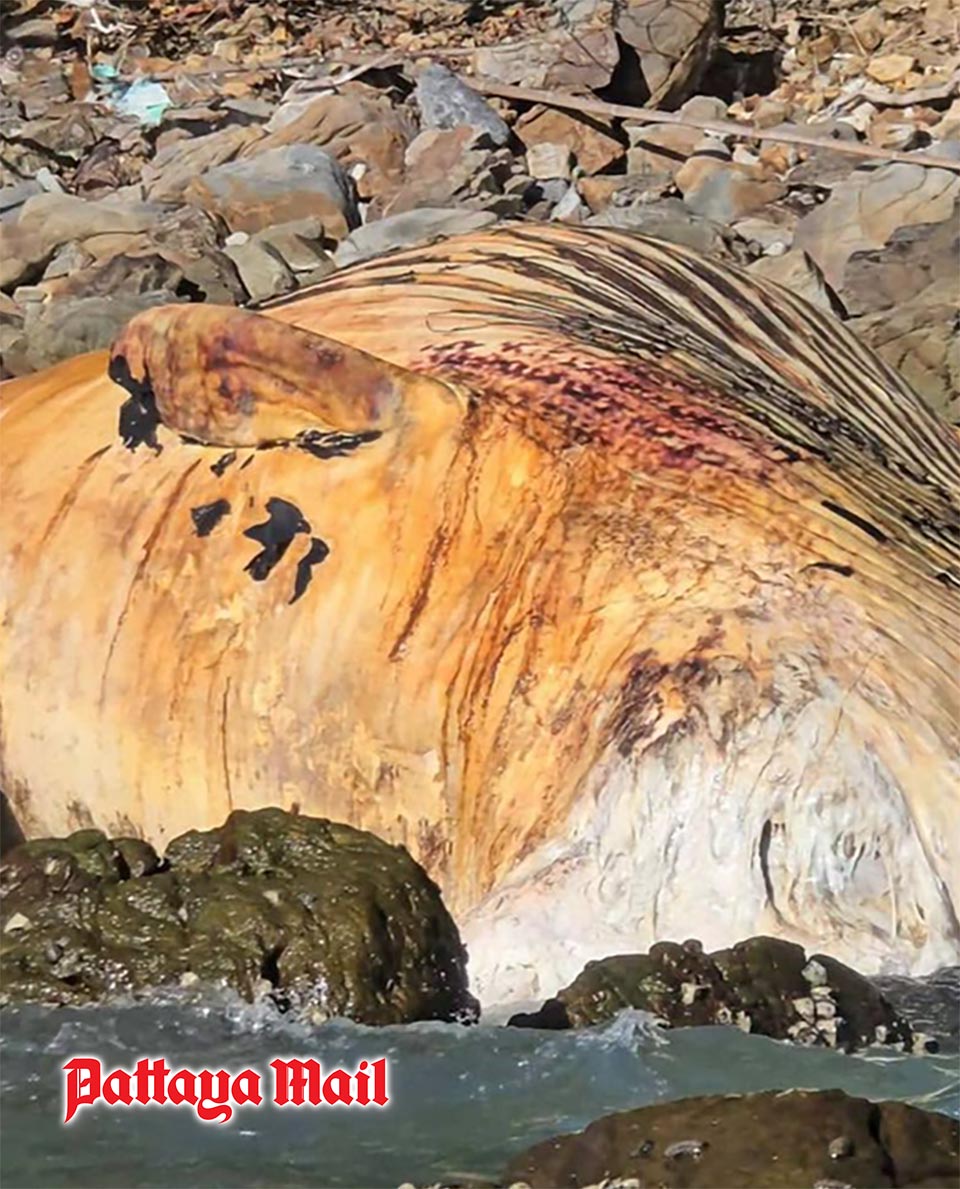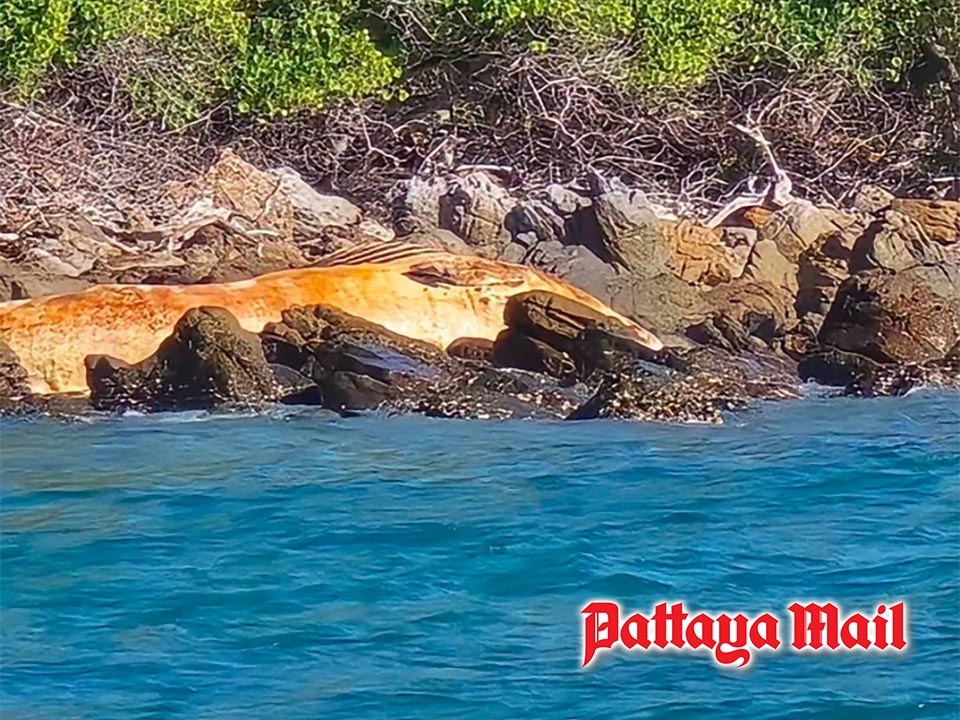
SATTAHIP, Thailand – A large dead Bryde’s whale has been found washed against rocks off Samae San Island, prompting marine authorities to prepare an operation to recover the carcass and investigate what killed the protected marine mammal. The whale was reported on August 17 after local residents and fishing groups spotted the carcass near the rocks on the rear side of Samae San Island in Samae San subdistrict, Sattahip.The discovery was also shared online, including video footage showing the large carcass floating near the island.
Wutthiphong Wong-in, director of the Marine Resources Conservation Division at the Marine and Coastal Resources Office 2 in Chonburi, said authorities were alerted by local fishermen. The whale’s sex, age and cause of death had not yet been established. Based on information from fishermen and photographs and video recorded at the site, the carcass was bloated and emitting a strong odour. Parts of its skin had been exposed to the sun and were badly damaged, while the body had become lodged among rocks around the island.
Following the report, Dr. Pinsak Suraswadi, director-general of the Department of Marine and Coastal Resources, ordered the Chonburi office to coordinate a recovery operation with the Naval Special Warfare Command, veterinary specialists from the Eastern Upper Gulf Marine and Coastal Resources Research Center, the Samae San conservation network and other agencies.
The recovery operation is scheduled for August 18, when officials plan to use suitable boats and equipment to move the whale from Samae San Island to Hat Yao on the Sattahip mainland.
Once recovered, the carcass will undergo a post-mortem examination to determine the cause of death. Officials will collect tissue and other biological samples, as well as relevant evidence, for laboratory analysis and genetic comparison.
Authorities will also investigate whether the whale’s death may have been linked to human activity. If evidence indicates that it was killed or injured through human action or an accident that may constitute a legal offence, authorities will collect evidence and proceed under the law. After examination and sampling, the carcass will be disposed of according to scientific and sanitary procedures. Officials are also considering preserving the whale’s skeleton for future display as an educational resource highlighting rare marine animals and Chonburi’s marine environment.
The Department of Marine and Coastal Resources urged residents and tourists to report sightings of rare marine animals or stranded marine life so officials can respond, collect data and handle the animals properly. Reports can be made to the department or through the 1362 hotline.