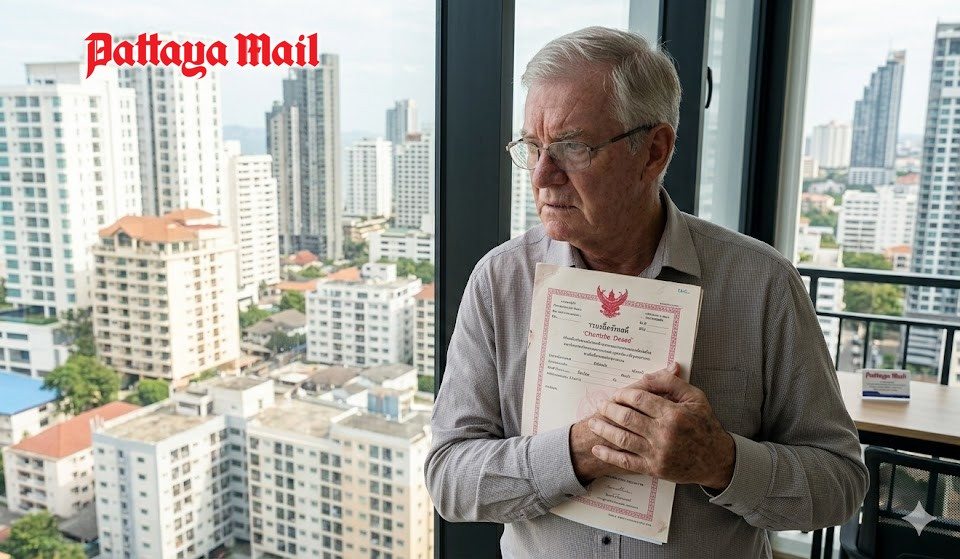
PATTAYA, Thailand – Amidst the Thai government’s proactive measures to investigate financial trails, income tax compliance, and the transparency of foreign asset holdings this year, the legal landscape for the expatriate community in Pattaya has shifted entirely. As a result, the issue of the urgent need for a dedicated Thai Will has risen to the top of the agenda and can no longer be ignored.
For years, many foreign residents operated under the assumption that a single will drafted in their home country would suffice to cover their global assets, including those in Thailand. However, in an era where state agencies have launched aggressive screenings into asset ownership structures and nominee arrangements, relying solely on a foreign will to protect Thai assets is no longer a safe strategy. It is a massive financial risk.
The new reality as authorities step up scrutiny
The push for expats to secure a localized Thai Will is directly tied to the ongoing crackdowns on corporate transparency and non-compliant property holdings. Throughout the past year, the Department of Business Development (DBD) and national security agencies have significantly increased audits into suspected nominee corporate structures used by foreign nationals to purchase land or real estate.
At the same time, banks and financial institutions have tightened their financial tracking protocols under international tax reporting frameworks. In this strict environment, when a foreign resident passes away without a legally sound, localized estate plan, the consequences for heirs can be devastating.
Of even greater concern is the fact that many expatriates who have settled down in Pattaya and across Thailand are getting older, yet a significant number have never planned or prepared for this eventuality. Furthermore, many individuals are single, have no local family, or are not legally married, leaving them with no statutory connections to anyone locally. Consequently, when a death occurs without any heirs to claim the inheritance and without a valid Thai Will in place, all those domestic assets—whether luxury condominiums, vehicles, or bank accounts—will legally revert to the state.
They will subsequently be auctioned off to redirect the funds into the national treasury, resulting in a deeply unfortunate loss. Without a distinct Thai Will, domestic assets are immediately frozen by authorities. The legal process to validate and execute a foreign will in a Thai court is notoriously slow, complex, and expensive, often leaving grieving families locked out of funds when they need them most.
The risks and hurdles of relying on a foreign will
While Thai courts do recognize foreign wills in theory, the practical administration of a foreign estate plan within today’s high scrutiny environment is a bureaucratic nightmare. Without a localized Thai Will, domestic assets are frozen immediately. To enforce a foreign will in a Thai court, the document must undergo a lengthy validation process. This includes formal translation into the Thai language, legalization by the Ministry of Foreign Affairs, and notarization by the relevant foreign embassy.
Furthermore, if the foreign will contains complex trust structures or clauses that contradict Thai property laws, it may be deemed unenforceable. For instance, if an expat attempts to leave land held through a nominee company to a foreign heir via a foreign will, the land office will reject the transfer outright. A localized Thai Will allows an individual to address these specific jurisdictional restrictions directly, ensuring that assets are distributed efficiently and in full compliance with local laws.
Key protections provided by a separate Thai will
Drafting a distinct will specifically for your assets in Thailand provides several critical operational advantages.
Immediate Asset Protection
A Thai Will streamlines the probate process, allowing a designated local executor to quickly access bank accounts and manage real estate holdings, preventing assets from being frozen indefinitely or liquidated into the state treasury.
Avoidance of Nominee Complications
For expats who hold assets through Thai corporate structures, a localized will ensures that company shares are transferred legally and transparently to intended heirs, minimizing the risk of the company being flagged for nominee irregularities during probate.
Simplified Judicial Process
A standard Thai Will, properly witnessed and drafted according to the Civil and Commercial Code, can be processed swiftly through the local court system, saving heirs months of costly litigation, diplomatic red tape, and exorbitant legal fees.
Separate wills for separate jurisdictions the safest strategy
The most effective legal strategy for foreign residents today is to maintain two concurrent wills: a worldwide will covering assets in their home country, and a specific Thai Will exclusively covering assets located within the Kingdom of Thailand. It is vital that both documents are drafted by professionals to ensure they contain reciprocal exclusion clauses. This prevents one will from inadvertently revoking or contradicting the other.
As Pattaya matures into a highly regulated economic hub backed by rigorous oversight, proactive legal compliance is the only way to safeguard your investments and legacy. Taking the time to structure a valid Thai Will today ensures that your hard earned assets remain secure, and that your loved ones are protected against unexpected administrative and legal hurdles.