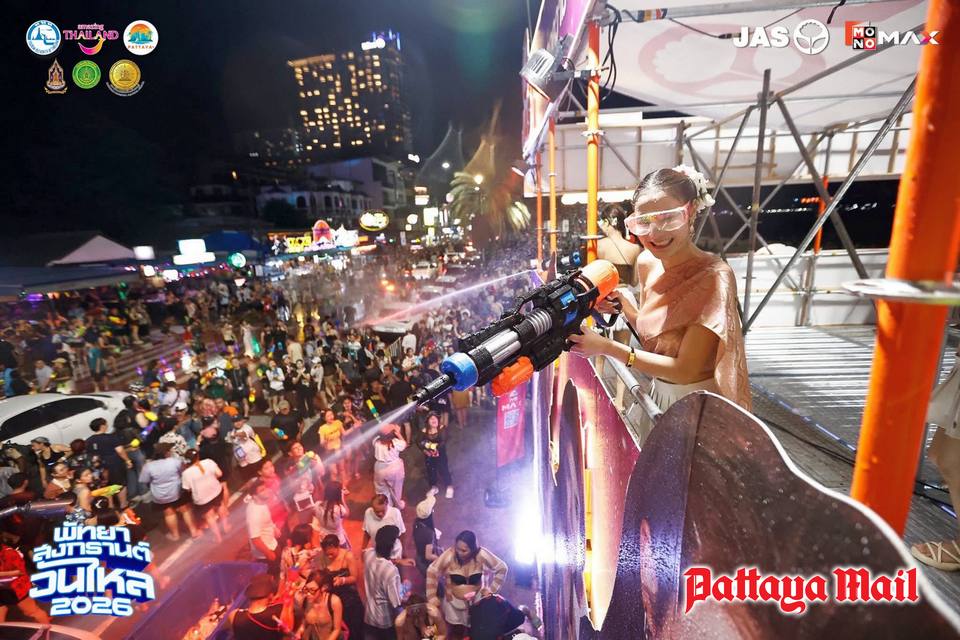
PATTAYA, Thailand – I am writing this article on a day when Pattaya is still in full celebration Songkran is ongoing, and today is Wan Lai, the local continuation of the festival. The music is still loud, echoing along Beach Road, blending with laughter, engines, and the rhythmic splash of water hitting pavement and skin. Pickup trucks crawl through crowded streets, carrying people armed with water guns and buckets, while tourists and locals alike surrender themselves to the moment. The city feels alive over flowing, almost electric.
And yet, in the middle of this peak, my mind drifts to what comes after. Because cities like Pattaya do not reveal their truth in moments of noise. They reveal it in the quiet that follows when the streets clear, when the neon lights dim earlier, when business owners sit back and ask the only question that really matters: Was it worth it?
Songkran, for all its celebration, is more than just a festival. It is Pattaya’s annual economic health check. On the surface, 2026 appears strong. The numbers are there. The crowds are undeniable. But beneath that surface lies a more complicated story, one that speaks not of how many people came, but of how they behaved, how they spent, and how long they stayed.
This year, the composition of visitors paints a telling picture. The Indian market continues to expand, particularly in large group travel segments visible in clusters moving together, filling tour buses, and occupying shared accommodations. Russian tourists remain a stable long-stay presence, especially in areas like Jomtien and Pratumnak, where routines feel less like tourism and more like temporary relocation. Meanwhile, domestic Thai travellers have returned with energy, but their presence is fleeting short trips, controlled spending, a sense of participation rather than indulgence. But perhaps the most significant shift is not who is coming, but where they are choosing to stay.
Condominiums, once a secondary option, have quietly taken centre stage. Short-term rentals offer affordability, flexibility, and space ideal for groups, families, and even solo travellers seeking autonomy. Kitchens reduce the need to dine out. Shared costs lower the barrier to entry. Comfort replaces service, and privacy replaces hospitality. Hotels may still report full occupancy, but something fundamental has shifted beneath the surface. Revenue per guest does not rise in tandem. The illusion of success masks a redistribution of economic benefit. And this redistribution becomes even more visible when looking at spending patterns across the city.
Walk into certain restaurants, and the story becomes clear. Tables turn slower than expected. High-end venues see fewer spontaneous walk-ins. Meanwhile, street food vendors remain busy, convenience stores experience constant traffic, and takeaway bags replace dining experiences. Tourists are still here but they are navigating the city differently. They are optimizing, adjusting, choosing carefully.
Inflation in 2026 has not stopped people from traveling, but it has reshaped how they spend. The result is a new reality one where volume remains high, but yield declines. A city full of people does not necessarily translate into a city full of economic activity. Pattaya is beginning to experience what can only be described as high-volume, low-yield tourism.
Beyond economics, the physical city itself tells another story one of pressure, resilience, and limits being tested. Traffic congestion continues to strain the city’s capacity, turning short distances into prolonged journeys. Waste accumulates faster than it can be processed, despite improvements in collection systems. But perhaps the most critical and least visible pressure point lies within the water system itself.
Songkran pushes water consumption to its extreme. Every splash, every bucket, every hose contributes to a collective demand that approaches critical load levels. In engineering terms, this is not merely usage it is a stress test. The question is not whether the system functions under normal conditions, but whether it can withstand peak demand without failure. Is there sufficient redundancy? Are reserve systems robust enough? Or has the city simply not yet encountered the breaking point?
These are not theoretical concerns. They are foundational to Pattaya’s future. Because Pattaya is no longer just a seasonal city. The traditional concept of “high season” is beginning to blur. The rise of digital nomads, long-stay residents, and remote workers is transforming the city into a year-round economy. People are no longer just visiting they are living, working, extending their presence beyond predefined tourist windows.
This shift changes everything. The question is no longer how well Pattaya performs during peak periods like Songkran. The real question is how it sustains itself during quieter months. Can businesses survive beyond the spikes? Can infrastructure support continuous demand rather than cyclical surges? Can the city transition from reacting to growth… to planning for it?
As the water eventually dries, as the music fades, and as Pattaya returns to its baseline rhythm, what remains is not the memory of celebration but the structure of reality.
Songkran 2026 has made one thing clear: foot traffic alone is no longer a measure of success. True economic strength lies in the quality of spending, the duration of stay, and the distribution of income across the ecosystem. It requires alignment from government planning to business strategy to investment vision.
Because when the last splash falls and the streets fall silent, the only thing that matters is not how loud the city once was but how strong it truly is.