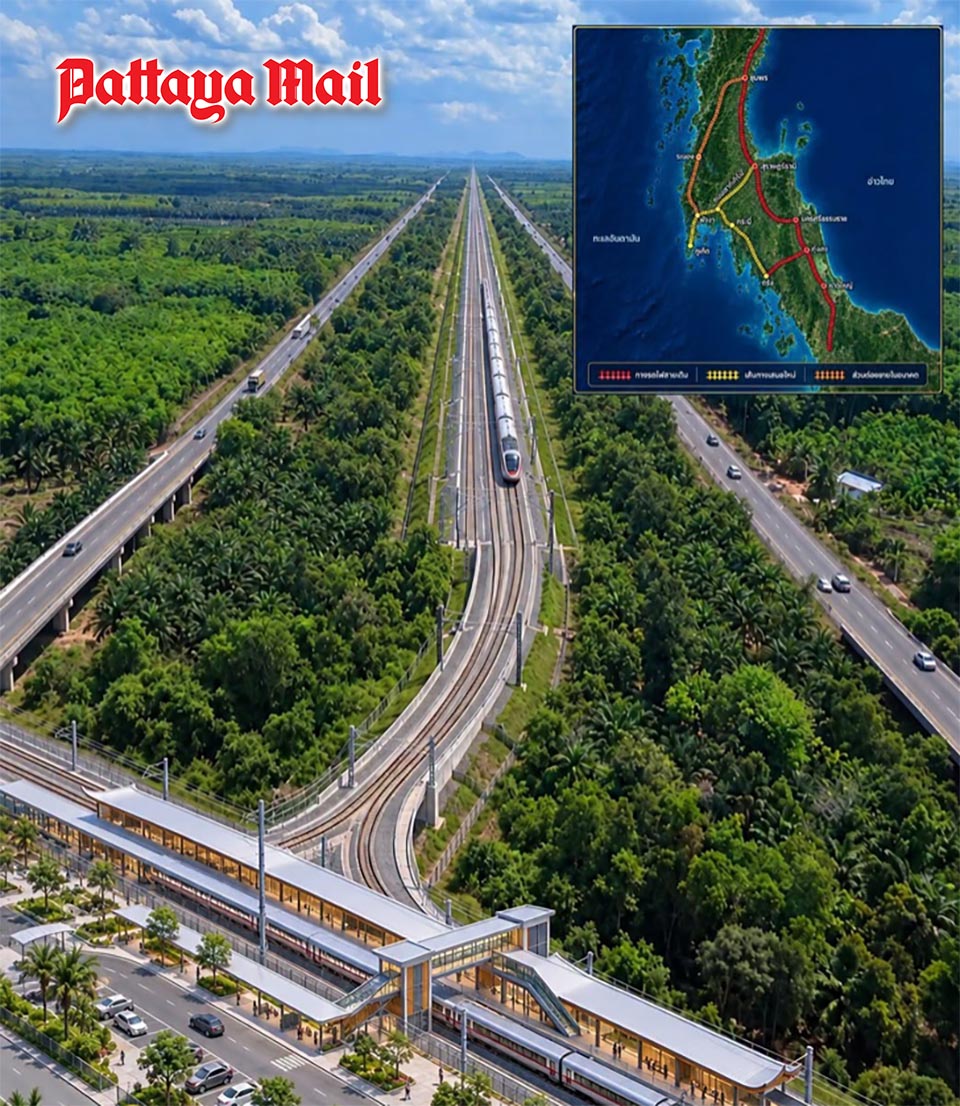
SURAT THANI, Thailand – Highway 44, stretching across southern Thailand between Surat Thani and Krabi, could offer an unusual opportunity to develop a future railway linking the Gulf of Thailand with the Andaman coast. Often known as the “Southern Highway”, the 133-kilometre road was developed with a wide central reservation in parts of its route, reflecting earlier plans for a land bridge connecting the two coasts. Space was set aside with future infrastructure, including rail and energy transport, in mind. The question now is whether that existing corridor should be studied again for a modern rail network.
One proposal would establish a railway branching from the existing southern rail network around Surat Thani and follow the Highway 44 corridor towards Krabi. Rather than ending at Krabi, the line could eventually continue south for roughly 100 kilometres to connect with the existing Thung Song–Kantang railway around Huai Yot in Trang province. Such a connection would create a second rail route through the southern peninsula, linking Surat Thani, Krabi and Trang before reconnecting with the existing southern railway network at Thung Song.
Further extensions could potentially connect Krabi with Phang Nga and Phuket, while another future route could run north from Phang Nga through Ranong and eventually connect with the southern railway at Chumphon. This would create an interconnected rail network serving both sides of the peninsula rather than concentrating the southern railway system almost entirely along the Gulf coast.
More than a railway to Krabi
The proposal is not simply about giving Krabi, Phang Nga or Phuket a direct railway connection. It could also provide greater resilience for Thailand’s transport network. Much of the existing southern railway depends on a single main corridor. Flooding, landslides, accidents or damage to railway infrastructure can therefore disrupt passenger and freight services over considerable distances.
A second route through the Andaman side could provide alternatives when sections of the main line are temporarily unavailable. Passenger and freight trains could potentially be diverted, reducing the risk of a disruption affecting the entire southern network. The concept could also improve connections between major tourism destinations, airports, ports, cities and local transport services.
Potential economic benefits
Krabi, Phang Nga, Phuket and Ranong are major tourism destinations, but most visitors currently depend on road transport or domestic flights to reach them. A direct rail connection could give residents and tourists another option while reducing dependence on cars and short-haul flights.
Stations along the route could also create opportunities for hotels, restaurants, local businesses, farmers and tourism operators. Towns currently regarded mainly as places to pass through could develop into new destinations. Freight could provide another important use. The South produces rubber, palm oil, fruit, seafood and processed agricultural products. A railway connected to ports and distribution centres could provide an alternative for moving goods, potentially reducing long-distance trucking costs and pressure on major roads.
Greater use of rail could also reduce fuel consumption, traffic, road accidents and emissions if sufficient passenger and freight demand developed.
An existing corridor with potential
One of the strongest arguments for further study is the existing Highway 44 corridor itself.
Because land was previously reserved in parts of the route for future infrastructure, using the existing corridor could potentially reduce the need for extensive new land acquisition compared with developing an entirely new railway alignment.
However, having space available does not mean a railway could simply be built there.
A proper feasibility study would need to examine engineering requirements, gradients, curves, drainage, utility infrastructure, road crossings, safety, environmental impacts and effects on nearby communities. Most importantly, authorities would need to establish whether passenger and freight demand would justify the investment.
A phased approach could therefore be considered, beginning with the Surat Thani–Krabi section before assessing extensions towards Huai Yot, Phang Nga and Phuket, and potentially Ranong and Chumphon at a later stage.
A Southern Mobility Corridor
The broader idea could be viewed as a Southern Mobility Corridor rather than a single railway line.
Under such a concept, passenger trains, freight services, airports, ports, local buses and tourism destinations could be connected into one transport network. Surat Thani could serve as a gateway between the Gulf and Andaman sides, while Huai Yot and Thung Song could provide connections to the southern network. Chumphon could become another northern connection point for an eventual Andaman route.
If developed successfully, the network would give the South more than one direction of travel and provide alternative routes during emergencies or infrastructure failures.
It could also spread the economic benefits of improved transport beyond the best-known tourist centres.
A corridor worth studying
The broad central reservation of Highway 44 should therefore not simply be viewed as unused space left over from an earlier infrastructure plan. It represents a corridor that previous generations deliberately prepared for future development. The original land-bridge concept may not have been selected in the form once envisaged, but that does not necessarily mean the infrastructure corridor has lost its strategic value.
A new feasibility study could determine whether the space can support a modern railway and whether demand from passengers, tourism and freight could justify the investment.
The idea remains a proposal rather than an approved railway project. But with Thailand seeking to expand rail connectivity and strengthen links between major economic and tourism centres, the Southern Highway 44 corridor may be worth examining again.
The question is no longer simply whether Thailand needs a railway to Krabi. It is whether the country should use an existing strategic corridor to build a wider rail network linking the Gulf of Thailand with the Andaman coast and giving southern Thailand more options for travel, trade and transport resilience.