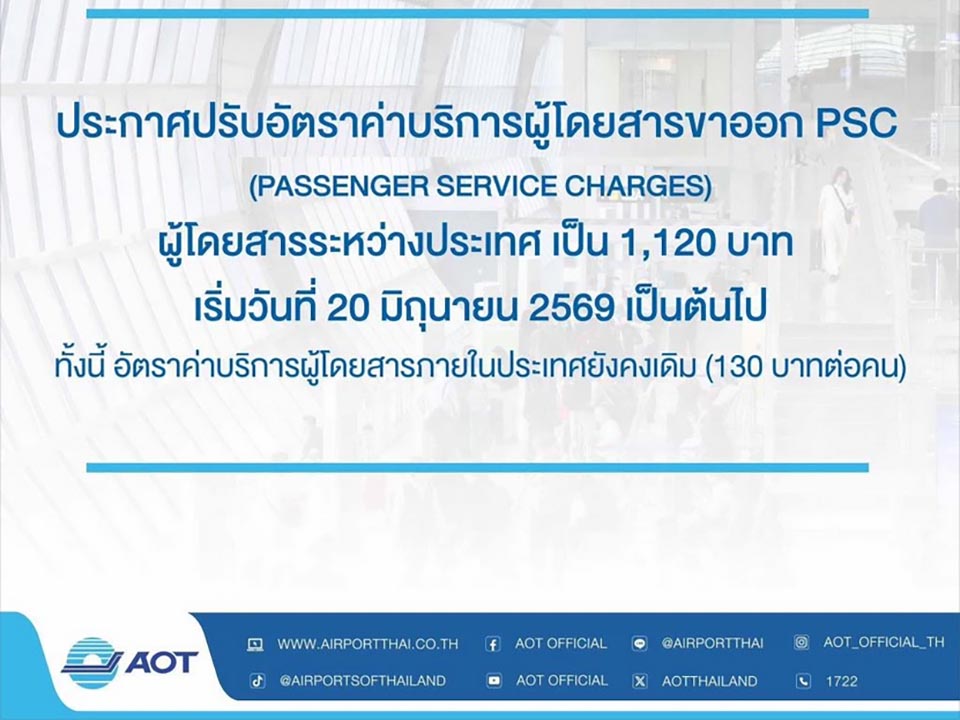
PATTAYA, Thailand – Thailand’s aviation sector has come under intense public scrutiny after Airports of Thailand (AOT) announced a sharp increase in the Passenger Service Charge (PSC) for international departures, raising the fee to 1,120 baht per passenger starting 20 June 2026.
The announcement, posted on AOT’s official social media channels on February 20, quickly triggered widespread debate online, with many travelers warning the hike could push airfares higher at a time when the cost of living remains under pressure.
Under the new structure, the higher PSC will apply only to international outbound passengers, while domestic PSC rates will remain unchanged at 130 baht per passenger, a move AOT says is intended to support the government’s domestic tourism policy.
Six Major Airports Affected
The revised PSC will be enforced at all six AOT-operated airports nationwide:
- Suvarnabhumi Airport
- Don Mueang International Airport
- Chiang Mai International Airport
- Mae Fah Luang–Chiang Rai International Airport
- Phuket International Airport
- Hat Yai International Airport
AOT: PSC Is Not a Tax
AOT President Pawina Jariyathitipong said the adjustment was approved by Thailand’s Civil Aviation Board on February 20, 2026, and complies with international principles set out by the International Civil Aviation Organization (ICAO), particularly ICAO Document 9082.
She stressed that the PSC is not a tax and not a profit-making charge, but a cost-recovery mechanism used exclusively for airport-related operations and long-term infrastructure investment. The adjustment, she said, followed stakeholder consultations and a full cost review by regulators, and still requires approval from relevant ministers.
Revenue from the higher PSC will be used to upgrade airport infrastructure and services, including:
- The SAT-1 satellite terminal at Suvarnabhumi Airport
- Passenger terminal renovations at Don Mueang
- Expanded use of Common Use Passenger Processing Systems (CUPPS) to reduce check-in times and congestion
According to AOT, surveys conducted among passengers and airlines found that most respondents viewed the new PSC level as reasonable and unlikely to affect travel decisions, provided service quality improves in tandem.
Public Divided Over Impact
Despite AOT’s assurances, social media reaction has been sharply divided. Critics argue the increase effectively transfers costs directly to travelers, potentially driving up ticket prices and dampening tourism sentiment, especially as Thailand’s economic recovery remains uneven.
Others defend the move as consistent with international norms, pointing to major regional hubs such as Changi Airport and Hong Kong International Airport, which charge higher passenger fees and reinvest heavily in service quality and infrastructure.
Transit Fee Debate Raises New Questions
Adding to the controversy is growing discussion around AOT’s plan to study the introduction of PSC charges for transit passengers, a category Thailand has traditionally exempted. The possibility has sparked fresh debate online about whether additional fees could undermine Thailand’s ambition to remain a competitive aviation hub in the region.
For now, AOT says any changes related to transit passengers remain under review, but the PSC hike has already reignited broader questions about costs, competitiveness, and who ultimately pays for Thailand’s push toward world-class airport standards.