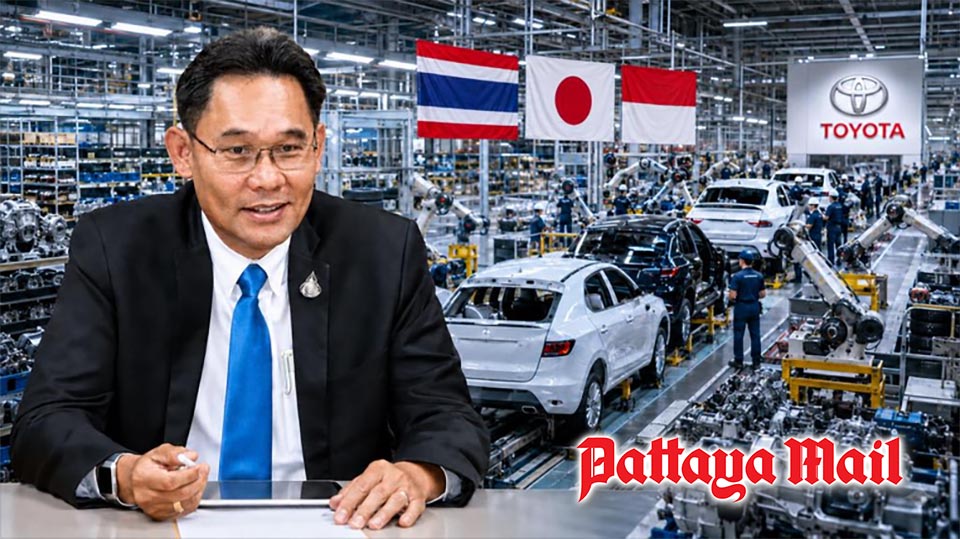
BANGKOK, Thailand – Thailand remains confident that Toyota and other Japanese automakers will maintain their long-established production bases in the country, with the National Economic and Social Development Council pointing to a deep automotive supply chain built through more than three decades of investment.
NESDC Secretary-General Danucha Pichayanan said during a briefing on Thailand’s second-quarter 2026 economic performance and outlook on August 17 that Thailand remains a strong automotive manufacturing base despite Indonesia’s efforts to attract additional Toyota investment. Toyota already has manufacturing and investment operations in Indonesia, meaning Jakarta’s efforts to attract further investment are part of growing competition among countries seeking to strengthen their automotive industries.
Danucha said Thailand’s major advantage is its long-standing economic relationship with Japan, particularly in the automotive sector. More than 30 years of investment have created a broad and deep supply chain covering vehicle assembly, parts manufacturers, logistics, skilled workers and supporting businesses.
This established ecosystem makes relocating production more complicated than simply comparing investment incentives or market size. Automakers must also consider whether another country has the supply chain, infrastructure and manufacturing capabilities needed to match Thailand.
“I believe Toyota and Japanese automakers probably see Thailand as a production base that remains efficient,” Danucha said. He also highlighted proposed Finance Ministry measures to support industries investing in Thailand, including facilitating imports of parts that cannot yet be produced domestically. Such measures could help strengthen domestic production and encourage further investment.
Danucha said concerns that lower import duties could reduce government revenue should be viewed in the wider economic context. Import tariff revenue is already much lower than in the past because free trade agreements and other international trade arrangements have gradually reduced tariffs. The government should therefore consider the broader economic benefits of investment measures, including job creation, exports and domestic value added, rather than focusing solely on lost import tax revenue.
One-Ton Pickups Still Lead Exports
Danucha acknowledged that exports of passenger cars have been declining, particularly vehicles powered by internal combustion engines, as countries impose stricter carbon-emission requirements and competition from electric vehicles intensifies. One-ton pickup trucks, however, remain a major Thai export product and continue to see growth, showing that Thailand has not lost its overall automotive competitiveness but is instead facing a major transition from combustion engines to electric vehicles.
The key challenge for the government is to preserve Thailand’s existing automotive manufacturing base while attracting electric vehicle producers and developing new supply chains domestically.
Danucha said this transition will be crucial for Thailand to retain its position as a regional automotive manufacturing hub amid intensifying competition from Indonesia and other countries.