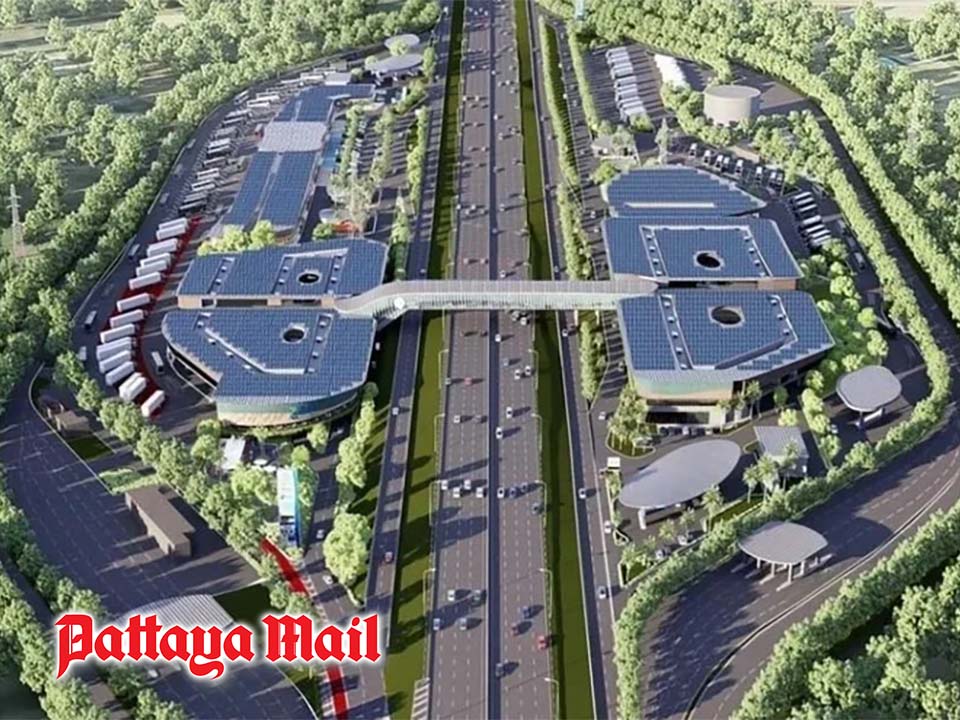
BANGKOK, Thailand – The Department of Highways (DOH) is reviewing the bidding conditions for rest-area facilities on the M81 Bang Yai–Kanchanaburi Motorway after no private companies submitted offers, with investors raising concerns about traffic volumes and the project’s financial viability.
DOH Director-General Piyapong Jiwattanakulpaisal said the department had invited private companies to bid for the development and management of rest areas on the M6 Bang Pa-in–Nakhon Ratchasima Motorway under two contracts and on the M81 Bang Yai–Kanchanaburi Motorway under one contract.
A subsidiary of the PTT Group was the only bidder for both M6 rest-area contracts. Its proposals are currently being reviewed by the selection committee under Section 36 of the 2019 Public-Private Partnership Act. The results are expected in September or October, with contract signing projected for February 2027 after the required approval process.
For M81, no companies submitted bids. The DOH has therefore conducted market sounding with around four to five private companies that purchased the request-for-proposal documents. The discussions focused on why they decided not to bid and what changes they would like to see in the conditions.
Piyapong said the information gathered would be used to review the bidding requirements and make them more suitable for investors. He acknowledged that both M6 and M81 are relatively new motorway routes, creating uncertainty over traffic volumes and the number of motorists likely to stop at rest areas. The M81 is also considerably shorter, which could reduce demand for stopping facilities.
The DOH plans to cancel the previous M81 bidding process before considering revised conditions. If only minor changes are required and they do not affect the project’s basic principles, a new invitation could be issued relatively quickly. Major changes affecting the project’s principles would require approval of the revised framework and could take longer.
Piyapong said the department was also considering alternative measures if the private-sector selection process takes longer than expected. Basic facilities, including rest areas and public toilets, could potentially be provided first.
Meanwhile, the selection process for the operation and maintenance (O&M) contract for the M82 elevated motorway from Bang Khun Thian to Ban Phaeo is progressing. Two bidders submitted offers: Bangkok Expressway and Metro (BEM), and a consortium of Don Muang Tollway (DMT) and Sino-Thai Engineering and Construction (STEC). The DOH expects to complete its evaluation by the end of 2026. Construction is scheduled to begin in 2027, with the full route expected to open and toll collection to begin by the end of 2028.
M5 Rangsit–Bang Pa-in project moves toward bidding
The DOH is also preparing tender documents for the M5 Uttaraphimuk elevated motorway from Rangsit to Bang Pa-in, with total investment estimated at 30.08 billion baht.
The department expects to invite bids by the end of 2026 or, at the latest, early 2027. Construction is planned to take four years. The M5 Rangsit–Bang Pa-in project covers approximately 29 kilometers and will have six lanes, with three lanes in each direction. It consists of two sections.
The first section, covering seven kilometers from the Don Mueang Monument to Rangsit, is already in service. The second section, from the Rangsit interchange to Bang Pa-in, covers 22 kilometers and will be newly constructed. A private-sector operator will be responsible for civil construction and the installation and operation of the O&M system along the route. The motorway will terminate at the Bang Pa-in interchange, completing another key connection in Thailand’s motorway network.